
Grease Trap Equipment Rules Buyers Should Know
Grease trap equipment rules can directly affect compliance, kitchen safety, and operating costs in restaurants, hotels, and food facilities. For buyers comparing hotel kitchen equipment, industrial food equipment, and professional catering equipment, understanding key standards before purchasing helps avoid costly mistakes. This guide outlines the essential regulations, selection factors, and practical buying points every decision-maker and operator should know.
In commercial kitchens, grease management is not just a plumbing issue. It is tied to wastewater discharge, hygiene control, fire risk reduction, maintenance scheduling, and long-term equipment performance. A poorly selected grease trap can lead to blocked drainage lines, odor complaints, emergency cleaning costs, and local code violations within the first 3 to 12 months of operation.
For procurement teams and operators, the challenge is that grease trap equipment rules vary by kitchen size, discharge volume, installation site, and inspection practices. A unit that works for a small café may fail in a 200-seat hotel kitchen or a central food production facility. Buyers need a practical framework that connects regulations with sizing, materials, maintenance, and supplier support.
Why Grease Trap Rules Matter in Commercial Kitchen Projects
Grease trap equipment is designed to separate fats, oils, and grease from wastewater before they enter the drainage system. In restaurants, hotels, school canteens, and food factories, wastewater from sinks, pre-rinse stations, dishwashing areas, and food prep zones can carry large amounts of grease solids. If these materials enter the sewer directly, they can harden, reduce flow capacity, and trigger repeated pipe blockages.
Most buyers first focus on tank size or price, but rules usually go further. Local authorities often check three core points: whether a grease trap is required, whether the installed capacity matches kitchen flow, and whether maintenance records are available. In many markets, inspection cycles range from monthly to quarterly, while pumping frequency may range from every 2 weeks to every 90 days depending on kitchen load.
These rules matter because grease trap performance directly affects several cost centers. Emergency drain cleaning can cost far more than planned preventive service. A trap that is undersized by even one capacity level may fill too quickly during peak meal periods, especially in operations serving 300 to 800 meals per day. Once grease bypass occurs, downstream damage can affect floors, pumps, interceptors, or municipal connections.
For buyers of commercial kitchen equipment, grease trap compliance also supports broader project goals. Modern foodservice operations are increasingly investing in integrated kitchen systems, energy-efficient appliances, and digital maintenance workflows. Grease control should be treated as part of the full kitchen equipment plan, not as a last-minute plumbing accessory added after layout approval.
Key compliance areas buyers should review
- Required installation point, such as under-sink, in-floor, or external interceptor placement.
- Flow rate and retention capacity based on fixture count, sink size, and peak discharge volume.
- Tank material standards, commonly stainless steel, coated steel, fiberglass, or heavy-duty polyethylene.
- Cleaning access, odor sealing, and maintenance space for service teams.
- Recordkeeping requirements, including service logs, waste disposal records, and inspection checklists.
Common operational consequences of poor rule compliance
When a grease trap is installed without checking flow demand, the first signs are usually slow drainage, odor leakage, and shortened cleaning cycles. Staff may need manual intervention 1 to 3 times per week, increasing labor time and sanitation risk. In larger kitchens, overflow during busy lunch or banquet periods can disrupt production and damage adjacent food preparation areas.
Another frequent issue is buying a low-cost unit without confirming access clearance. A trap may fit under a sink but leave insufficient room for lid opening, sludge removal, or safe inspection. This turns routine maintenance into a difficult task and often causes service delays, which then reduce separation efficiency.
Core Rule Categories: Sizing, Installation, Materials, and Maintenance
Although regulations differ by country and municipality, buyers can usually organize grease trap equipment rules into four categories: sizing, installation, material suitability, and maintenance. Reviewing these categories during kitchen design or equipment replacement helps align procurement decisions with real operating conditions.
Sizing is often the most critical factor. Capacity is typically linked to flow rate, retention time, and grease storage volume. Small under-sink units may serve a single prep sink or pot wash station, while larger interceptors may support multiple fixtures across an entire restaurant line. As a practical range, compact units may handle tens of liters per minute, while larger systems are selected for significantly higher continuous loads in hotels and industrial food equipment settings.
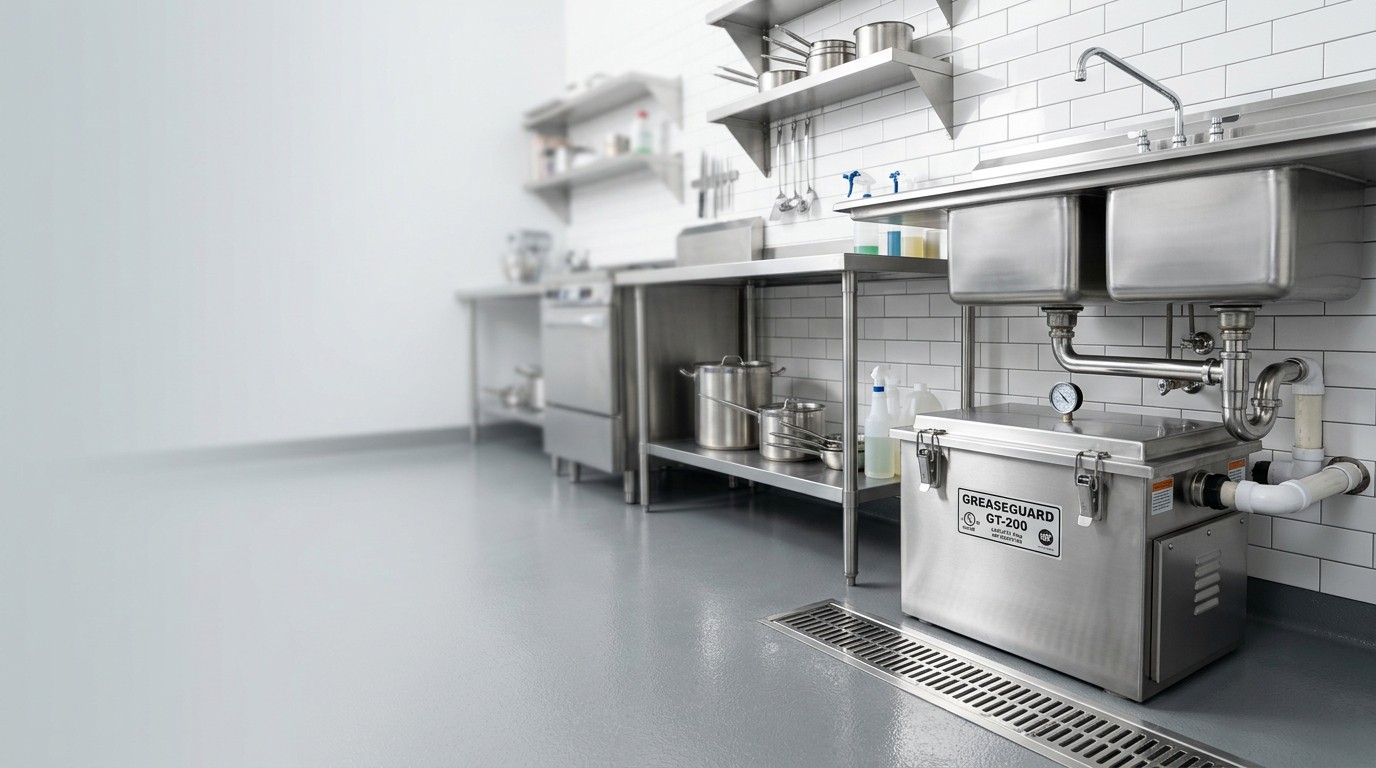
Installation rules usually cover where the unit can be placed, what fixtures must connect to it, whether venting is required, and how easy it is to access for inspection. Indoor systems are common where space is tight and cleaning is frequent, while outdoor systems are often preferred for higher volume sites that need larger holding capacity. Clearance for opening, servicing, and safe waste removal should be confirmed before the order is placed.
Material selection affects durability and cleaning performance. Stainless steel is popular in professional catering equipment environments because it resists corrosion and is easy to sanitize. Polyethylene and fiberglass can also be effective in selected applications, especially where weight and installation flexibility matter. The correct choice depends on wastewater temperature, chemical exposure, cleaning method, and expected service life, which often ranges from 5 to 15 years under normal commercial use.
A practical comparison of common grease trap rule checkpoints
The table below summarizes the most common rule areas procurement teams should verify before approving a grease trap purchase for a restaurant, hotel, or food processing kitchen.
The main lesson is that compliance is not controlled by one parameter. A kitchen can buy a strong stainless steel unit and still fail operationally if the trap is undersized or impossible to service. Procurement should review the full set of rule categories together with kitchen consultants, facility engineers, and daily operators.
Maintenance rules often decide real-life success
Even a correctly sized grease trap can become ineffective if maintenance rules are not followed. A practical benchmark in many foodservice sites is to service the trap before grease and solids occupy more than about 25% of the effective volume. Waiting too long increases odor, reduces separation time, and raises the probability of discharge failure.
Buyers should therefore ask not only how the unit is built, but how it will be cleaned every week, every month, and during peak seasons. In banquet hotels, holiday resorts, and central kitchens, load variation can be substantial, so the maintenance plan should match actual production cycles rather than a fixed generic schedule.
How to Select the Right Grease Trap for Different Kitchen Scenarios
Selecting the right grease trap equipment starts with understanding the kitchen scenario. A quick-service restaurant, a hotel banquet kitchen, and a food processing facility may all discharge grease, but their flow patterns are very different. The first may have short high-volume bursts, the second may face sharp event-driven peaks, and the third may run long production shifts of 8 to 16 hours.
For buyers evaluating hotel kitchen equipment or industrial food equipment, the grease trap should be sized according to fixture layout and production reality, not estimated only by floor area. Ask how many sinks will connect, what kind of food is handled, whether hot wastewater enters the system, and how many meals or batches are produced daily. These details shape the right retention volume and service schedule.
It is also important to match the system type to the site. Under-sink grease traps are useful where drainage points are isolated and space is limited. Large external interceptors are more suitable where several fixtures feed a central line. Automatic grease removal units may reduce manual cleaning labor in high-frequency kitchens, but they still require planned inspection and staff training.
The procurement decision should consider both purchase cost and total operating cost over 12 to 36 months. A cheaper unit with poor access, weak lid seals, or short cleaning intervals may create higher labor and waste handling costs than a more robust system. In B2B kitchen projects, the lowest upfront price is rarely the most economical choice.
Scenario-based buying guide
The following table shows how grease trap selection priorities often change by application type in the kitchen equipment industry.
This comparison shows why a one-size-fits-all buying strategy fails. Each site has its own operational profile, so buyers should translate kitchen output and staffing conditions into equipment requirements before final selection.
Five practical questions before ordering
- How many fixtures will discharge into the grease trap during peak periods?
- What is the expected daily meal count or processing volume: below 100, 100 to 500, or above 500 units?
- Will staff clean the unit in-house, or will an external service contractor handle it?
- Is there enough installation and lid-opening clearance for safe maintenance?
- Does the supplier provide sizing support, installation guidance, and spare parts access over at least 12 months?
These questions help reduce common procurement errors. They are especially useful when comparing quotations from multiple kitchen equipment suppliers that may present similar-looking products with very different practical service requirements.
Common Buyer Mistakes, Risk Control, and Implementation Planning
One of the most common mistakes is treating grease trap equipment as a commodity item. In reality, performance depends on installation quality, operator behavior, and cleaning discipline as much as tank construction. A trap installed in the wrong location or connected to unexpected discharge points can fail even if it meets basic specification sheets.
Another mistake is underestimating maintenance labor. In some kitchens, the trap is accessible only by moving other equipment, stopping production, or scheduling cleaning outside service hours. If a unit requires 30 to 45 minutes of staff time twice a week, that labor burden should be included in the procurement review. Equipment that saves 10 minutes per cleaning can deliver meaningful annual savings when multiplied across 100 or more service events.
Risk control starts during planning. Buyers should request a layout review, confirm connected fixtures, and ask the supplier to define the cleaning method. It is also wise to check whether the chosen model supports future kitchen expansion. A site expecting a 20% to 30% increase in meal volume within 2 years may need extra capacity margin now rather than early replacement later.
Implementation should include coordination among procurement, engineering, kitchen management, and sanitation teams. This is especially important in hotels and industrial food equipment projects where multiple systems, including dishwashing, drainage, ventilation, and floor drainage, must work together. The grease trap should be reviewed as part of the whole process flow.
Risk checklist for procurement and operation
- Do not approve a model only from catalog dimensions; confirm working capacity and access space.
- Do not assume all sinks should connect; verify intended wastewater sources and exclusion points.
- Do not ignore lid sealing and odor control in indoor kitchen areas with limited ventilation.
- Do not rely on generic maintenance intervals; adjust service frequency after the first 30 to 60 days of operation.
- Do not separate the grease trap decision from the overall kitchen equipment and drainage plan.
A simple 4-step implementation approach
A practical rollout often follows four steps. First, assess flow sources and projected kitchen load. Second, compare installation types and confirm material suitability. Third, set a cleaning and inspection routine before handover. Fourth, review the first 4 to 8 weeks of operation and adjust service frequency if grease accumulation is faster than expected.
This structured approach reduces surprises after opening. It also gives operators a clearer standard for routine checks, which is important in kitchens with staff turnover or multi-shift schedules.
FAQ and Final Buying Advice for Decision-Makers
Buyers often ask whether grease trap rules are mainly a local code issue or a practical equipment issue. The answer is both. Local requirements define what is acceptable, but daily kitchen performance determines whether the equipment remains compliant over time. That is why smart procurement combines code review with realistic operating analysis.
For businesses sourcing hotel kitchen equipment, professional catering equipment, or industrial food equipment, grease trap selection should be part of a broader equipment strategy focused on safety, uptime, and cost control. A well-chosen unit supports smoother operations, cleaner drainage, and more predictable maintenance budgets over the long term.
How often should a commercial grease trap be cleaned?
The interval depends on trap size, menu type, and kitchen load. In many commercial kitchens, cleaning may be needed every 2 to 4 weeks for smaller high-use units, while larger interceptors may follow a monthly or quarterly service plan. A good practice is to inspect the unit regularly and clean it before grease and solids occupy roughly one quarter of effective capacity.
What should procurement teams request from suppliers?
At minimum, ask for sizing logic, material details, installation requirements, maintenance access guidance, and recommended cleaning frequency. It is also useful to request lead time information, spare parts availability, and after-sales response expectations, such as support within 24 to 72 hours for urgent operational issues.
Are automatic grease removal units always better?
Not always. They can reduce manual handling in high-volume kitchens, but they still require inspection, operator training, and proper installation. For some smaller sites, a well-designed manual unit with easy access and a disciplined cleaning schedule can be more cost-effective over a 1 to 3 year period.
Final purchasing guidance
The best grease trap equipment decision balances compliance, serviceability, and operational fit. Buyers should verify rule requirements early, compare total ownership cost rather than unit price alone, and involve both engineering and kitchen operators in the selection process. This reduces the risk of oversizing, undersizing, or buying a system that is difficult to maintain in real kitchen conditions.
If you are planning a new kitchen project or replacing existing drainage equipment, now is the right time to review your grease trap requirements alongside the rest of your commercial kitchen equipment. Contact us to discuss your application, get a tailored recommendation, and explore practical solutions for restaurants, hotels, central kitchens, and food processing facilities.
Popular Tags
Kitchen Industry Research Team
Dedicated to analyzing emerging trends and technological shifts in the global hospitality and foodservice infrastructure sector.
Industry Insights
Join 15,000+ industry professionals. Get the latest market trends and tech news delivered weekly.
No spam. Unsubscribe anytime.
Contact With us
Contact:
Anne Yin (Ceramics Dinnerware/Glassware)
Lucky Zhai(Flatware)