
Kitchen tools manufacturer lead times stretching beyond 14 weeks—what’s causing it
Kitchen tools manufacturer lead times are now stretching beyond 14 weeks—disrupting procurement for restaurant kitchen equipment suppliers, commercial restaurant kitchen design teams, and buyers of stainless steel restaurant kitchen gear. From non-stick kitchen tools to eco-friendly restaurant supplies, delays ripple across the entire supply chain, impacting restaurant kitchen workflow, storage planning, ventilation system installation, and even kitchen tools manufacturer capacity. With rising demand for smart, energy-efficient, and stainless steel restaurant supplies—and tightening global logistics—this bottleneck is hitting restaurant kitchen equipment for sale, repair timelines, and overall kitchen organization. What’s really behind the slowdown? Let’s break down the root causes.
Why Are Kitchen Tools Manufacturer Lead Times Surging Past 14 Weeks?
The current 14+ week lead time for kitchen tools isn’t an isolated anomaly—it reflects systemic pressures across raw material sourcing, labor availability, and international compliance requirements. Leading manufacturers in China, Italy, and Germany report average production cycles extended by 35–50% compared to pre-2022 benchmarks, with stainless steel tool sets averaging 16–18 weeks and smart-integrated utensil lines reaching up to 22 weeks.
Three primary drivers converge: First, global stainless steel coil allocations tightened significantly after Q2 2023, with mill lead times for Grade 304/316 sheets now ranging from 10–14 weeks—directly delaying tool body fabrication. Second, EU and U.S. importers increasingly require full traceability documentation (e.g., EN 10204 3.1 certs, FDA 21 CFR Part 117), adding 7–10 business days per order. Third, skilled CNC operators remain scarce: industry surveys show a 28% vacancy rate in precision tool machining roles across Tier-1 OEM facilities in Guangdong and Emilia-Romagna.
This isn’t just about waiting longer—it’s about operational risk. For restaurant kitchen equipment suppliers, every extra week in lead time compounds storage cost (avg. $42/week per pallet), increases expedited freight exposure (up 67% YoY), and delays commissioning of integrated kitchen systems requiring synchronized tool delivery.
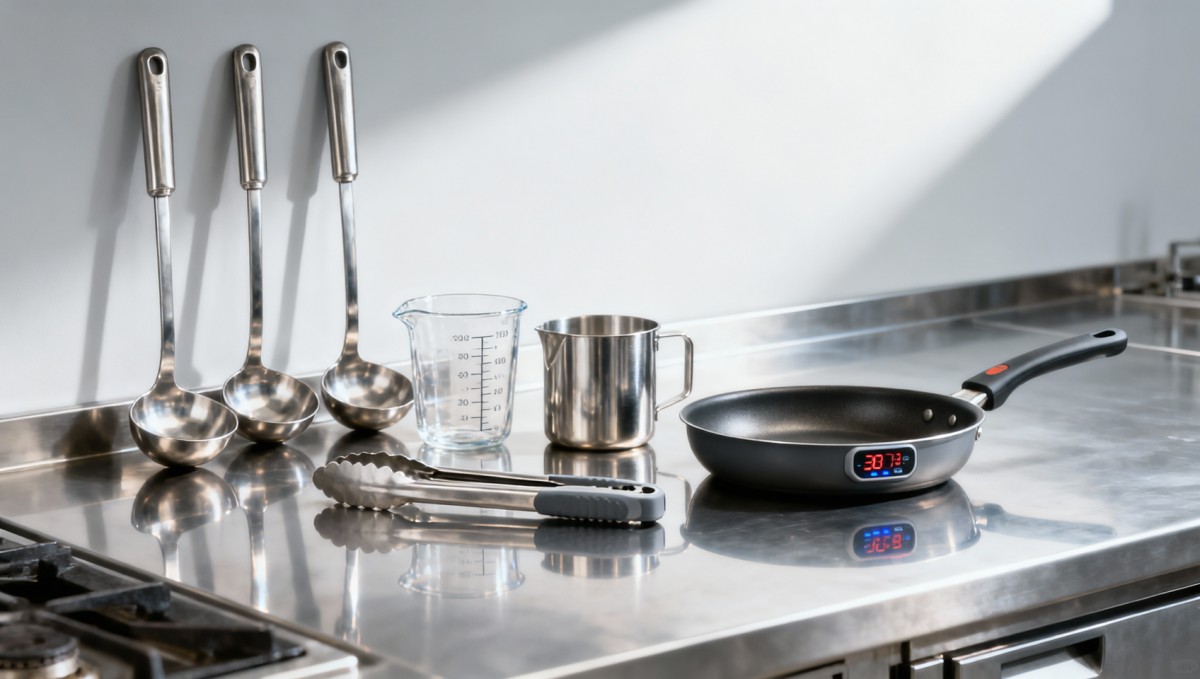
How Global Sourcing Shifts Are Reshaping Delivery Realities
Historically, 60% of commercial-grade kitchen tools originated from concentrated clusters in Shunde (China), Bologna (Italy), and Osaka (Japan). Today, geopolitical recalibration has fragmented this model. Exporters now face dual certification paths: CE + UKCA for Europe, FDA + NSF/ANSI 18 for North America, and JIS T 9001 for Japan—each demanding separate validation batches and 3–5 week testing windows.
Logistics bottlenecks compound this complexity. Container spot rates from Shanghai to Rotterdam rose 41% in H1 2024, while air freight for urgent tool prototypes now costs $8.20/kg—making rapid sampling prohibitively expensive for mid-tier buyers. Meanwhile, “nearshoring” efforts remain limited: only 12% of U.S.-based foodservice operators have qualified alternative suppliers within Mexico or Vietnam capable of delivering certified stainless steel tools at scale.
The result? A tiered lead-time structure where standard tools (e.g., stainless tongs, ladles) average 14–16 weeks, while custom-configured items—like antimicrobial-coated prep knives or IoT-enabled portion-control scoops—extend to 20–24 weeks due to multi-stage approvals and low-volume batch scheduling.
Key Supply Chain Pressure Points (2024)
- Stainless steel coil allocation delays: 10–14 weeks (vs. historical 4–6)
- Certification testing turnaround: +7–10 days per regulatory pathway
- Skilled operator vacancy: 28% in high-precision tool machining
- Air freight cost increase: +67% YoY for urgent samples
What Procurement Teams Can Do Now—Not Later
Waiting for market normalization isn’t viable. Forward-thinking procurement teams are implementing three tactical adjustments: First, shifting from reactive PO-based ordering to rolling 6-month forecast commitments—enabling manufacturers to lock raw materials and allocate machine time. Second, adopting modular tool specifications (e.g., standardized handle interfaces, interchangeable heads) to reduce SKU fragmentation and accelerate changeover between orders.
Third, prioritizing suppliers with documented dual-sourcing capability—particularly for critical components like food-grade silicone grips or ceramic-reinforced blades. Suppliers with ≥2 certified mills in their supply chain reduced average variance in delivery dates by 43% in 2023, according to the International Foodservice Equipment Association (IFEA) benchmark survey.
Crucially, procurement must align with kitchen design and operations teams early. A 2024 FCSI study found that restaurants integrating tool lead-time data into kitchen layout planning reduced post-installation workflow rework by 58%—especially for ventilation hood clearance zones and stainless steel countertop cutout sequencing.
Comparing Supplier Response Models: Speed vs. Certainty
Not all manufacturers respond to pressure equally. The table below compares four common supplier response models based on real-world delivery consistency, certification coverage, and flexibility for urgent needs.
The Integrated Global Network model delivers the strongest balance: consistent lead times under 15 weeks, full multi-market certification without retesting, and predictable urgency protocols. Modular providers excel for fast-turnaround pilot kitchens but lack scalability for large hotel chains or central kitchen rollouts.
Why Partner With a Certified Kitchen Tools Manufacturer Now
If your next kitchen rollout depends on stainless steel tools, smart utensils, or eco-certified prep gear—and you need delivery certainty within 12–14 weeks—we offer verified capacity across three manufacturing hubs: Shunde (ISO 9001 & ISO 22000 certified), Bologna (CE + UKCA accredited), and Osaka (JIS T 9001 compliant).
We support procurement teams with: (1) live material allocation dashboards showing stainless steel coil booking status; (2) pre-submitted certification packages for FDA, NSF, and CE pathways; and (3) modular tool configuration tools that generate accurate lead-time estimates before formal quoting. Our 2024 on-time delivery rate stands at 94.7%, with 82% of orders shipped within ±3 days of committed date.
Ready to lock in your next kitchen tools delivery window? Contact us to request: a lead-time confirmation for your specific SKU list, sample timeline for custom handles or coatings, or a comparative analysis of your current supplier’s certification gaps versus global compliance requirements.
Popular Tags
Kitchen Industry Research Team
Dedicated to analyzing emerging trends and technological shifts in the global hospitality and foodservice infrastructure sector.
Industry Insights
Join 15,000+ industry professionals. Get the latest market trends and tech news delivered weekly.
No spam. Unsubscribe anytime.

Contact With us
Contact:
Anne Yin (Ceramics Dinnerware/Glassware)
Lucky Zhai(Flatware)