
Catering Equipment Market Trends: Where Suppliers Can Find Growth
The strongest growth opportunities in catering equipment are tied to specific operating problems: unreliable output, labor-intensive preparation, high utility costs, and equipment downtime. A connected oven or automated production line may attract attention, but demand is more durable when the equipment fits the buyer’s menu, facility, and maintenance capabilities.
For suppliers assessing catering equipment market trends, the practical question is not simply which products are gaining interest. It is where that interest can become a purchase, which customers can use the equipment effectively, and what support is needed after installation. The answers differ considerably between an independent restaurant replacing a single appliance and a central kitchen planning a production line.
Growth is shifting from individual appliances to operating solutions
Buyers still need conventional ovens, refrigeration, food preparation machines, and dishwashing equipment. What is changing is how they assess those purchases. A lower purchase price can lose its appeal if a machine consumes more utilities, requires frequent attention, or cannot keep pace during service. Conversely, a feature-rich model can be difficult to justify if most of its capacity or functions go unused.
This favors suppliers that can connect a product’s specifications to an operating outcome. A combi oven, for example, may appeal to a kitchen that needs several cooking methods in limited space. Its value is less clear when the menu is narrow, staff need a very simple workflow, or the site cannot accommodate the installation requirements.
Suppliers can also find opportunities around existing equipment. Replacement parts, installation, preventive maintenance, and operator training address recurring needs that do not depend on a buyer opening a new location. These services require investment in technical capability, but they can make equipment purchases more attractive to customers concerned about interruptions to service.
Energy efficiency is a buying argument when the operating case is clear
Cooking, refrigeration, ventilation, and warewashing all consume resources, making efficiency a relevant consideration for kitchens with long operating hours. Demand is particularly promising where buyers face pressure to control utility costs or have internal sustainability targets. Equipment designed to reduce energy or water consumption can be competitive when those savings fit the way the kitchen actually operates.
The comparison must go beyond a product label or a general claim of efficiency. A buyer needs to know how the equipment performs at the expected workload, including warm-up, idle periods, cleaning cycles, and peak service. An oversized unit may use more resources than a smaller one even if it offers attractive features. Installation costs and the availability of suitable electrical or gas infrastructure can also change the economics.
For suppliers, a useful proposal compares total ownership costs under a stated operating pattern: purchase and installation, expected utility use, routine maintenance, and replacement parts. Any projected savings should rest on transparent assumptions about hours of use, local utility rates, and production volume. In a lightly used facility, a simpler appliance with a lower initial cost may be the better purchase.
Automation is most compelling in repeatable, high-volume work
Labor pressure and the need for consistent output make automation an important source of demand. The best opportunities are often found in repetitive tasks: portioning, mixing, slicing, dispensing, and controlled cooking. In central kitchens and food processing facilities, automation can also help operators coordinate batches and reduce manual handling between production stages.
However, automation does not remove the need for skilled operators or sound production planning. A machine that handles one step quickly can create a bottleneck elsewhere if preparation, packaging, or cleaning cannot keep up. Changeovers matter too. A highly specialized system may suit a stable menu with large batches, while a flexible machine is often more practical for kitchens that change recipes frequently.
A supplier evaluating this segment should look closely at the whole workflow, not just the capacity of a single unit. Ask what happens before and after the automated task, how long cleaning takes, which parts contact food, and what staff must do when the machine stops. Equipment that is easy to disassemble and maintain may create more value than a faster machine that is difficult to integrate into daily operations.
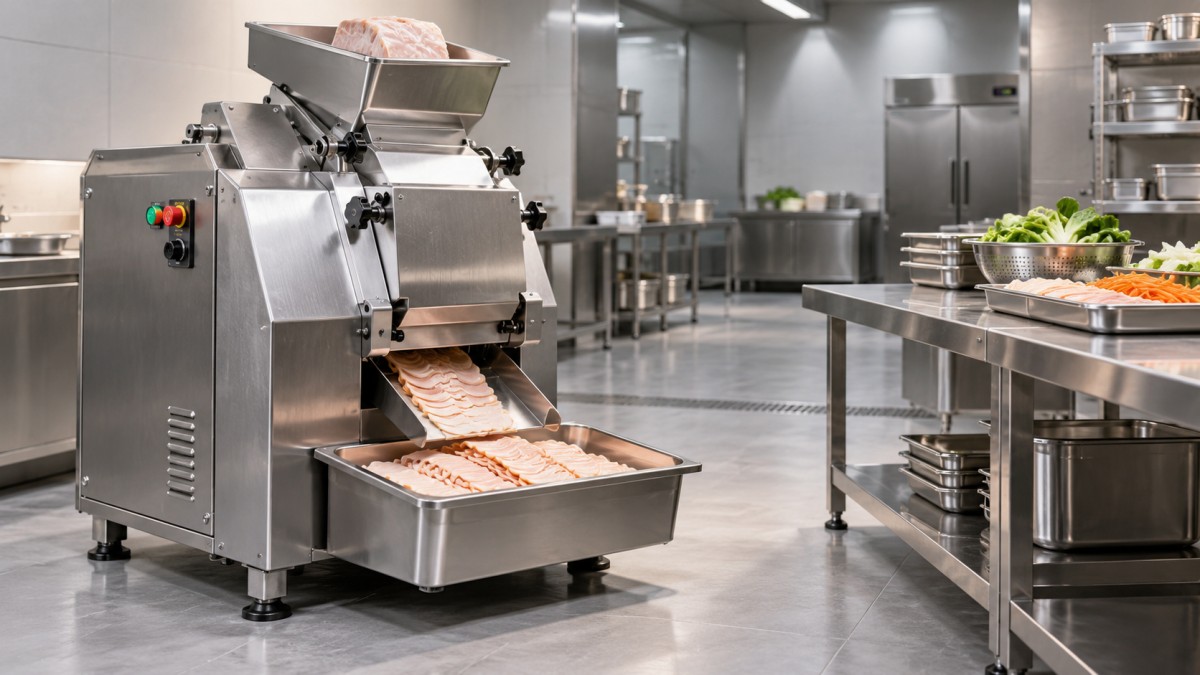
Smaller restaurants may still benefit from partial automation, such as programmable cooking controls or a dedicated preparation machine. These purchases typically require a clearer justification than a full production line: the equipment must solve a frequent problem without consuming too much counter space or adding a complicated cleaning routine.
Connected equipment needs a practical reason to be connected
Smart kitchen equipment can record operating conditions, support programmed recipes, provide alerts, or help managers monitor equipment across locations. Those capabilities are most useful when someone acts on the information. A multi-site operator may value visibility into equipment status or standardized cooking settings; a single-site kitchen may prefer straightforward controls and dependable local service.
Connectivity also introduces questions that do not arise with a standalone appliance. Buyers may need to assess network availability, user access, data ownership, ongoing software charges, and compatibility with existing systems. They should understand which functions continue working if the connection is interrupted and how updates are handled over the equipment’s life.
For suppliers, the opportunity is not simply to add a screen or an app. It is to make a specific task easier, such as identifying a temperature problem or applying an approved recipe consistently. A demonstration based on the customer’s workflow is more persuasive than a long feature list. Where software depends on another provider, the responsibilities for support and ongoing access should be clear in the commercial agreement.
Different foodservice formats create different demand
Product-market fit depends heavily on the type of operation. A compact restaurant, a hotel kitchen, and a central production facility may all buy cooking equipment, but their purchasing priorities are not interchangeable.
These categories are starting points, not fixed rules. A small business with a limited, high-volume menu may have a strong case for a dedicated machine. A large hotel with changing banquet requirements may place more value on flexibility than on maximum throughput. Suppliers that qualify buyers by menu, production pattern, available space, and service expectations can avoid mistaking organizational size for actual equipment need.
Where regional expansion can become sustainable growth
Expanding foodservice activity in emerging markets can create demand for new kitchens, replacement equipment, and higher-capacity production. But a growing hospitality sector alone does not guarantee a good market for every supplier. Purchasing power, kitchen size, local cooking practices, utility infrastructure, and access to repair services all affect which products can sell and remain in use.
A market-entry assessment should therefore begin with the intended customer and route to market. A supplier selling to large hotel projects may work through kitchen consultants, contractors, or distributors; one targeting small restaurants may need a wider dealer network and readily available replacement parts. Equipment must also suit local electrical supplies, gas connections where relevant, and the space available for delivery and installation.
Import-related costs, applicable product requirements, documentation, and after-sales obligations should be included before a price is offered. A competitive factory price can become less attractive once freight, installation, training, and local service are included. Buyers may also favor a slightly more expensive product if repairs and consumables are readily available.
Manufacturing and export centers including China, Germany, Italy, and Japan offer a broad range of equipment, but country of origin alone is not a reliable shortcut for evaluating a product. The more useful comparison is whether the manufacturer and its local partners can deliver the required specification, documentation, spare parts, and support at a cost the customer can sustain.
How to distinguish a promising trend from a viable opportunity
Before expanding a product range or entering a new region, assess the opportunity against a real purchasing situation. The following sequence keeps the discussion focused on demand that a supplier can serve:
- Define the operating problem. Identify the task, the current limitation, and the type of kitchen affected. “Interest in automation” is less actionable than demand for consistent portioning in a high-volume preparation process.
- Establish the conditions of use. Consider menu variety, throughput, operating hours, available utilities, cleaning time, and staff capability. These conditions determine whether the proposed equipment can deliver its intended benefit.
- Compare the full commercial offer. Include installation, training, consumables, maintenance, spare parts, and software where applicable. Separate one-time charges from ongoing costs.
- Assess the route to service. Determine who installs and repairs the equipment, where parts are held, and how a customer gets help during an interruption. A sales channel without technical support may struggle with complex products.
- Test the buying case. Use a representative operating scenario to compare the proposed solution with the customer’s current approach and simpler alternatives. State the assumptions behind any cost or productivity estimate.
Replacement demand deserves separate attention from new construction. An existing kitchen may have a clear need but little room to alter ventilation, utilities, or workflow. In that situation, an appliance that fits the existing footprint and can be installed with minimal disruption may win over a more capable system that requires extensive modifications.
Supplier selection should also account for continuity. A buyer considering a multi-site rollout needs confidence that equivalent units, technical documentation, and support will remain available as locations are added or equipment is replaced. For a distributor, the same issue affects inventory decisions and the ability to meet service commitments.
The most attractive opportunities are those where a measurable operating need, a suitable product, and a workable support model meet. Suppliers that can demonstrate that fit have a stronger basis for growth than those relying on a broad trend label alone.
Popular Tags
Kitchen Industry Research Team
Dedicated to analyzing emerging trends and technological shifts in the global hospitality and foodservice infrastructure sector.
Industry Insights
Join 15,000+ industry professionals. Get the latest market trends and tech news delivered weekly.
No spam. Unsubscribe anytime.



Contact With us
Contact:
Anne Yin (Ceramics Dinnerware/Glassware)
Lucky Zhai(Flatware)