
Commercial Kitchen Equipment: Balancing Purchase Price and Lifetime Costs
Commercial Kitchen Equipment: Balancing Purchase Price and Lifetime Costs
The challenges of balancing cost and quality in commercial kitchen equipment go far beyond the initial quote. A lower purchase price can hide expensive installation work, higher utility bills, frequent repairs, and downtime that arrives during the busiest service of the week. The right comparison is not simply between two machines. It is between two ways of funding production over the equipment’s useful life.
That does not mean the most expensive option is automatically the best investment. A premium combi oven may earn its place in a hotel kitchen running several meal periods, yet be difficult to justify in a small operation with a narrow menu. A sound purchase decision connects price, operating conditions, service support, and cash flow—without paying for capabilities the kitchen will rarely use.
Start with the workload, not the specification sheet
Before comparing prices, establish what the equipment must deliver during peak demand. Average daily output is useful for budgeting, but it can conceal the bottleneck that matters. A dishwasher that handles the day’s total plate count may still leave staff waiting for clean crockery during a concentrated lunch rush.
Ask the kitchen team to describe the busiest operating window: batch sizes, recovery time, door-opening frequency, product temperatures, and the tasks performed simultaneously. Refrigeration in a hot production kitchen faces different conditions from refrigeration in a cool storeroom. An oven used continuously needs a different assessment from one switched on for occasional finishing work.
Translate those conditions into an agreed requirement before suppliers quote. Otherwise, the cheaper offer may simply contain less capacity, fewer accessories, or an unsuitable duty rating. Equally, buying excess capacity can increase capital spending, occupy valuable space, and create unnecessary standby consumption. Leave headroom for credible growth, not an expansion plan nobody has approved.
Build the cost comparison around the installed asset
The invoice price is only the beginning. A practical total cost of ownership calculation includes purchase, delivery, installation, utilities, consumables, planned maintenance, repairs, disruption, and eventual removal, less any defensible residual value. Use the same evaluation period and operating assumptions for every option.
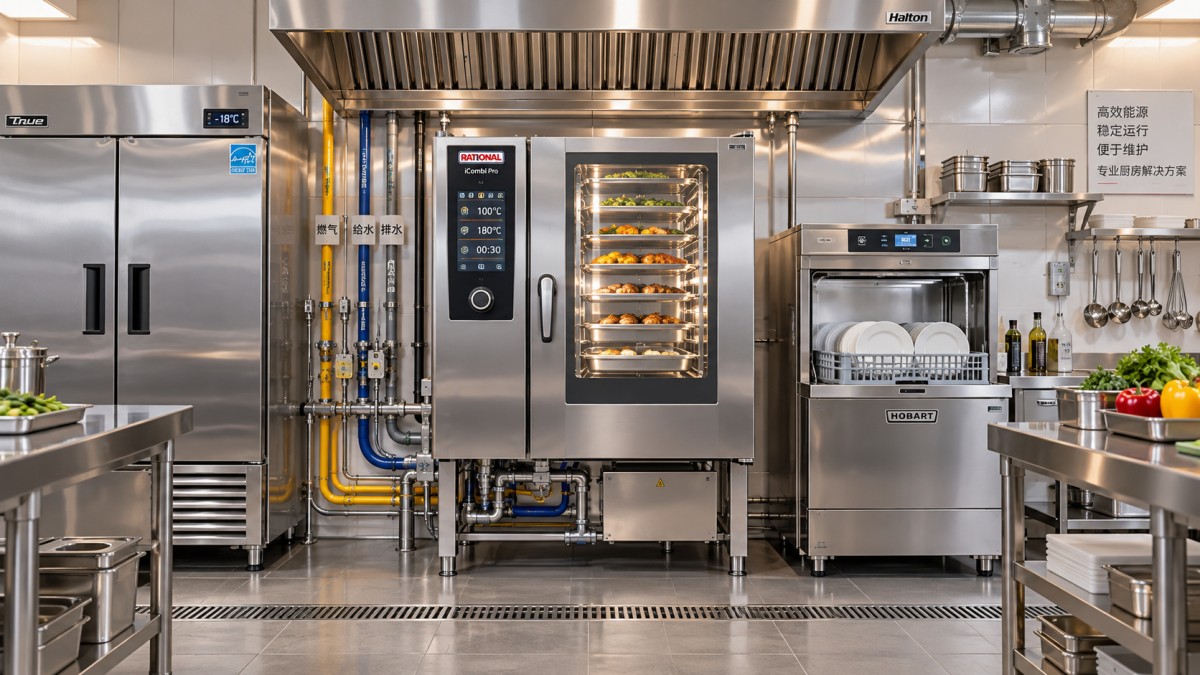
Installation deserves its own review. Electrical supply, gas connections, drainage, ventilation, water treatment, access routes, and commissioning can change the project economics. A machine that fits the floor plan may not fit through the service entrance. An apparently straightforward replacement may require changes to an existing hood or utility connection.
Separate committed costs from estimates. A quoted installation charge is different from an assumed repair allowance. For longer investment horizons, discounted cash flow can help compare expenditure occurring at different times; apply the organization’s approved discount rate consistently. Do not let a precise-looking spreadsheet disguise uncertain inputs.
Energy savings need operating context
Energy-efficient kitchen equipment can justify a higher purchase price, especially where operating hours are long. But nameplate power is not an annual consumption forecast. It describes a rated electrical input, not how often heaters, compressors, or other components operate under actual conditions.
Compare measured consumption using equivalent test conditions wherever possible. For cooking equipment, distinguish active cooking from idle operation. For refrigeration, check ambient conditions, loading assumptions, and temperature settings. For warewashing, include water, heating, and chemicals rather than electricity alone. Independent performance information, where available for the category and market, is more useful than an unsupported “low-energy” claim.
Build the estimate from expected usage and local tariffs, then test what happens if operating hours fall or energy prices change. A premium that pays back under continuous production may not do so in a seasonal venue. Include filter replacements or water-treatment servicing where the equipment requires them; otherwise, the savings calculation is incomplete.
Some equipment also changes the load on surrounding systems. Heat and steam released into the kitchen can affect ventilation and cooling requirements. These interactions should be reviewed with the relevant designer or installer rather than counted as automatic savings.
Treat downtime as a business risk, not just a repair bill
An inexpensive repair can still cause an expensive interruption. If the only fryer fails before evening service, the consequences may include a restricted menu, slower orders, emergency rental, and overtime. A refrigeration failure can introduce product-loss and food-safety concerns, depending on the temperatures reached and how quickly staff respond.
Avoid estimating downtime by multiplying all lost sales by the outage duration. Some demand may shift to other menu items or service periods. Model the likely lost contribution margin, then add identifiable costs such as spoilage, rental, and recovery labor. Keep uncertain reputational effects separate instead of turning them into an arbitrary financial penalty.
The operational question is whether the kitchen can work around a failure. Two smaller units may offer more resilience than one large unit, but they can also cost more to install, clean, and maintain. That trade-off is worth examining for a central kitchen supplying multiple outlets; it may be unnecessary for a lightly used secondary appliance.
Supplier support is part of this calculation. Ask who actually performs local repairs, whether coverage extends to evenings or weekends, and which parts are stocked nearby. Clarify whether a quoted response time means acknowledgment, technician attendance, or restoration of service. Those are very different commitments.
Define quality in ways that affect the budget
“Commercial grade” is too vague to support approval. Quality should be assessed through suitability for the workload, cleanability, temperature control, repair access, component availability, and the condition of surfaces exposed to food, heat, moisture, or cleaning chemicals.
Look beyond exterior finish. Door seals, hinges, shelving, drain access, and removable food-contact components influence daily use. A difficult cleaning process can create recurring labor costs or encourage shortcuts. However, a machine advertised as easy to clean still needs a demonstration: ask staff to remove, wash, and reinstall the relevant parts.
Safety and compliance are acceptance conditions, not optional upgrades. Verify the documentation applicable to the installation location and equipment category with the responsible installer or authority. Overseas sourcing can be commercially sensible, but a familiar badge or a supplier’s assurance does not establish suitability for every market. Check utility compatibility, documentation, warranty coverage, and service arrangements before shipment.
Used or refurbished equipment can reduce initial spending, particularly for simpler assets whose condition can be inspected. Require service history where available, an operational test, and clarity on what refurbishment included. Treat missing records, obsolete controls, or uncertain parts supply as risks to price—not details to resolve after purchase.
Pay for automation only when the workflow supports it
Programmable cooking, automated food processing, and connected monitoring can improve consistency or reduce repetitive work. The financial case depends on what changes on the floor. Saving a few minutes per batch does not necessarily reduce payroll if staffing must remain unchanged during service.
Separate cash savings from capacity benefits. Time released for preparation, cleaning, or handling additional orders may be valuable, but it should not be presented as a guaranteed wage reduction. Ask for a demonstration using representative products and batch sizes, including loading, unloading, changeovers, and cleaning—not just the automated cycle.
Connected equipment introduces other questions: subscription fees, software support, network requirements, data access, and operation during a connection failure. Remote alerts only help if someone receives them and has a response procedure. For some kitchens, robust controls and dependable local service are a better purchase than a feature-rich system nobody has time to manage.
Make the approval show where the decision could change
A useful approval paper presents the installed price, expected annual expenditure, critical service conditions, and the assumptions driving the recommendation. Compare a realistic base case with a lower-utilization case and a disruption case. If one option only wins when every assumption is favorable, the decision is fragile.
When considering leasing or financing, compare total payments, fees, ownership terms, maintenance responsibilities, and end-of-term obligations. Lower monthly payments can preserve cash, but they do not necessarily mean lower lifetime cost. Keep the equipment selection and the funding decision distinguishable.
The strongest recommendation may be the mid-priced option with adequate capacity and reliable support, not the lowest quote or the most advanced machine. Before releasing the order, close the unresolved items: confirm site readiness, document inclusions, agree commissioning and training, and verify service coverage. A higher purchase price deserves approval only when its benefits are relevant, supported, and likely to be realized in this kitchen.
Popular Tags
Kitchen Industry Research Team
Dedicated to analyzing emerging trends and technological shifts in the global hospitality and foodservice infrastructure sector.
Industry Insights
Join 15,000+ industry professionals. Get the latest market trends and tech news delivered weekly.
No spam. Unsubscribe anytime.
Hot Articles
 Midera Food Processing Acquires Phoenix Innovations to Expand Poultry Equipment Business
 Essential Baking Equipment for a Home Kitchen and What Each Tool Does
- Macau Firm Introduces Smart Cooking Equipment to Free Up Kitchen Space
- Catering Equipment Industry Updates: Energy Standards, Prices and Lead Times


Contact With us
Contact:
Anne Yin (Ceramics Dinnerware/Glassware)
Lucky Zhai(Flatware)