
Choosing a Ceramic Soup Mug: Capacity, Grip, and Microwave Safety
Choosing a Ceramic Soup Mug: Capacity, Grip, and Microwave Safety
A comforting bowl of soup should be easy to heat, hold, and enjoy—but the wrong mug can mean spills, an awkward grip, or uncertainty at the microwave. Choosing a ceramic soup mug starts with three practical checks: enough capacity for your usual serving, a handle that feels secure when full, and clear manufacturer guidance on microwave safety. Whether you’re reheating lunch or settling in with homemade chowder, this guide will help you compare these everyday essentials and find a mug that fits your routine.
The wider kitchen equipment industry puts considerable effort into food safety, efficient preparation, and easier cleaning, from restaurant appliances to household utensils. Those priorities matter here, too. A soup mug is a simple purchase, but its shape, finish, and handling can determine whether it becomes an everyday favorite or stays at the back of the cupboard.
Choose capacity by your serving, not the number on the box
A mug’s advertised capacity may describe how much it holds when filled to the rim. That is not necessarily how much soup you can comfortably heat, stir, and carry. Look for a distinction between brimful capacity and recommended usable capacity. If the listing gives only one number, ask how it was measured.
You need space above the soup for movement, stirring, and toppings. A thick lentil soup may bubble unevenly during reheating; a clear broth may slosh when you walk. Neither belongs right at the rim.
As a practical starting point, compare your usual portion with these approximate sizes. These are shopping guides, not standardized serving recommendations:
- 12 US fl oz, approximately 355 mL: worth considering for a small serving or soup alongside a sandwich, provided the actual portion leaves headroom.
- 16 US fl oz, approximately 473 mL: a useful size to assess for an everyday lunch, though it will not comfortably carry a full 16-fluid-ounce serving if that is its brimful capacity.
- 20–24 US fl oz, approximately 591–710 mL: gives more room for substantial portions, noodles, or additions, but increases the loaded weight.
The easiest check costs nothing: pour your normal serving into a measuring jug. Then choose a mug with room beyond that volume. Remember that fluid ounces measure volume, not the mug’s weight, and US and imperial fluid ounces are slightly different. Milliliter specifications make international listings easier to compare.
Check external dimensions as well. A generous mug may fit your appetite but not your microwave’s height clearance or turntable. Measure with the lid fitted if you intend to use it during reheating.
Shape affects eating as much as storage
A wide opening makes it easier to scoop chunky vegetables, stir thick soup, and reach the bottom with a spoon. It also exposes more surface area, which can help soup cool but allows more opportunity for splashes. A taller, narrower mug can suit sipping broth, yet may be awkward for noodles or a large soup spoon.
Look for a smooth rim that feels comfortable against the lips. An exaggerated outward flare may look attractive but can make drinking less controlled. Inside, a gently curved transition between the wall and base is easier to scrape clean than a tight corner.
The base deserves attention, too. It should sit flat without rocking. A tall body on a small foot can feel less reassuring when stirred, particularly on a crowded desk. For desk lunches, a stable footprint may be more useful than extra height.
Judge the handle with the mug full
An empty mug can feel beautifully balanced and become tiring once filled. The soup adds substantial weight, and a thick ceramic body adds more before lunch even goes in. Compare the product’s empty weight when that information is available.
A secure handle needs enough clearance for your fingers without forcing your knuckles against the hot body. Small decorative loops can require a pinching grip rather than allowing fingers to support the load. A very large handle is not automatically better: if it places your hand farther from the mug, the load can feel harder to control.
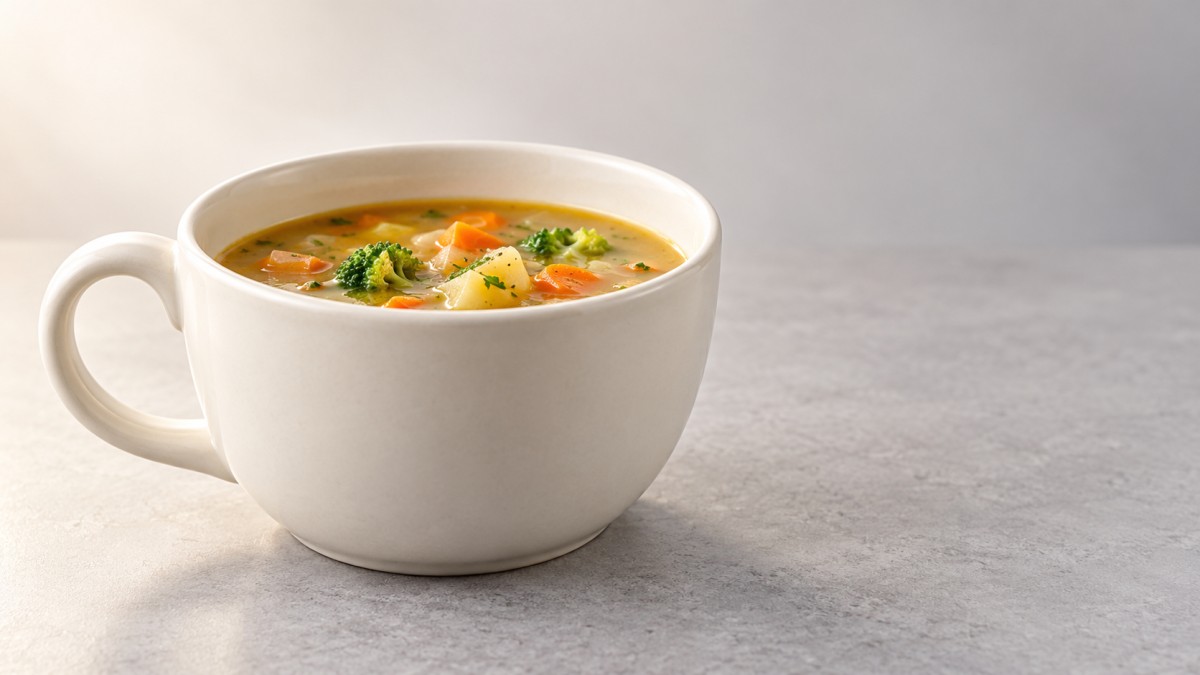
When shopping in person, check whether the handle has comfortable edges and enough room for your preferred grip. With the retailer’s permission, assess the mug with cool water rather than hot liquid. Lift it slightly above a counter, hold it briefly, and put it down. Notice whether it twists, strains your wrist, or encourages you to support the body with your other hand.
For reduced hand strength or limited dexterity, consider a lighter body, a smaller serving, or a two-handled design. Two handles can distribute the load, but both need comfortable clearance. Do not assume any ceramic handle will remain cool after microwaving; use suitable heat protection when needed.
Microwave-safe must apply to the exact mug
“Ceramic” describes a broad material category, not a microwave-safety guarantee. Earthenware, stoneware, and porcelain differ in composition and firing, while glazes, decoration, and attached components introduce further variables. Appearance alone cannot establish whether a mug is suitable.
Look for an explicit microwave-safe statement on the base, packaging, or manufacturer’s instructions for the exact product. If a seller uses a symbol without explaining it, request clarification. A statement that the mug is dishwasher-safe does not establish microwave compatibility, and microwave-safe does not mean oven-safe or stovetop-safe.
Metallic rims and decorations are a warning sign. Unless the manufacturer specifically approves the item for microwave use, keep mugs with metallic details out of the microwave. The same caution applies to decorative, vintage, or handmade pieces whose intended use is unclear.
Food-contact suitability is a separate question. A microwave-safe statement is not, by itself, documentation that the glaze meets applicable food-contact requirements. Buy products clearly intended for serving food, and seek relevant product information when the maker or finish is uncertain. Marketing terms such as “natural” or “non-toxic” do not replace that information.
Safe material does not mean cool or evenly heated
Even an approved mug can become hot as heat transfers from the soup. Microwave-safe should never be read as “safe to grab bare-handed.” Allow standing time, check cautiously, and use dry oven mitts or another suitable heat-resistant grip.
Heat according to the soup’s instructions, using pauses to stir where appropriate. Thick soup can contain hotter and cooler areas, so steam rising from the surface is not proof of an even temperature. For leftovers, follow recognized food-safety guidance and use a food thermometer rather than judging by the mug’s temperature.
Avoid abrupt temperature changes unless the manufacturer expressly permits them. Moving a chilled mug straight into intense heating, or placing a hot mug on a cold, wet surface, can create thermal stress. Microwave approval alone does not establish freezer-to-microwave suitability.
Treat the lid as a separate purchase decision
A lid can reduce splatter and help retain warmth, but it brings its own instructions. The ceramic body may be microwave-safe while the lid, gasket, or clip is not. Confirm each component separately, including whether a vent must be opened or the lid removed during heating.
Never microwave soup in a tightly sealed container. Steam needs an escape route. After heating, open the cover away from your face and hands because trapped steam can burn.
Also distinguish between a splash-resistant cover and a lid intended for transport. A loose ceramic cap may work well at a desk but leak inside a bag. Even a gasketed lid should not be assumed leakproof without clear manufacturer guidance. If you carry soup to work, a dedicated transport container and a separate eating mug may be the more practical combination.
Cleaning and condition determine long-term usefulness
An elaborate lid is less convenient if its seal cannot be removed for cleaning. Check that you can reach the underside of the cover, vent openings, and gasket channel. Follow the specified cleaning method rather than assuming every component belongs in the dishwasher.
Inspect the ceramic for chips, cracks, rough interior patches, and fine crack networks in the glaze, often called crazing. These can make cleaning more difficult and may indicate damage. A cracked handle is especially concerning because failure could release hot soup. Stop using damaged pieces for hot food and seek replacement guidance rather than relying on a household adhesive repair.
For online purchases, a clear return policy and useful product documentation matter more than decorative packaging. Check the mug promptly on arrival, including its handle attachments and base. Replacing a damaged item before use is far easier than discovering a defect with hot soup inside.
Make the final choice around your routine
For chunky lunchtime soup, favor spoon access, a stable base, and sufficient working capacity. For sipping broth, rim comfort and balance may matter more. If you routinely reheat leftovers, clear microwave instructions should outweigh an attractive finish. If lifting is difficult, avoid oversizing simply because the larger option seems better value.
Before choosing a ceramic soup mug, confirm four things: your actual serving fits with headroom, the loaded weight is manageable, the exact mug and lid have suitable heating instructions, and all food-contact surfaces are accessible for cleaning. If a listing leaves one of those questions unanswered, ask for the missing detail—or choose a better-documented alternative.
Popular Tags
Kitchen Industry Research Team
Dedicated to analyzing emerging trends and technological shifts in the global hospitality and foodservice infrastructure sector.
Industry Insights
Join 15,000+ industry professionals. Get the latest market trends and tech news delivered weekly.
No spam. Unsubscribe anytime.

Contact With us
Contact:
Anne Yin (Ceramics Dinnerware/Glassware)
Lucky Zhai(Flatware)