
How Restaurant Kitchen Equipment Parts Affect Downtime
In busy commercial kitchens, even a small component failure can bring operations to a halt. Understanding how restaurant kitchen equipment parts influence performance, repair speed, and maintenance planning is essential for after-sales service teams. This article explores how the right parts strategy can reduce downtime, improve equipment reliability, and help foodservice businesses maintain efficiency, safety, and consistent output.
Why after-sales teams should use a checklist first
For after-sales maintenance personnel, downtime is rarely caused by one issue alone. In most cases, the real impact comes from the relationship between failure frequency, replacement speed, part availability, equipment age, and how critical the affected component is to kitchen output. That is why a checklist-based approach works better than a general inspection. It helps technicians identify which restaurant kitchen equipment parts create the highest operational risk, which failures can be solved immediately, and which cases require escalation, temporary workarounds, or advance stocking.
A structured review also improves communication with restaurant managers. Instead of saying a machine is “broken,” service teams can explain whether the issue involves a wear part, a control component, a heat-related failure, a supply chain delay, or an installation problem. This level of clarity supports faster approvals, better spare parts planning, and more realistic service-level commitments.
First-priority checklist: what to confirm before judging downtime risk
Before ordering parts or promising a repair timeline, confirm the following key points. These checks are the foundation for evaluating how restaurant kitchen equipment parts affect downtime in real operating environments.
- Identify whether the failed part is critical to operation. A damaged door gasket may reduce efficiency, while a failed igniter, thermostat, contactor, sensor, or control board may stop the unit completely.
- Confirm the exact model, serial number, voltage, fuel type, and revision level. Similar machines often use different restaurant kitchen equipment parts, and a mismatch adds unnecessary delay.
- Check whether the part is a common wear item or a low-frequency specialty component. Wear items can often be stocked locally, while specialty parts may require factory lead time.
- Assess if the fault caused secondary damage. A failed fan motor may also affect bearings, wiring, and temperature controls, increasing downtime beyond one replacement part.
- Review kitchen usage intensity. Equipment running long shifts in restaurants, hotels, and central kitchens experiences faster degradation than lightly used units.
- Determine if temporary operation is possible. Some issues allow reduced-capacity use, while others create immediate food safety or fire risk and require shutdown.
- Check stock status across service vehicles, local warehouses, distributors, and manufacturers. Downtime is often more about logistics than repair difficulty.
Core judgment standard: which parts create the most downtime
Not all restaurant kitchen equipment parts carry the same operational impact. After-sales teams should prioritize components according to how they affect cooking continuity, food safety, and repair complexity.
1. Control and electrical parts
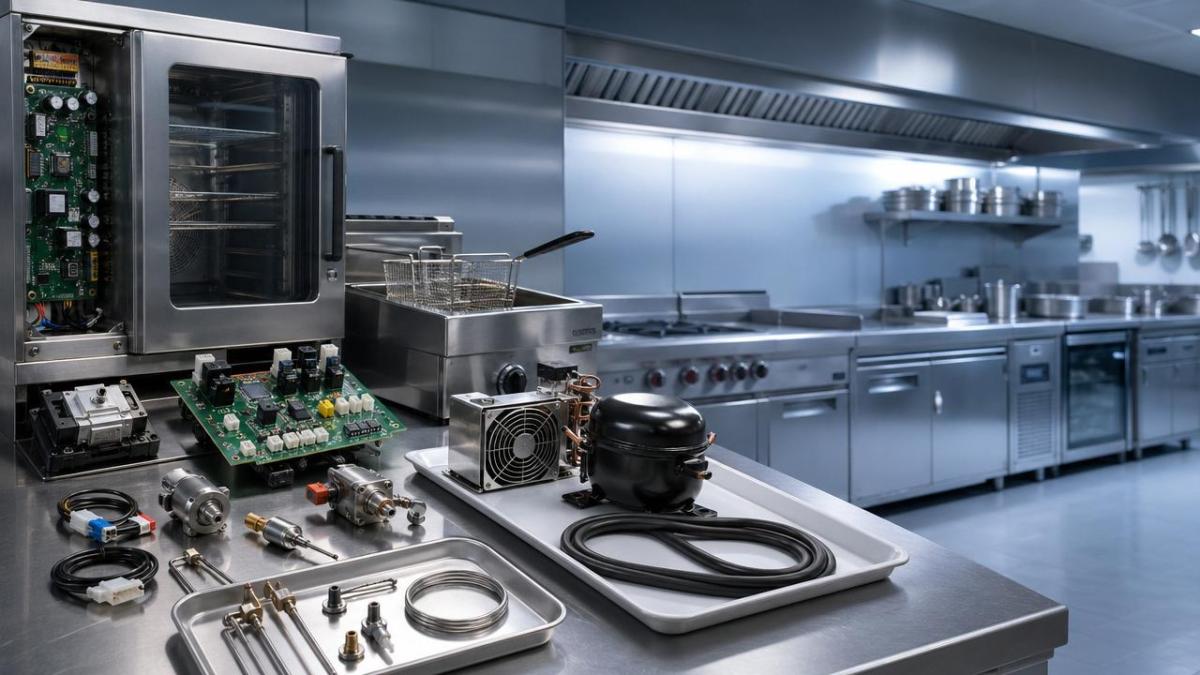
Control boards, relays, contactors, switches, probes, thermostats, and touchscreen modules often create hard stops. These parts are especially important in modern smart or semi-automated kitchen systems. Even when the mechanical structure is intact, one failed electrical component can disable the entire machine. They also tend to require model-specific matching, so identification errors commonly extend downtime.
2. Heating and ignition parts
Burners, heating elements, igniters, gas valves, high-limit thermostats, and flame sensors directly affect production capacity. In ovens, fryers, grills, steamers, and ranges, these restaurant kitchen equipment parts are mission-critical. A minor ignition issue during peak service can disrupt a full shift, especially when backup equipment is limited.
3. Refrigeration system parts
Compressors, evaporator fans, condenser motors, defrost components, door seals, and sensors influence both uptime and food safety. Refrigeration failures are high-risk because the cost of downtime includes product spoilage, compliance exposure, and emergency transfer of inventory. These parts should be monitored not only for failure, but also for declining performance.
4. Mechanical wear parts
Belts, bearings, rollers, hinges, latches, seals, blades, and pumps may appear less technical, but they often fail more frequently. Because they degrade gradually, operators sometimes ignore early warning signs until the equipment stops. For after-sales teams, these are some of the most cost-effective restaurant kitchen equipment parts to stock preventively.
5. Water and filtration-related parts
Solenoid valves, hoses, filters, nozzles, float switches, and drain components are essential in combi ovens, dishwashers, ice machines, and beverage equipment. Poor water quality accelerates wear and can create repeated service calls if root causes are not addressed.
Practical evaluation table for service prioritization
Use the following reference when deciding which restaurant kitchen equipment parts deserve immediate action, local inventory, or preventive replacement planning.
Scenario-based checks: what changes by kitchen type
The same part may have different downtime consequences depending on where the equipment is installed. Service teams should adjust their judgment to the operating scenario rather than relying only on part cost.
Quick-service restaurants
Speed and repeatability matter most. For this environment, restaurant kitchen equipment parts linked to fryers, griddles, holding units, and beverage systems often deserve the highest priority. Even short interruptions can create long order backlogs.
Hotels and full-service restaurants
Menu variety increases dependence on ovens, steamers, refrigeration, and dishwashing systems. Downtime risk must be evaluated by service period, banquet schedule, and whether substitute equipment is available. A part failure before a large event has a much greater business impact than the same issue during low occupancy.
Central kitchens and food processing operations
In high-volume production settings, line balance is critical. One failed motor, conveyor part, sensor, or pump may stop downstream processes and affect packing, chilling, or dispatch. Here, restaurant kitchen equipment parts should be assessed not only by unit failure, but by system bottleneck effect.
Commonly overlooked issues that extend downtime
Many service delays are avoidable. The following risk points are frequently missed during field support and should be part of every maintenance review.
- Ordering by appearance only. Restaurant kitchen equipment parts that look similar may differ in voltage, connector type, firmware, dimensions, or mounting layout.
- Replacing the failed part without checking the cause. Overheating, poor ventilation, unstable power supply, grease buildup, and water scale can cause repeat failures.
- Ignoring consumable or wear cycles. Gaskets, filters, belts, and probes often show predictable degradation patterns that should be addressed before failure.
- Underestimating lead time for imported or discontinued items. In global kitchen equipment supply chains, some legacy parts require cross-reference or upgrade kits.
- Not documenting recurring failures by location or model. Without trend tracking, service teams miss opportunities to improve stocking strategy and preventive maintenance intervals.
Execution guide: how to reduce downtime through parts strategy
If the goal is to reduce service delays, after-sales teams need more than technical skill. They need a repeatable parts management process. The most effective approach usually includes the following actions.
- Build an A-B-C parts list by failure criticality. “A” items stop operations immediately, “B” items reduce capacity, and “C” items mainly affect efficiency or comfort.
- Create model-specific spare parts kits for high-volume customer sites. These kits should include the restaurant kitchen equipment parts most likely to fail under actual operating conditions.
- Link maintenance records to parts consumption. This helps identify premature wear, weak components, and site-specific causes such as water quality or cleaning methods.
- Train technicians on fast identification and substitution rules. When approved alternatives or upgrade assemblies exist, they should be documented clearly.
- Coordinate with suppliers on lead times, safety stock, and end-of-life notices. This is especially important for digital controls and imported assemblies.
- Use preventive visits to replace predictable wear items before busy seasons, major events, or holiday peaks.
What information should be prepared before requesting support or placing orders
To speed up repair approval and parts dispatch, after-sales teams should collect complete site information in advance. At minimum, prepare equipment brand, model, serial number, installation date, fault symptoms, alarm codes, operating photos, usage intensity, and any previous replacement history. For restaurant kitchen equipment parts with electrical or control functions, also confirm voltage, phase, connector style, and firmware version if applicable. Accurate pre-check data reduces misorders and shortens downtime significantly.
Final action points for after-sales teams
The impact of restaurant kitchen equipment parts on downtime is not only about whether a part fails. It depends on how quickly the issue is identified, how well the replacement is matched, whether root causes are corrected, and whether critical stock is available before the next breakdown. For maintenance teams, the most practical path is clear: prioritize high-impact parts, classify risk by kitchen scenario, track repeat failures, and build a preventive inventory plan around real service data.
If you need to move from reactive repair to a stronger after-sales support system, start by confirming five items with internal teams or suppliers: which restaurant kitchen equipment parts cause the longest outages, which models fail most often, which components should be stocked locally, what lead times apply to critical replacements, and whether any upgrade kits or compatible substitutes can reduce future downtime. Those answers provide the fastest route to better service response, higher equipment reliability, and more stable kitchen operations.
Popular Tags
Kitchen Industry Research Team
Dedicated to analyzing emerging trends and technological shifts in the global hospitality and foodservice infrastructure sector.
Industry Insights
Join 15,000+ industry professionals. Get the latest market trends and tech news delivered weekly.
No spam. Unsubscribe anytime.
Contact With us
Contact:
Anne Yin (Ceramics Dinnerware/Glassware)
Lucky Zhai(Flatware)