
Kitchen manufacturing is shifting toward flexible output
Kitchen manufacturing is entering a new phase as global buyers demand faster delivery, customized production, and smarter equipment solutions. For business evaluators, this shift toward flexible output signals more than an operational upgrade—it reflects changing cost structures, supply chain strategies, and competitive positioning across the kitchen equipment industry. Understanding this transition is essential for assessing future market opportunities and manufacturing resilience.
Why flexible output is becoming central to kitchen manufacturing
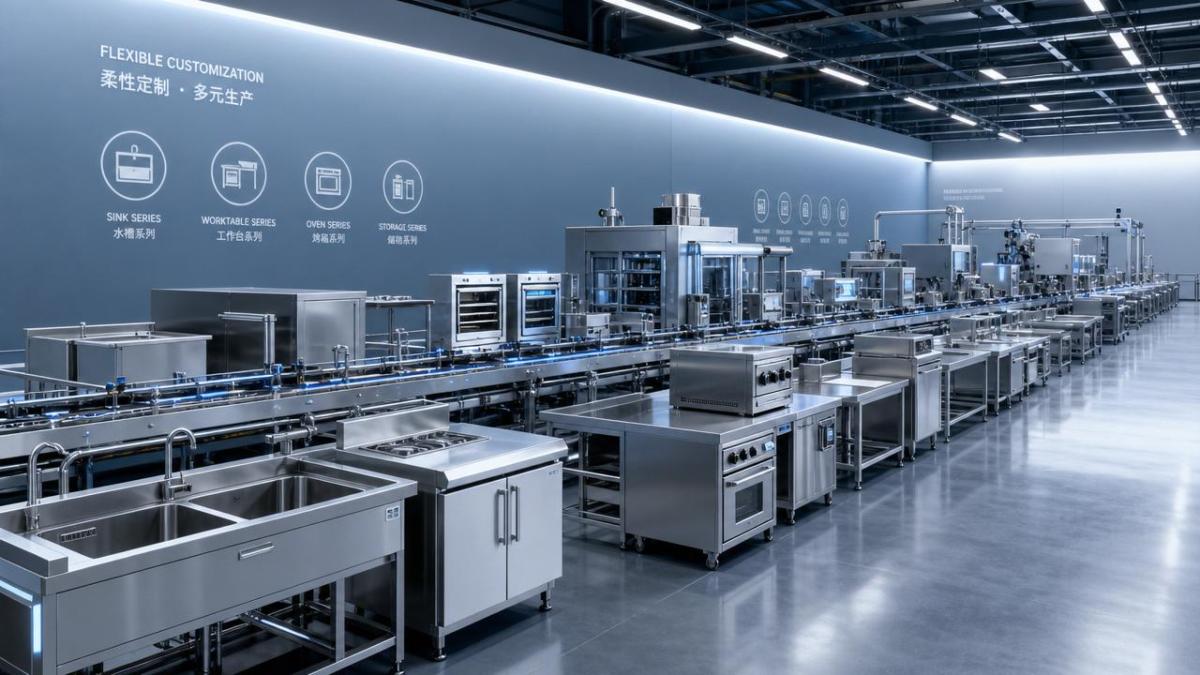
Traditional kitchen manufacturing often relied on long production runs, stable product catalogs, and predictable regional demand. That model still works for standard sinks, worktables, ovens, and storage units, but it is under pressure. Foodservice operators now expect shorter lead times, mixed product orders, and equipment that fits specific workflows, energy targets, and local compliance needs.
Flexible output in kitchen manufacturing refers to the ability to switch between product types, batch sizes, materials, and configurations without heavy disruption to cost, quality, or delivery performance. It combines modular design, digital planning, adaptable production lines, and supplier coordination. For business assessment teams, this is not only a factory topic. It influences sourcing risk, customer retention, inventory exposure, and margin stability.
What is driving the shift
- Demand fragmentation across restaurants, hotels, central kitchens, food processors, and residential channels makes one-size-fits-all output less practical.
- Smart kitchen equipment requires tighter integration of electronics, sensors, controls, and software-ready components.
- International buyers increasingly request project-based customization for dimensions, power standards, materials, and safety features.
- Supply chain volatility has made rigid production schedules more expensive and less reliable than before.
In practical terms, kitchen manufacturing is moving from volume efficiency alone to a balance between volume efficiency and response agility. Companies that can reconfigure quickly often gain an advantage in quotation speed, export adaptability, and aftermarket service planning.
How business evaluators should assess flexible kitchen manufacturing capacity
When reviewing a supplier or production partner, business evaluators should avoid judging kitchen manufacturing only by installed capacity or equipment count. Flexible output depends on a broader operating system. A factory may have strong metal fabrication assets yet still struggle with mixed-order scheduling, component traceability, or multi-country compliance.
The table below highlights core evaluation dimensions that reveal whether kitchen manufacturing flexibility is real or only claimed in sales presentations.
A useful procurement insight is that flexible kitchen manufacturing should improve both resilience and commercial responsiveness. If a supplier promises customization but cannot explain component planning, sample confirmation, or change control, the risk remains high.
Questions worth asking during supplier evaluation
- How many product families can be produced on shared lines without major downtime?
- What percentage of orders require non-standard dimensions, voltage, accessories, or packaging?
- How are urgent export orders prioritized without delaying core production?
- What are the most common bottlenecks: sheet metal, heating components, controllers, assembly, or testing?
Which applications benefit most from flexible output
Not every buyer values flexibility in the same way. In kitchen manufacturing, the strongest benefits appear where specification diversity, installation constraints, and speed-to-market are important. This is especially relevant in cross-border procurement and multi-site expansion programs.
The following comparison helps business evaluators judge where flexible kitchen manufacturing creates measurable value rather than simply adding complexity.
For household kitchen products, flexibility also matters, but the commercial payoff is often strongest in B2B environments where installation, throughput, and compliance vary by project. That is why business evaluators in the kitchen equipment sector often treat manufacturing flexibility as a strategic asset rather than a simple production feature.
Flexible output versus traditional mass production: what changes in cost and risk
One common misconception is that flexible kitchen manufacturing automatically reduces cost. In reality, it changes the cost structure. Unit production cost may increase for some small-batch configurations, but total business cost can fall because inventory, obsolescence, redesign delays, and missed-sales risk decline.
Where the financial trade-off appears
- Lower finished goods inventory because output can be triggered closer to actual demand.
- Higher planning and coordination effort because more configurations must be controlled accurately.
- Reduced markdown and obsolete stock risk when product features evolve quickly.
- Better margin protection for project orders where customization justifies differentiated pricing.
For evaluators, the key question is not whether flexible output is cheaper on paper. The better question is whether it improves total landed value across procurement, delivery, installation, and lifecycle service. In kitchen manufacturing, this broader view usually produces a more accurate decision.
Risks that should still be monitored
- Too many custom variants can overload engineering and delay approval cycles.
- If modularity is weak, customization may create hidden quality inconsistency.
- Electronics and software-enabled kitchen equipment can extend sourcing lead times if component alternatives are not prepared.
What technical and compliance signals indicate a mature kitchen manufacturing system
Flexible output should not come at the expense of product safety, hygiene, or energy performance. Mature kitchen manufacturing systems build flexibility on top of controlled materials, repeatable processes, and documented inspection. This is especially important for commercial cooking equipment, food contact components, and powered appliances exported into regulated markets.
Key technical checkpoints
- Material consistency for stainless steel grades, surface finishing, weld quality, and corrosion resistance in high-moisture environments.
- Electrical configuration control for voltage, frequency, grounding, wiring safety, and control panel adaptation.
- Thermal and airflow performance verification in ovens, fryers, ventilation-linked systems, and heated holding equipment.
- Cleaning and sanitation design, including drainability, smooth contact surfaces, and minimized contamination traps.
Depending on destination market and product type, buyers may also need alignment with general electrical safety, food-contact material expectations, or energy-related labeling requirements. Even when a purchase does not demand a specific certification package at the quotation stage, evaluators should confirm whether the supplier understands the target compliance pathway and documentation process.
How to build a practical procurement framework for flexible kitchen manufacturing
A strong evaluation model compares suppliers across both current order needs and future operational adaptability. That is particularly important when sourcing commercial kitchen equipment, automated food processing machinery, or integrated kitchen systems intended for expansion.
The table below can be used as a working procurement checklist during RFQ review, factory audit preparation, or supplier shortlisting in kitchen manufacturing projects.
This kind of framework helps evaluators compare suppliers on business fit, not only purchase price. In kitchen manufacturing, a slightly higher ex-factory cost may be justified if the supplier can reduce redesign cycles, shipment splitting, and field installation issues.
Common questions business evaluators ask about kitchen manufacturing
How do we know whether flexible output is genuine?
Look for operational evidence. Ask how engineering revisions are approved, how mixed orders are scheduled, how many shared components exist across product lines, and what happens when a key part is delayed. Real flexibility in kitchen manufacturing is visible in process discipline, not only in a wide catalog.
Does flexible kitchen manufacturing always mean lower MOQ?
Not always. Some factories can offer low MOQ on modular products but still require economic minimums for special tooling, non-standard heating systems, or custom electrical assemblies. Evaluators should ask which parts of the order drive MOQ rather than assuming the whole project follows one rule.
What is the usual impact on delivery time?
Standard items may ship quickly, while modified products depend on drawing approval, sourced components, and test requirements. A mature kitchen manufacturing partner should separate estimated lead time by order type and clearly identify the decision points that can delay shipment.
What mistakes are common during supplier comparison?
Many teams compare only unit price and overlook tooling logic, export readiness, spare parts planning, and utility compatibility. Another frequent error is ignoring the long-term value of shared product platforms, especially when the buyer expects phased expansion across restaurants, hotels, or food processing sites.
What the next stage of kitchen manufacturing will look like
The future of kitchen manufacturing will likely combine flexible output with deeper digital integration. Smart scheduling, production data visibility, energy-efficient design, and modular product architecture will shape which suppliers can serve both standard demand and specialized applications. This direction aligns with broader market demand for automation, food safety assurance, and sustainable operating cost control.
For business evaluators, the strategic takeaway is clear: flexible output is becoming a proxy for resilience. It indicates how well a supplier can respond to specification changes, market volatility, and multi-region expansion. In a sector serving restaurants, hotels, central kitchens, food processors, and residential demand, that capability has direct commercial value.
Why choose us for kitchen manufacturing evaluation and sourcing support
If you are reviewing kitchen manufacturing options, we can support a more practical decision process around product fit, manufacturing flexibility, and supply risk. Our focus is not limited to catalog selection. We help align technical requirements, commercial priorities, and delivery constraints so your evaluation can move faster with fewer hidden assumptions.
- Parameter confirmation for materials, power configuration, dimensions, workflow needs, and installation conditions.
- Product selection support across commercial kitchen equipment, food processing machinery, smart kitchen solutions, and mixed project orders.
- Delivery timeline discussion based on standard models, modified units, urgent orders, and export coordination.
- Customization review covering structure changes, utility standards, accessories, packaging, and documentation needs.
- Certification and compliance communication for destination-market expectations and document preparation pathways.
- Sample support and quotation planning to help you compare options before larger procurement commitments.
If your team is assessing suppliers, preparing an RFQ, or comparing flexible kitchen manufacturing capabilities across regions, contact us with your target application, specification list, expected order volume, and timeline. We can help structure the evaluation around the factors that matter most to cost, delivery, and long-term operational fit.
Popular Tags
Kitchen Industry Research Team
Dedicated to analyzing emerging trends and technological shifts in the global hospitality and foodservice infrastructure sector.
Industry Insights
Join 15,000+ industry professionals. Get the latest market trends and tech news delivered weekly.
No spam. Unsubscribe anytime.
Contact With us
Contact:
Anne Yin (Ceramics Dinnerware/Glassware)
Lucky Zhai(Flatware)