
Restaurant Kitchen Equipment Dimensions for Better Line Planning
Effective line planning starts with accurate restaurant kitchen equipment dimensions. For technical evaluators, understanding spatial requirements, clearance standards, and workflow relationships is essential to building kitchens that are efficient, compliant, and scalable. This article explores how proper dimensional planning improves installation accuracy, staff movement, equipment integration, and long-term operational performance in modern foodservice environments.
Why dimensional planning changes from one kitchen scenario to another
In practice, restaurant kitchen equipment dimensions are never evaluated in isolation. A compact café, a hotel banquet kitchen, a quick-service outlet, and a central production kitchen may all use grills, refrigeration, sinks, prep tables, and ventilation systems, but the dimensional priorities are different in each case. What looks acceptable on a specification sheet can fail once operator turning radius, door swing, cleaning access, utility routing, and service clearance are added.
For technical assessment teams, the main question is not simply whether a piece of equipment fits a room. The better question is whether the full working envelope fits the intended production line. This includes loading and unloading space, aisle width, pass-through points, separation of raw and cooked zones, and maintenance accessibility. In many projects, dimensional errors do not appear during purchasing; they appear during installation, inspection, or the first week of operation.
That is why restaurant kitchen equipment dimensions should be reviewed by scenario. A line designed for speed-focused assembly behaves differently from a line designed for multi-course plating. Likewise, a cloud kitchen may value density and throughput, while a fine-dining kitchen may prioritize circulation, station discipline, and thermal separation. The same nominal equipment width or depth can have very different implications depending on production rhythm and staffing patterns.
Typical foodservice scenarios where dimensions drive line planning decisions
The following scenarios are among the most common environments where restaurant kitchen equipment dimensions strongly influence layout quality, compliance, and future expansion potential.
This scenario view helps technical evaluators avoid the common mistake of using standard restaurant kitchen equipment dimensions without matching them to production logic. Even compliant dimensions can create operational waste if they are assigned to the wrong environment.
Scenario-based priorities for quick-service, dine-in, and delivery-focused kitchens
Quick-service lines: compact equipment must still support clean movement
Quick-service concepts often push for the smallest possible footprint, but aggressive compression can backfire. In this scenario, restaurant kitchen equipment dimensions should be checked against repetitive motion and order surge conditions. Griddles, fryers, undercounter refrigeration, heat lamps, and assembly counters must form a short, readable sequence. If door openings from refrigerated bases collide with staff legs or neighboring equipment, the line loses speed immediately.
Technical evaluators should test not only static dimensions but also use dimensions: basket lift height, tray landing space, condiment reach, and packaging shelf depth. Small inefficiencies multiply quickly in high-frequency service models.
Casual and full-service kitchens: spacing supports coordination
In casual dining and full-service environments, the issue is less about maximum density and more about coordination across stations. Here, restaurant kitchen equipment dimensions must support sauté, grill, pantry, plating, and dish handling without overlap. A line that is too narrow creates collision points during service, while oversized spacing increases walking time and delays pass communication.
Evaluators should pay close attention to pass-through alignment, hot holding access, and the relationship between refrigerated prep units and final finishing equipment. These kitchens benefit from dimensions that preserve visual communication and station ownership.
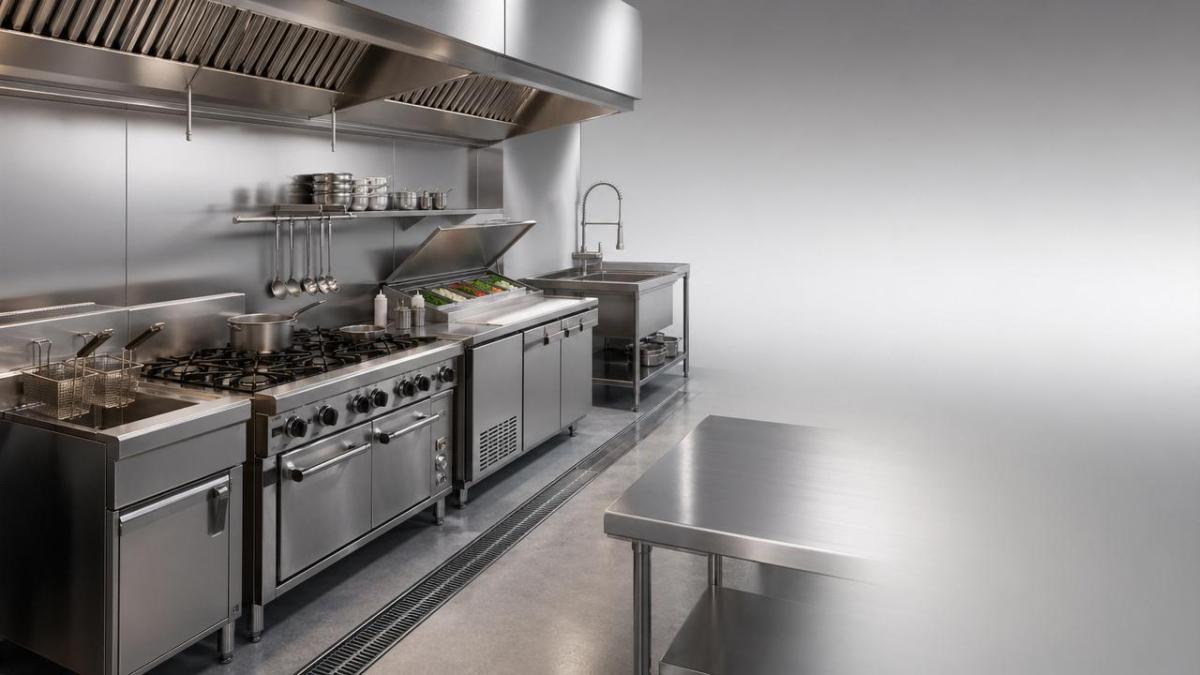
Cloud kitchens: equipment dimensions should allow brand flexibility
A delivery-first kitchen usually changes menus faster than a traditional restaurant. For that reason, restaurant kitchen equipment dimensions should be selected with replacement and reconfiguration in mind. A line that exactly fits today’s fryer and prep table may fail when a combi oven, blast chiller, or extra freezer is added later.
In this setting, modular dimensions, standardized service gaps, and shared utility corridors are often more valuable than maximum single-brand optimization. Technical teams should verify whether equipment can be exchanged without breaking hood coverage, floor drain access, or electrical routing.
Key dimensional checkpoints technical evaluators should review
Across most applications, a strong review of restaurant kitchen equipment dimensions should include more than height, width, and depth from a catalog. The following checkpoints are practical and decision-oriented.
- Operating envelope: Include handle projection, door swing, lid opening, rack pull-out, and loading clearance.
- Human circulation: Check working aisles under normal and peak staffing conditions, not just during low occupancy.
- Maintenance space: Confirm rear, side, or top access for cleaning, inspection, and part replacement.
- Utility connection zone: Verify gas, power, water, drainage, and ventilation positions against actual installation conditions.
- Vertical coordination: Review shelf heights, hood capture area, and overhead interference with sprinklers or lighting.
- Transport path: Ensure equipment dimensions fit through delivery doors, lifts, corridors, and turning points before arrival.
These checks are especially important in modern kitchen equipment projects where automation, energy-saving devices, and smart controls add new service and ventilation requirements. As the kitchen equipment industry moves toward integrated systems, dimensional planning becomes more interconnected rather than less.
Different business sizes show different dimensional risk profiles
The same restaurant kitchen equipment dimensions may be low risk for one operator and high risk for another. Scale matters because staffing depth, menu complexity, replacement budget, and growth plans all affect what counts as a suitable fit.
For evaluators, this means dimensional approval should reflect business model maturity. A start-up may need flexibility and low replacement friction, while a chain may need standardized restaurant kitchen equipment dimensions that support rollout consistency across regions.
Common dimensional misjudgments that cause expensive rework
Several mistakes appear repeatedly in foodservice projects. First, teams rely on nominal equipment size and ignore operating clearances. Second, they validate a line against floor area but not against real workflow. Third, they forget that dishwashing, waste handling, and receiving zones also consume dimensional capacity, even if the core cooking line appears efficient.
Another frequent problem is evaluating restaurant kitchen equipment dimensions without considering future technology adoption. Smart cooking systems, automated dispensing units, digital control panels, and energy-efficient ventilation often require revised spacing, access, or service routes. In the broader kitchen equipment industry, this matters because kitchens are becoming more connected and performance-driven. A layout that leaves no adaptation room can become obsolete before the equipment reaches end of life.
Finally, some teams overlook the difference between “can be installed” and “can be operated well.” Passing installation is not the same as supporting safe labor movement, sanitation discipline, and long-term maintenance.
How to adapt restaurant kitchen equipment dimensions to real project conditions
A practical approach is to review dimensions in layers. Start with the menu and production method, then map station relationships, then place equipment blocks, and only after that confirm utilities and service access. This prevents technical teams from approving equipment simply because it matches a room drawing.
For projects in renovation buildings, verify structural columns, uneven walls, ceiling drops, drainage levels, and existing shaft positions early. For new builds, reserve tolerance for brand changes and code updates. In both cases, restaurant kitchen equipment dimensions should be recorded in a coordinated schedule that distinguishes body size, working size, and maintenance size.
Where possible, evaluators should request mock line studies, operator walk-through simulations, or digital layout validation. These methods reveal whether the selected dimensions truly match the intended scenario, especially in high-output or mixed-menu environments.
FAQ: scenario-focused questions about restaurant kitchen equipment dimensions
Should compact equipment always be preferred in small restaurants?
Not always. Compact units save floor area, but if they reduce prep surface, limit access, or create cleaning difficulty, they may hurt throughput. The right restaurant kitchen equipment dimensions depend on production pattern, not room size alone.
When is modular sizing more important than maximum output?
Modular sizing is especially valuable in cloud kitchens, chain rollouts, and expanding operations where menu or equipment changes are likely. Standardized modules reduce redesign cost and improve replacement efficiency.
What is the best way to compare dimensions from different suppliers?
Use a normalized comparison sheet that includes nominal size, operating clearance, maintenance access, utility connection points, and ventilation requirements. This gives a better basis for technical evaluation than catalog dimensions alone.
Conclusion and next-step guidance
Restaurant kitchen equipment dimensions are most valuable when evaluated in context: service style, staffing, menu complexity, expansion plans, and compliance needs. For technical evaluators, the goal is not only to fit equipment into a layout, but to confirm that each dimensional choice supports movement, sanitation, installation, maintenance, and future adaptability.
If you are reviewing a new line plan or retrofitting an existing facility, begin by identifying the exact kitchen scenario and its operational priorities. Then compare restaurant kitchen equipment dimensions against real workflow, not just floor drawings. That approach leads to better procurement decisions, smoother commissioning, and more resilient foodservice operations over time.
Popular Tags
Kitchen Industry Research Team
Dedicated to analyzing emerging trends and technological shifts in the global hospitality and foodservice infrastructure sector.
Industry Insights
Join 15,000+ industry professionals. Get the latest market trends and tech news delivered weekly.
No spam. Unsubscribe anytime.

Contact With us
Contact:
Anne Yin (Ceramics Dinnerware/Glassware)
Lucky Zhai(Flatware)