
Kitchen Automation Sounds Efficient, but Where Are the Risks?
Kitchen automation promises faster service, smarter workflows, and stronger consistency, but every upgrade brings hidden risks. From Heated Display, Refrigerated Worktable, Charbroiler, and Wok Range systems to broader kitchen innovation strategies, businesses must weigh safety, maintenance, data control, and operational costs before investing. Understanding both the benefits and the vulnerabilities is essential for operators, buyers, and decision-makers seeking efficient yet reliable kitchen automation.
Across restaurants, hotels, central kitchens, and food processing facilities, automation is no longer limited to premium projects. It now appears in prep lines, hot holding, temperature monitoring, order coordination, and energy management. For buyers and operators, the real question is not whether automation can improve kitchen performance, but where the operational, technical, and financial risks begin to outweigh the expected gains.
This matters especially in the kitchen equipment industry, where reliability, hygiene control, heat output, and workflow timing directly affect service quality. A smart Charbroiler that reduces manual intervention may still increase downtime if spare parts are hard to source. A Refrigerated Worktable with connected monitoring may protect ingredients better, yet create new risks around sensor accuracy, software updates, and alarm fatigue.
For information researchers, this topic clarifies what automation actually changes in daily kitchen operations. For users and line staff, it highlights practical concerns such as training, safety, and cleaning. For procurement teams and business leaders, it provides a framework for evaluating return on investment, deployment readiness, and long-term support before any purchase decision is made.
Where Kitchen Automation Delivers Real Operational Value
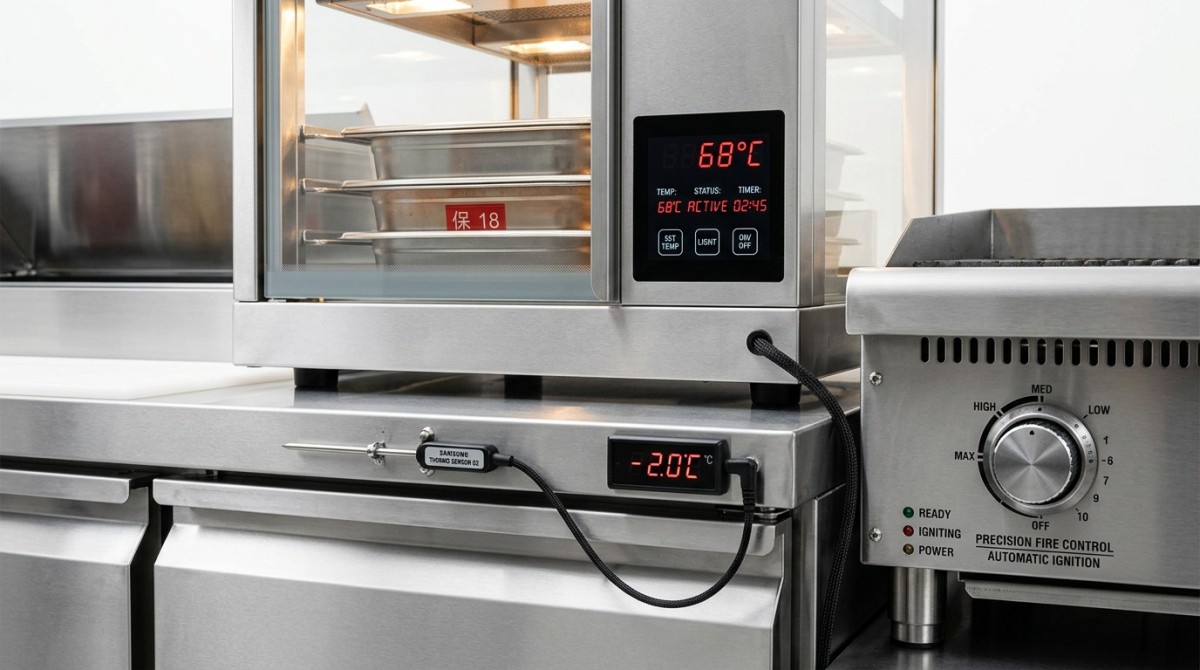
Kitchen automation earns attention because it can remove repeatable manual steps, improve timing consistency, and reduce avoidable waste. In a high-volume kitchen serving 300 to 800 meals per day, even a 10 to 20 second reduction in one prep or holding task can create a measurable labor advantage over a full shift. That is why automated hot holding, programmed cooking cycles, and digital temperature tracking are spreading across both chain and independent operations.
In practical terms, automation is most valuable when a process has 3 characteristics: high repetition, clear target parameters, and direct impact on food quality or labor usage. Heated Display units with stable holding temperatures, for example, can reduce manual checking frequency. Refrigerated Worktables with temperature alarms can protect ingredients during rush periods. Wok Range controls with programmable heat profiles can support consistency in kitchens where speed and repeatability matter.
The advantage is not simply speed. A kitchen that can maintain hot holding at 60°C to 75°C or cold storage at 1°C to 4°C with fewer deviations is also reducing the risk of food loss, rework, and customer complaints. In operations where food cost already represents 28% to 35% of revenue, even a 1% to 3% reduction in waste has meaningful commercial value.
However, automation delivers value only when the equipment matches the workflow. A high-spec system placed in a low-discipline kitchen often underperforms because staff bypass settings, ignore alerts, or struggle with maintenance routines. Automation should therefore be judged not by how advanced it sounds, but by how reliably it supports real kitchen behavior during 6 to 12 hour operating windows.
Typical gains by equipment type
Before evaluating the risks, it helps to compare where automated kitchen equipment usually creates the strongest operational return.
The key takeaway is that automation works best when linked to measurable outcomes such as shorter hold-check intervals, reduced spoilage events, or lower retraining pressure. It is less effective when purchased only as a modernization signal without workflow redesign, standard operating procedures, and maintenance discipline.
The Main Risks Hidden Behind an “Efficient” Kitchen
The first major risk is operational dependency. Once a kitchen begins to rely on automated controls, even a minor sensor failure, display fault, or software freeze can interrupt multiple steps at once. In a manual setup, staff may compensate through experience. In a highly automated environment, one failed interface can slow prep, holding, cooking, and dispatch within 20 to 30 minutes of a breakdown.
The second risk is safety management. Automation does not remove heat, gas, electricity, steam, or sharp-edged tooling from the kitchen. In fact, it may add layers of control hardware that require stricter lockout, inspection, and cleaning routines. A Wok Range or Charbroiler with automated ignition or power control still demands daily visual checks, correct ventilation, and disciplined shutdown procedures at the end of every shift.
The third risk concerns data reliability and digital control. Connected kitchen systems often promise remote monitoring, preventive alerts, and production visibility. Yet if alarm thresholds are poorly set, managers may receive too many false alerts and begin ignoring them. If user permissions are too broad, settings can be changed without traceability. In multi-site operations, inconsistent configuration across 5 to 50 locations can turn a useful dashboard into misleading management data.
A fourth concern is hidden cost escalation. Initial equipment prices do not always include installation adjustments, staff training, replacement probes, firmware support, downtime planning, or spare parts inventory. A business that budgets only for purchase price may underestimate the 12 to 36 month ownership cost, especially in regions where technical service coverage is limited.
Four risk categories every buyer should review
- Technical risk: sensor drift, controller faults, unstable connectivity, and compatibility issues with existing power or ventilation systems.
- Operational risk: staff bypassing automation, weak training, slow recovery procedures, and overdependence on preset modes.
- Compliance risk: incomplete temperature records, poor cleaning access, and documentation gaps during hygiene inspections.
- Financial risk: underestimated maintenance frequency, longer-than-expected spare part lead times, and energy use higher than projected under peak load.
Why risk increases with partial digital adoption
Many kitchens do not fail because they automate too much, but because they automate unevenly. When one station is digitally controlled and another remains manual, staff must manage two logic systems at once. This increases training time and creates confusion in shift handovers. In medium-sized operations, mixed workflows often need 2 to 4 weeks of adjustment before they stabilize, and some never fully do without revised SOPs.
That is why risk assessment should happen before procurement, not after installation. The goal is not to reject automation, but to identify where it creates fragile dependencies that are unacceptable for the production volume, staffing level, and service model of the business.
How to Evaluate Automated Kitchen Equipment Before Purchase
A sound procurement process starts by matching equipment capability with service reality. A central kitchen producing 1,500 portions per day has different needs from a restaurant serving 180 covers over lunch and dinner. Buyers should define workload, peak-hour rhythm, menu complexity, sanitation requirements, and utility constraints before comparing product features.
At minimum, a pre-purchase review should cover 6 areas: capacity, control accuracy, cleaning access, maintenance intervals, spare part availability, and operator learning curve. A system with impressive automation but a 6-week spare part lead time may be too risky for high-turnover operations. Likewise, equipment that requires 3 days of staff retraining may not fit a kitchen with high seasonal labor turnover.
Power and environmental requirements also deserve close attention. Commercial kitchen equipment can operate across ranges such as 3kW to 18kW for electric units or require stable gas pressure and extraction support for flame-based equipment. If the site cannot maintain these conditions, performance and safety both suffer. Procurement should therefore involve technical review, not just price comparison.
For buyers managing multiple facilities, standardization can reduce long-term cost. Choosing fewer control platforms simplifies training, spare parts planning, and service response. The savings may not appear in the first invoice, but over 24 months they can become more important than a 5% to 8% difference in unit price.
A practical procurement checklist
The table below can help procurement teams, kitchen managers, and decision-makers compare automation projects using the same criteria.
A checklist like this shifts the discussion from general claims to operational fit. It also helps procurement teams explain decisions internally, especially when a lower-priced option appears attractive but carries longer service delays, harder cleaning access, or a steeper learning curve.
Questions that should be answered before approval
- What happens if the control system fails during peak service, and how long is the recovery path?
- Can current staff operate, clean, and troubleshoot the unit after no more than 2 or 3 training rounds?
- Are consumables, probes, gaskets, and controllers locally available or dependent on overseas lead times?
- Does the projected energy saving still hold when the equipment runs at realistic load for 8 to 12 hours?
Implementation, Training, and Maintenance: Where Many Projects Succeed or Fail
Even well-selected kitchen automation can disappoint if implementation is rushed. A proper rollout usually requires 3 stages: site readiness review, controlled installation and testing, and post-launch monitoring. Depending on equipment complexity, this process may take 7 to 21 days for a single location and longer for multi-site deployments. Skipping validation often leads to recurring faults that are blamed on the equipment but actually come from installation mismatch.
Training is equally important. Operators do not need engineering-level knowledge, but they must understand normal settings, alarm meaning, cleaning limits, and when to escalate a fault. In many kitchens, the best approach is role-based instruction: one module for line users, one for supervisors, and one for maintenance contacts. Short sessions of 45 to 90 minutes are usually more effective than a single long briefing.
Maintenance should be planned from day one. Automated kitchen equipment often combines thermal components, control boards, sensors, seals, and user interfaces. Neglecting any one of these can affect the whole unit. For example, a Refrigerated Worktable may still cool, but poor gasket condition or blocked airflow can force longer compressor cycles and raise energy usage over time. A smart Heated Display may maintain heat poorly if probes become contaminated or calibration drifts.
The best-performing sites usually treat automation as a managed system rather than a plug-and-play purchase. They assign ownership, keep cleaning logs, test alarms, and review downtime events monthly. This does not require a large engineering team, but it does require discipline.
Recommended rollout and service framework
A structured rollout reduces avoidable failures, especially when introducing automated cooking or monitored holding systems into active kitchens.
This framework shows that successful automation depends as much on implementation quality as on equipment specification. Businesses that allocate time for testing and user adoption are more likely to protect uptime, food safety, and return on investment.
Common implementation mistakes
- Installing automated equipment without checking whether ventilation, electrical load, or drainage supports the real operating condition.
- Training only managers while leaving line operators to learn during live service.
- Failing to stock critical wear parts such as probes, seals, ignition items, or control accessories.
- Ignoring small recurring alarms that later develop into production interruptions.
Which Businesses Benefit Most, and When Should They Be Cautious?
Not every kitchen needs the same level of automation. High-volume restaurants, hotel banquet kitchens, central kitchens, and food processing facilities usually gain the most because they run repeatable processes under time pressure. In these environments, automation supports standardization across shifts and sites, often delivering stronger value over 12 to 24 months than in small kitchens with highly customized cooking styles.
Businesses should be more cautious when menus change frequently, staffing is unstable, or equipment usage is irregular. A kitchen that only experiences peak volume 2 days per week may not recover the investment as quickly as one running steady throughput every day. Likewise, artisanal concepts that depend heavily on chef judgment may need selective automation rather than system-wide control layers.
The most effective strategy is often targeted deployment. Instead of automating everything, companies can start with areas where failure costs are high and process variation is common. Refrigerated storage monitoring, automated hot holding, and selected digital controls for core cooking stations are often safer first steps than a full-system conversion.
Decision-makers should also consider supplier support geography. Countries such as China, Germany, Italy, and Japan remain major production centers for kitchen equipment, but local service capacity may vary by market. For international buyers, the right choice is not just a strong manufacturer, but a solution that can be installed, maintained, and supported within the actual operating region.
FAQ for operators, buyers, and decision-makers
How do I know if kitchen automation is worth the investment?
Start by measuring repeatable pain points: labor intensity, temperature deviation, food waste, and service delays. If one process causes frequent losses or repeated manual intervention across 5 or more shifts per week, automation is usually worth evaluating. The strongest cases are those with clear baseline metrics before purchase.
What should procurement teams focus on besides purchase price?
Focus on total cost of ownership over at least 12 to 36 months. Include installation changes, staff training, maintenance frequency, energy use under load, spare part availability, and service response times. A lower upfront price can become more expensive if downtime risk is high or maintenance access is poor.
Are automated kitchens harder for staff to use?
They can be easier in routine tasks, but only if interfaces are simple and training is practical. In most kitchens, staff should reach functional confidence after 1 to 2 training sessions for basic operation. If a system requires constant supervisor intervention, it may be overcomplicated for the site.
What is the safest way to begin automation?
Begin with controlled, measurable areas such as holding, cooling, monitoring, or one high-volume cooking station. Pilot one process, review downtime and quality impact for 30 to 90 days, and then decide whether broader rollout makes sense. This reduces risk and improves internal buy-in.
Kitchen automation can absolutely improve speed, consistency, and process control, but efficiency alone is not a sufficient buying reason. The strongest projects are built on operational fit, realistic maintenance planning, clear training, and supplier support that matches the business location and service model. For restaurants, hotels, food processing sites, and central kitchens, the real advantage comes from balancing automation benefits with manageable risk.
If you are evaluating Heated Display units, Refrigerated Worktables, Charbroilers, Wok Ranges, or broader smart kitchen solutions, a structured assessment can help you avoid expensive missteps and choose equipment that performs reliably in daily use. Contact us today to discuss your application, compare suitable configurations, and get a tailored kitchen automation solution for your operational goals.
Popular Tags
Kitchen Industry Research Team
Dedicated to analyzing emerging trends and technological shifts in the global hospitality and foodservice infrastructure sector.
Industry Insights
Join 15,000+ industry professionals. Get the latest market trends and tech news delivered weekly.
No spam. Unsubscribe anytime.



Contact With us
Contact:
Anne Yin (Ceramics Dinnerware/Glassware)
Lucky Zhai(Flatware)