
What to ask a kitchen design manufacturer before approval
Before signing off on a project, technical evaluators should ask the right questions to a kitchen design manufacturer about compliance, material quality, workflow efficiency, energy performance, customization, and after-sales support. In a market driven by automation, food safety, and smart integration, a structured review helps reduce risk, verify manufacturing capability, and ensure the final kitchen solution meets operational and long-term performance requirements.
Why scenario-based review matters before approving a kitchen project
A technical evaluator rarely reviews a kitchen layout in a vacuum. The same kitchen design manufacturer may serve a hotel banquet kitchen, a quick-service restaurant, a central production unit, or a residential premium project, but approval criteria are not identical. A plan that works for a low-volume café may fail in a high-throughput hospital kitchen. A visually attractive line may still create bottlenecks, sanitation risk, or service access problems once operations begin.
That is why approval should be tied to application scenarios. Evaluators need to test whether the manufacturer understands peak demand, utility conditions, local codes, equipment interconnection, cleaning regimes, operator safety, and future expansion. In practical terms, the best questions are not only “Can you build it?” but also “Can you prove this design fits our exact use case?”
For technical teams in the kitchen equipment industry, this scenario-based method improves decision quality. It reduces redesign costs, prevents hidden compliance gaps, and gives buyers a more realistic view of ownership cost over the full life cycle.
Typical application scenarios and what changes in each one
Before discussing approval questions, it helps to split projects into common operating environments. A capable kitchen design manufacturer should clearly explain how its design logic changes by scenario rather than offering one standard answer for all customers.
This comparison shows why approval standards should be contextual. When evaluating a kitchen design manufacturer, the right questions depend on whether output, hygiene zoning, smart control, aesthetics, or service life is the leading business priority.
Questions to ask about compliance and risk in different project settings
Compliance is the first checkpoint because a beautiful design that fails code review or food safety standards is not approvable. Ask the manufacturer which standards apply in your market and project type. These may include food-contact material requirements, electrical safety, ventilation rules, fire protection spacing, drainage design, and local sanitation codes.
For restaurants and hotels, ask how grease extraction, exhaust routing, and thermal loads were calculated. For central kitchens and food processing sites, ask how raw and cooked zones are separated, how personnel and material movement are controlled, and whether the design supports HACCP-oriented process management. For institutions, ask about anti-slip details, rounded corners, operator protection, and emergency shutoff design. For residential smart kitchens, ask about electrical load balancing, certification of built-in systems, and child-safety considerations where relevant.
A dependable kitchen design manufacturer should provide drawings, compliance references, material certificates, and a clear responsibility boundary between design, fabrication, installation, and local approvals. If answers remain general, that is a risk signal.
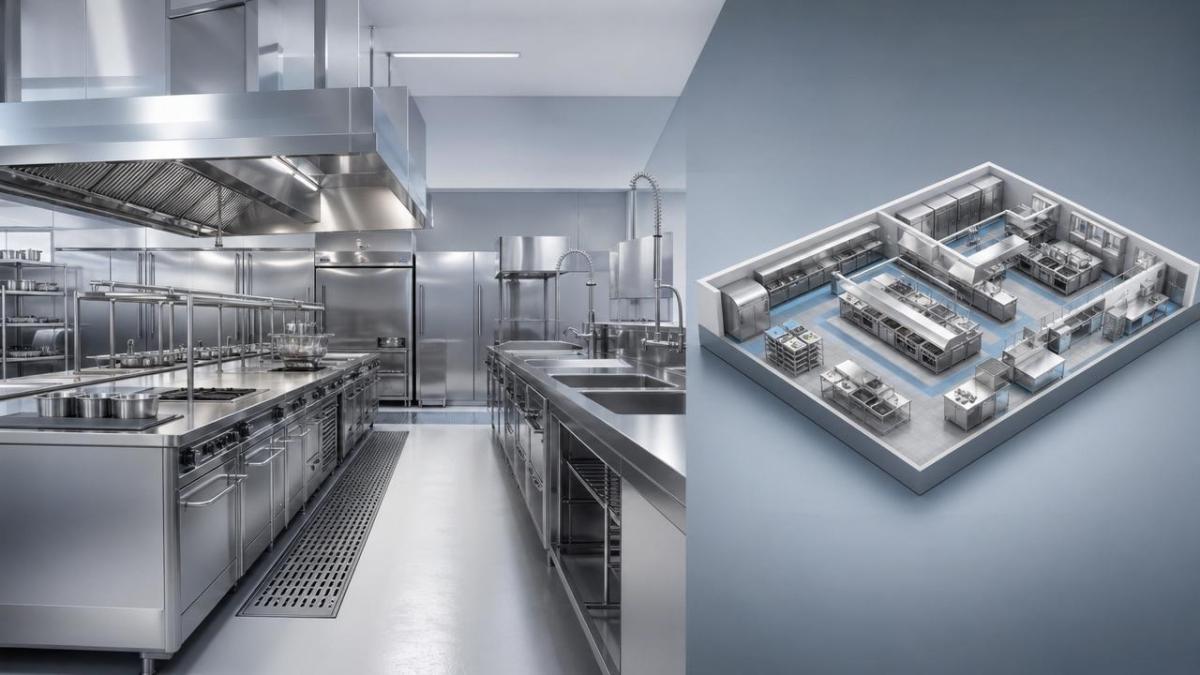
How to evaluate materials, fabrication quality, and sanitation fit
Material quality should never be checked only at the specification-sheet level. Technical evaluators should ask what stainless steel grade is used in food-contact areas, what thickness applies by equipment category, how welds are treated, and whether surfaces are designed for easy cleaning. In high-moisture or high-salt environments, corrosion resistance becomes more important. In heavy-duty commercial kitchens, structural rigidity and impact resistance may carry more weight than decorative finish.
For food processing and central kitchen scenarios, request details about sealed joints, drainage slope, removable components, and avoidance of dead corners where residue can collect. For premium hotel and open-kitchen projects, ask whether visible finishes maintain appearance after repeated cleaning and heat exposure. For residential applications, ask about scratch resistance, integrated storage hardware, and compatibility with smart appliances.
A strong kitchen design manufacturer should also explain its quality control process: incoming material inspection, fabrication tolerances, polishing methods, trial assembly, and final inspection records. This matters because approval is not only about the design concept but also about repeatable manufacturing execution.
Workflow questions: where operational efficiency succeeds or fails
In many projects, the biggest hidden problem is not equipment failure but poor workflow. Ask the manufacturer to walk through a full operating cycle: receiving, storage, washing, preparation, cooking, plating, waste removal, and cleaning. The design should reduce unnecessary crossing paths, waiting time, and manual handling.
For fast-paced restaurant kitchens, ask whether stations are arranged according to menu sequence and peak order patterns. For banquet kitchens, ask how the layout supports simultaneous batch cooking and service staging. For institutional kitchens, ask whether circulation remains safe when staffing levels change across shifts. For central kitchens, ask whether the design supports linear process logic and traceability. For residential smart kitchens, ask whether movement between storage, sink, prep, and cooking areas matches ergonomic use rather than showroom styling alone.
A qualified kitchen design manufacturer should be willing to simulate throughput assumptions. If they cannot explain why each workstation is positioned where it is, the design may not be mature enough for approval.
Energy performance and smart integration by use case
Energy efficiency means different things in different settings. In a commercial restaurant, lower idle consumption and faster heat recovery may deliver the most value. In a hotel or hospital, load stability and utility planning may be more critical. In a central kitchen, automation and monitoring may justify higher initial cost if they improve consistency and labor efficiency.
Ask the kitchen design manufacturer for actual energy data, not broad promises. What are the rated loads, standby consumption levels, ventilation interactions, and water-saving features? Can the equipment connect to digital kitchen management, fault alerts, or production reporting systems? Are sensors and controllers from standardized suppliers with service availability in your region?
This is especially important in modern kitchen equipment projects, where intelligence and efficiency are major buying drivers. Approval should consider not only current needs but also whether the system can integrate with future automation, remote monitoring, or enterprise facility management tools.
Customization questions: when standard modules are enough and when they are not
Customization is often presented as a benefit, but it should be reviewed carefully. Too little customization may lead to wasted space or awkward operation. Too much customization may create service difficulties, long lead times, and higher replacement cost. Evaluators should ask which parts are standard, which are adapted, and what engineering validation supports the custom elements.
In compact city restaurants, custom sizing may be necessary to fit tight footprints. In hotel kitchens, custom pass-throughs and support counters may help multi-station coordination. In central kitchens, custom conveyor or automated handling interfaces may be justified. In high-end residential projects, custom panels and integrated storage may be essential for the user experience.
A good kitchen design manufacturer should define tolerances, site measurement responsibility, installation dependencies, and spare-part implications. Approval should be delayed if custom design choices have not been translated into manufacturable details.
After-sales support and lifecycle questions that technical evaluators should not skip
Many approval teams focus heavily on design and procurement price, then underestimate support risk. Ask who will handle commissioning, operator training, warranty response, preventive maintenance, and replacement parts. For export projects or multi-site businesses, ask how service coverage works across regions.
In restaurants, downtime directly affects revenue. In hospitals and schools, service failures can disrupt essential meal operations. In food processing environments, delays may threaten production planning and hygiene control. In smart residential kitchens, software and electronics support may become as important as mechanical service.
The right kitchen design manufacturer should provide response-time commitments, spare-part lists, recommended maintenance intervals, and escalation procedures. If the project includes intelligent kitchen systems, ask about software updates, data ownership, cybersecurity basics, and compatibility after future upgrades.
Common approval mistakes across kitchen scenarios
Several errors appear repeatedly during technical review. One is approving based on drawings without validating actual operating flow. Another is accepting premium materials without checking whether fabrication details support hygiene and durability. A third is focusing on initial cost while ignoring utility use, maintenance complexity, and service access. A fourth is assuming that a manufacturer with strong residential expertise can automatically meet commercial or processing standards, or the reverse.
Technical evaluators should also be cautious when a kitchen design manufacturer uses generic references that do not match the project scenario. A successful café project does not prove capability for a hospital kitchen. A strong fabrication workshop does not guarantee digital integration expertise. Approval should be based on scenario-relevant evidence.
Practical approval checklist for technical evaluators
Before final approval, ask the manufacturer to confirm the following in writing:
- Applicable codes, certifications, and sanitation requirements for the exact project location and use case
- Material grades, thicknesses, weld treatment, and cleaning-oriented construction details
- Workflow logic supported by station arrangement, throughput assumptions, and operator safety considerations
- Energy, water, ventilation, and utility data with realistic operating conditions
- Scope and engineering basis of custom elements, including site tolerances and installation constraints
- Commissioning, training, maintenance, spare parts, and service-response commitments
Using this checklist helps turn discussions with a kitchen design manufacturer into a measurable approval process rather than a subjective comparison of proposals.
Final decision: align the manufacturer with your real operating scenario
The best approval decisions come from matching technical questions to the real operating environment. Restaurants need speed and resilience, hotels need coordination across multiple functions, central kitchens need process discipline and automation readiness, institutions need safe and maintainable systems, and premium residential projects need integration and finish quality. The right kitchen design manufacturer should show evidence that it understands those differences and can design, fabricate, and support accordingly.
Before you approve, ask for scenario-specific proof: drawings tied to workflow, compliance documentation, material details, utility data, and lifecycle support plans. That disciplined review will help ensure the final kitchen solution is not only manufacturable, but also operationally suitable, efficient, and sustainable over the long term.
Popular Tags
Kitchen Industry Research Team
Dedicated to analyzing emerging trends and technological shifts in the global hospitality and foodservice infrastructure sector.
Industry Insights
Join 15,000+ industry professionals. Get the latest market trends and tech news delivered weekly.
No spam. Unsubscribe anytime.
Contact With us
Contact:
Anne Yin (Ceramics Dinnerware/Glassware)
Lucky Zhai(Flatware)