
Why kitchen manufacturing bottlenecks still affect delivery dates
Even as demand for commercial and residential equipment keeps rising, kitchen manufacturing bottlenecks continue to disrupt delivery schedules across global markets. For distributors, agents, and dealers, these delays affect inventory planning, customer commitments, and profit margins. Understanding what causes these bottlenecks is the first step toward choosing more reliable suppliers and building a stronger, more resilient supply strategy.
Why delivery pressure has become a persistent market signal
The current challenge is not simply that factories are busy. The bigger change is that kitchen manufacturing now operates in a more volatile environment than it did a few years ago. Demand patterns have shifted, product specifications have become more complex, and buyers expect faster fulfillment even when supply chains remain uneven. This combination has turned isolated production delays into a recurring structural issue.
For distributors and regional agents, this matters because delivery reliability is no longer just an operational detail. It has become a competitive factor. When restaurant chains, hotels, central kitchens, and residential project buyers plan openings or renovations, delayed kitchen equipment can push back entire business schedules. In that context, kitchen manufacturing bottlenecks affect not only factories, but also channel trust, project cash flow, and after-sales planning.
Another important signal is that delays are appearing across multiple product categories. Stainless steel workstations, cooking lines, refrigeration equipment, food preparation machines, and smart kitchen systems each face different constraints, yet many buyers experience the same result: uncertain lead times. That points to a wider industry transition rather than a temporary problem in one product line.
The main forces creating kitchen manufacturing bottlenecks
Several forces are converging at the same time. First, product customization has increased. Buyers now request specific dimensions, energy-saving features, digital controls, regional compliance options, and branded configurations. These requirements improve end-user value, but they also reduce the efficiency of standardized production. In many factories, customized orders interrupt production rhythm and create scheduling conflicts.
Second, component dependency remains a major factor in kitchen manufacturing. A supplier may complete metal fabrication on time, but still wait for controllers, compressors, burners, motors, sensors, or electronic interfaces. As equipment becomes more intelligent and energy efficient, the share of critical purchased parts rises. One late component can hold back final assembly, testing, and shipment.
Third, labor structure is changing. Many manufacturers can expand order intake faster than they can expand skilled labor. Welding, assembly, quality inspection, and system calibration require trained workers. When labor turnover is high or training pipelines are slow, capacity looks sufficient on paper but becomes unstable in practice.
Fourth, global compliance expectations have become stricter. Certification, electrical standards, food-contact material requirements, and energy regulations differ by market. For exporters, kitchen manufacturing now includes more document checks, more product validation, and more pre-shipment inspection steps. These measures improve market access, but they also extend the path from order confirmation to delivery.
These pressures show why kitchen manufacturing bottlenecks are proving difficult to eliminate quickly. They are tied to the industry's modernization, not just to short-term disruption.
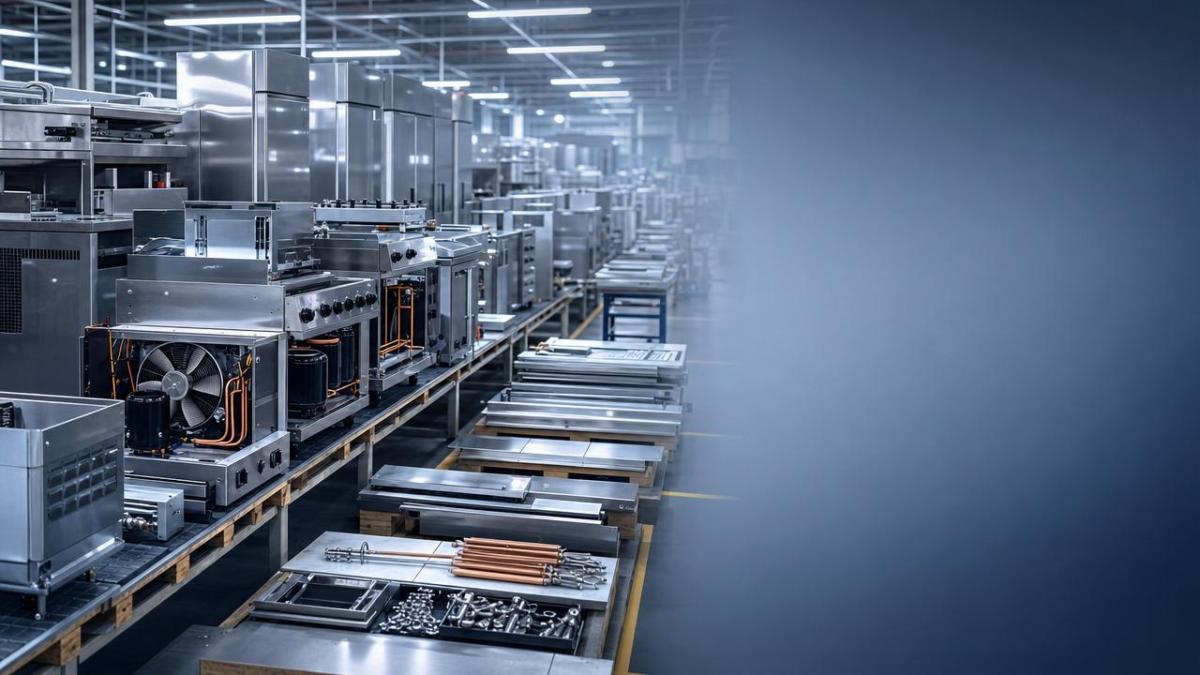
How changing demand is reshaping factory priorities
The kitchen equipment market is expanding in two directions at once. On one side, commercial buyers want durable, efficient, and integrated systems for restaurants, hotels, cloud kitchens, and food processing facilities. On the other side, residential buyers increasingly seek premium appliances, smart controls, and compact multifunctional designs. This broad demand base is good for growth, but it complicates kitchen manufacturing planning.
Factories that once specialized in a narrower range of products now serve more channels, more export destinations, and more product variants. Capacity must be divided across urgent project orders, repeat dealer stock orders, OEM programs, and new product launches. In such an environment, production sequencing becomes a strategic decision. High-value custom orders may receive priority, while standard replenishment orders move more slowly.
Dealers should also note that energy efficiency and smart technology are no longer optional features in many markets. They influence specification choices and purchasing decisions. Yet these upgrades often require new supply partners, new software compatibility checks, and additional testing procedures. In other words, the same innovation that strengthens long-term market value can increase short-term manufacturing friction.
Why bottlenecks hit distributors, dealers, and agents differently
Although all channel partners feel the effect, the impact is not identical. Distributors handling broad inventory portfolios face stock imbalance. Some fast-moving models may be unavailable while slower products still occupy warehouse space. Agents working on project business face timeline risk, because a delayed cooking suite or refrigeration line can postpone installation and final acceptance. Dealers focused on local retail or regional commercial sales often face customer dissatisfaction first, especially when promised delivery dates must be revised more than once.
Kitchen manufacturing delays also affect margins in less visible ways. Freight costs may rise when orders are split into multiple shipments. Sales teams spend more time on updates and problem management. Service teams may need to reschedule technicians. Promotional campaigns tied to expected arrivals can lose effectiveness. For channel businesses, the true cost of delay is often much larger than the supplier’s revised lead time suggests.
The signals that separate temporary delays from structural risk
Not every late shipment means a supplier is weak. The more useful question is whether delays are isolated or structural. Channel buyers should watch for recurring patterns. If lead times vary sharply between quotation, confirmation, and production update, the manufacturer may lack scheduling discipline. If only certain models are delayed, the issue may be component-specific. If quality problems rise along with late deliveries, the factory may be overextending capacity.
Another strong signal is communication quality. Reliable kitchen manufacturing partners usually explain the source of delay clearly: material, labor, certification, subcontractor timing, or shipping availability. Less reliable suppliers often provide only general reassurances. For distributors and agents, clarity is often as valuable as speed, because it supports customer planning and internal decision-making.
It is also important to monitor whether a factory has invested in process improvement. Manufacturers adopting digital production planning, supplier integration, modular design, and standardized testing are generally better positioned to reduce bottlenecks over time. Those still relying heavily on manual coordination may remain vulnerable even if current output appears strong.
What channel partners should evaluate before committing volume
In today’s market, supplier evaluation should go beyond catalog quality and price. A distributor or dealer should assess how kitchen manufacturing capacity is organized. Important questions include whether the factory separates standard and custom production, how it manages critical components, what percentage of processes are outsourced, and how often delivery performance is reviewed internally.
Buyers should also look at product architecture. Equipment built on modular platforms is often easier to produce consistently than highly fragmented designs. A manufacturer that standardizes frames, control systems, and common components across product lines can usually respond faster when demand changes. This does not remove all bottlenecks, but it reduces disruption from variant complexity.
For larger accounts, a practical step is to share rolling forecasts. Kitchen manufacturing becomes more stable when suppliers can see demand signals earlier, especially for repeat models and seasonal peaks. Forecast sharing is not a guarantee, but it improves component planning and production slot allocation.
How the next phase of kitchen manufacturing may evolve
Looking ahead, the industry is likely to reduce some bottlenecks while creating new ones. Automation, digital planning systems, and smarter procurement tools should improve visibility and throughput. Factories with stronger process control will gain advantage, especially in export markets that require consistency and traceability. At the same time, the push toward connected, efficient, and compliant equipment will continue to raise technical requirements.
This means kitchen manufacturing will probably become more polarized. Some suppliers will move toward higher resilience through automation, standardized modules, and better supplier coordination. Others may continue to struggle with unstable lead times, especially if they depend on fragmented sourcing or manual planning. For channel partners, supplier selection will increasingly be a question of operational maturity, not just manufacturing scale.
Practical actions for a more resilient supply strategy
A stronger response starts with realistic segmentation. Not every item needs the same sourcing model. Core high-volume products may justify safety stock or dual sourcing. Project-based items may require longer quotation validity and earlier technical confirmation. Smart or certified equipment may need deeper supplier audits before expansion.
It is also wise to measure suppliers on delivery stability, not only average lead time. A factory that promises eight weeks and delivers in eight to nine may be more valuable than one that promises six weeks but often ships in ten. For distributors and agents, predictability supports healthier inventory turns and stronger customer credibility.
Finally, communication frameworks should be upgraded. Shared milestone reporting, component risk alerts, and agreed substitution rules can reduce the business damage caused by kitchen manufacturing delays. When both sides understand what is changing and how decisions will be made, problems become easier to contain.
Conclusion: what to confirm before the next buying cycle
Kitchen manufacturing bottlenecks still affect delivery dates because the industry is expanding, upgrading, and diversifying at the same time. Demand is rising, product requirements are becoming more complex, and operational discipline now matters more than ever. For dealers, distributors, and agents, the best response is not simply to ask for faster shipment. It is to identify which suppliers have the systems, transparency, and production structure to stay reliable as the market changes.
If your business wants to judge how these trends will affect future orders, focus on a few critical questions: Which product categories are most exposed to component or customization risk? Which suppliers communicate lead-time changes with real operational detail? Which partners are investing in process upgrades that make kitchen manufacturing more stable over time? The answers will help you build a supply strategy that protects delivery performance, customer trust, and long-term growth.
Popular Tags
Kitchen Industry Research Team
Dedicated to analyzing emerging trends and technological shifts in the global hospitality and foodservice infrastructure sector.
Industry Insights
Join 15,000+ industry professionals. Get the latest market trends and tech news delivered weekly.
No spam. Unsubscribe anytime.


Contact With us
Contact:
Anne Yin (Ceramics Dinnerware/Glassware)
Lucky Zhai(Flatware)