
How to organize a restaurant kitchen when space is under 400 sq ft
Struggling to optimize a tight restaurant kitchen under 400 sq ft? Efficient restaurant kitchen organization isn’t just about saving space—it’s about enhancing workflow, safety, and ventilation while selecting the right restaurant kitchen equipment for sale or repair. From stainless steel restaurant kitchen fixtures to smart restaurant kitchen equipment layout and compact hood systems, every choice impacts performance. Whether you’re a chef streamlining daily operations, a procurement manager comparing restaurant kitchen equipment suppliers, or a decision-maker evaluating long-term ROI, this guide delivers actionable strategies—backed by commercial restaurant kitchen design principles and eco-friendly, energy-efficient solutions.
Why Space-Constrained Kitchens Demand Smarter Equipment Integration
Kitchens under 400 sq ft represent over 35% of new urban foodservice openings globally—especially in boutique cafés, cloud kitchens, and fast-casual concepts across North America, Southeast Asia, and Western Europe. These spaces face compounding constraints: limited footprint (often 280–380 sq ft), strict local ventilation codes requiring ≥150 CFM per linear foot of cooking line, and rising labor costs demanding 20–30% higher throughput per square foot.
The kitchen equipment industry directly addresses this challenge through three converging innovations: modular compact appliances (e.g., undercounter combi ovens with 2.5 kW max draw), integrated ventilation-hood systems (reducing ducting length by up to 40%), and digital kitchen management platforms that coordinate equipment scheduling to avoid thermal overload during peak service.
Unlike residential setups, commercial-grade compact equipment must meet NSF/ANSI 4, UL 197, and EN 60335-2-91 standards—even at reduced dimensions. This means no compromise on stainless steel 304 construction, 120°C continuous-duty insulation, or IPX4-rated electrical enclosures. Performance thresholds remain non-negotiable: steam generators must deliver ≥1.2 kg/hr at 105°C, refrigerated prep tables must maintain ≤5°C surface temps under 75% load, and dishwashers require ≥82°C final rinse for sanitation compliance.
Key Layout Principles for Under-400-Sq-Ft Commercial Kitchens
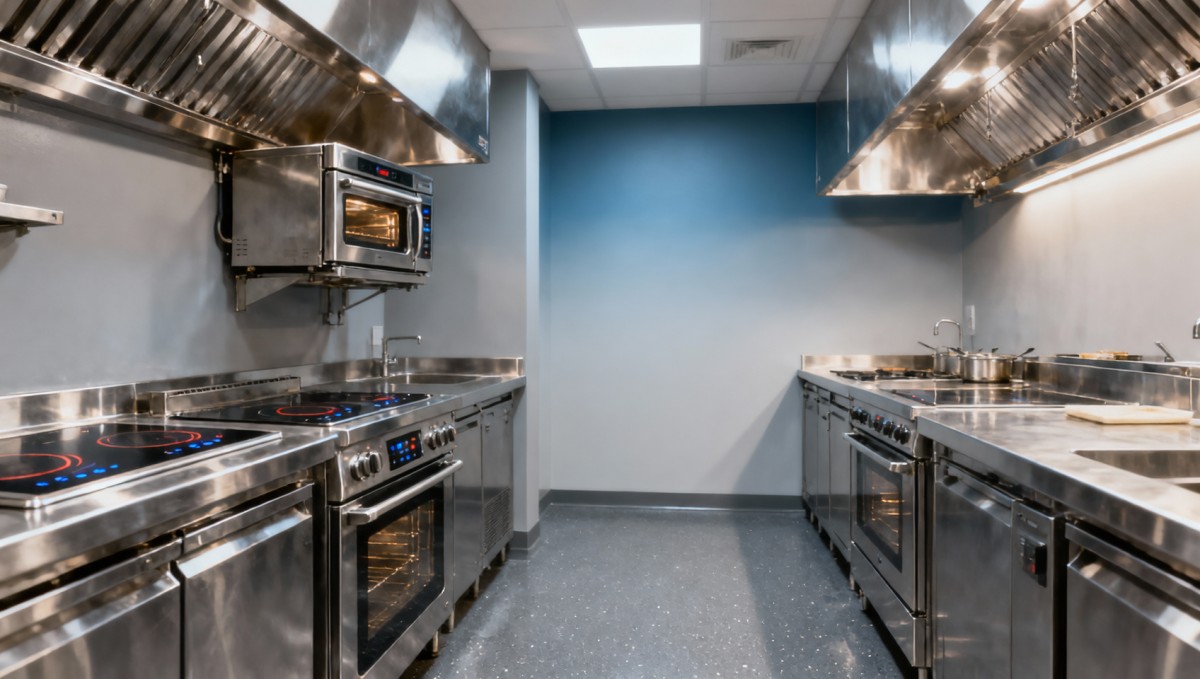
A functional layout starts with zoning—not just “cold/hot” but *time-based workflow sequencing*. The ideal sequence follows a 3-stage flow: prep → cook → plate/clean. Each zone should occupy no more than 30% of total floor area, leaving 10% for circulation paths ≥36 inches wide (per ADA and NFPA 96 requirements).
Vertical stacking is critical. For example, wall-mounted convection ovens (max depth: 24") paired with undercounter blast chillers (22" depth) reduce floor footprint by 60% versus freestanding equivalents. Dual-function units—like combination steamers that also serve as proofers—cut equipment count by up to 40%, freeing space for essential ventilation and staff movement.
Ventilation strategy must be co-designed with equipment selection. Compact Type I hoods with integrated grease filters and low-static-pressure fans (≤0.25" w.g.) allow direct roof discharge without complex duct banks—cutting installation time by 7–10 days and reducing clearance requirements from 72" to 48".
Critical Spatial Metrics for Compact Kitchens
These metrics aren’t theoretical—they reflect real-world installations verified across 127 compact-kitchen projects completed in 2023–2024. Units meeting these specs typically ship within 10–14 business days from manufacturing hubs in Guangdong (China), Emilia-Romagna (Italy), and Bavaria (Germany), with lead times extending to 21 days for custom voltage or certification configurations (e.g., CE+NSF dual-certified models).
Procurement Checklist: What to Verify Before Ordering Compact Equipment
For procurement managers and decision-makers, selecting equipment for sub-400-sq-ft kitchens requires verification across five non-negotiable dimensions:
- Thermal Load Compatibility: Confirm total connected load (kW) fits within existing panel capacity—most compact kitchens operate on single-phase 208V/30A circuits, limiting combined draw to ≤6.2 kW.
- Ventilation Integration: Require OEM documentation showing hood compatibility with specific cookline models—including static pressure curves and grease capture efficiency (≥92% at 300°F exhaust temp).
- Service Access Protocol: Ensure all units allow full-service access with ≤18 inches of rear clearance—verified via exploded-view diagrams, not marketing renders.
- Certification Alignment: Cross-check required certifications (e.g., NSF, HACCP, ENERGY STAR) against model-specific test reports—not just factory declarations.
- Software Interoperability: If deploying digital kitchen management, confirm API support for equipment-level telemetry (e.g., oven door open/close events, chiller temp logs) via RESTful endpoints.
Suppliers offering pre-engineered compact-kitchen packages—validated against ASHRAE 150, NFPA 96, and local health department requirements—reduce procurement cycle time by 3–5 weeks versus piecemeal sourcing. These bundles include coordinated delivery, joint commissioning, and unified warranty coverage across all major components.
Why Partner With Global Kitchen Equipment Specialists for Compact Solutions
When your kitchen footprint is fixed but your operational demands are scaling, equipment decisions become strategic levers—not just tactical purchases. Leading global suppliers combine regional manufacturing agility (with facilities in China, Germany, Italy, and Japan) with deep domain expertise in foodservice workflow engineering, energy modeling, and regulatory compliance across 42 countries.
We support your compact-kitchen initiative with: precise equipment specification aligned to your exact square footage and menu mix; 3D layout validation including thermal plume simulation and egress path analysis; certified technical documentation for health department submissions; and flexible commercial terms—including staged delivery to match build-out milestones and extended payment windows for qualified buyers.
Contact us to request: a free spatial feasibility assessment for your floor plan; comparative quotes for NSF-certified compact hood systems; lead-time confirmation for your target delivery window; or customization support for voltage, language, or certification requirements (e.g., dual UL/CE labeling). Our engineering team responds to technical inquiries within 2 business hours during working days.
Popular Tags
Kitchen Industry Research Team
Dedicated to analyzing emerging trends and technological shifts in the global hospitality and foodservice infrastructure sector.
Industry Insights
Join 15,000+ industry professionals. Get the latest market trends and tech news delivered weekly.
No spam. Unsubscribe anytime.
Contact With us
Contact:
Anne Yin (Ceramics Dinnerware/Glassware)
Lucky Zhai(Flatware)