
Restaurant Supplies Manufacturer vs Trading Company: Which Is Better for OEM Orders?
Choosing between a restaurant supplies manufacturer and a trading company shapes far more than unit price in OEM buying. It influences design control, compliance confidence, lead-time stability, and the ability to scale product lines across commercial kitchens, hotels, food processing sites, and retail channels. In a kitchen equipment market moving toward automation, smart functions, and energy efficiency, the sourcing model behind an OEM order often determines whether a project stays efficient or becomes difficult to manage.
Why the sourcing model matters more in today’s kitchen equipment market
Kitchen equipment is no longer a simple category built around basic stainless steel products. Many OEM programs now involve electrical components, digital controls, food safety requirements, and market-specific certification.
That change makes sourcing decisions more strategic. A restaurant supplies manufacturer may offer direct production visibility, while a trading company may offer broader supplier coordination and faster product matching.
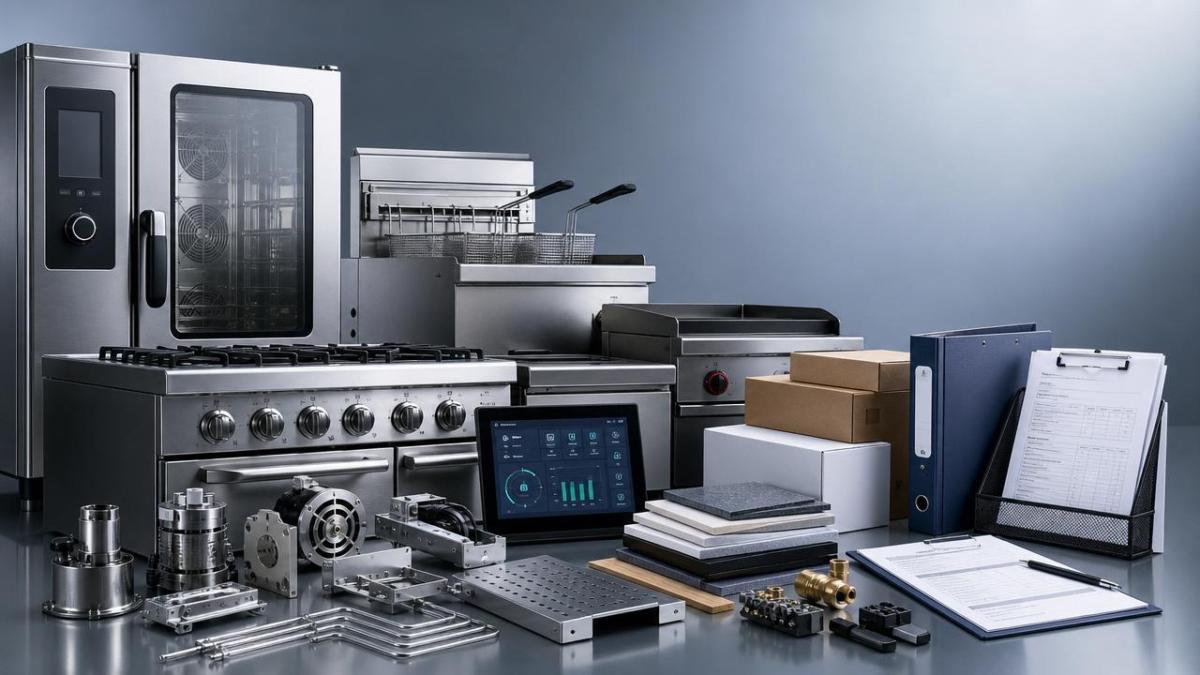
For OEM orders, the key question is not which model is universally better. It is which model fits the product, the target market, the customization depth, and the risk tolerance of the project.
Understanding the difference at a practical level
A restaurant supplies manufacturer produces goods in its own factory or through tightly controlled production resources. It usually manages tooling, production engineering, process control, and quality checkpoints more directly.
A trading company usually does not own the full production process. Instead, it coordinates factories, consolidates sourcing, manages export procedures, and acts as the commercial interface for the buyer.
In real business, the boundary is not always absolute. Some trading firms operate like sourcing integrators with strong technical teams. Some manufacturers also trade products outside their own factory range.
That is why supplier labels alone are not enough. The real comparison should focus on capability, transparency, and execution.
Where a restaurant supplies manufacturer usually has the advantage
When an OEM project requires custom dimensions, branded appearance, unique performance targets, or repeated engineering changes, a restaurant supplies manufacturer often provides stronger control.
Direct access to production teams shortens feedback loops. Questions about materials, weld quality, heating systems, packaging tests, or assembly methods can be answered closer to the source.
This becomes especially important in categories such as cooking equipment, food preparation machines, kitchen electrical appliances, and integrated workstations for central kitchens.
- Better control over tooling and product revisions
- More reliable cost breakdown for high-volume orders
- Faster root-cause analysis when defects appear
- Stronger consistency across repeat production batches
- Clearer protection for proprietary OEM specifications
For buyers planning long-term programs, a restaurant supplies manufacturer can also support product roadmaps. That matters when the market is shifting toward smart kitchen systems and energy-saving upgrades.
When a trading company may be the better fit
A trading company can be useful when the order covers many product types rather than one specialized line. A mixed project may include cookware, small appliances, utensils, stainless furniture, and light food processing equipment.
In that case, one factory rarely covers every category well. A trading company can reduce coordination effort by combining multiple suppliers under one communication and shipping structure.
This model also helps when the order quantity per item is too small for direct factory attention. Some manufacturers prioritize large-volume SKUs and may respond slowly to fragmented OEM demand.
- Easier supplier consolidation across diverse categories
- Lower communication burden for multi-item sourcing
- More flexibility for market testing and short runs
- Convenient export handling and shipment combination
A capable trading company can also add value by screening factories, checking documentation, and matching the right production partner to the buyer’s technical and commercial needs.
Comparing both options across key OEM decision points
The strongest sourcing choice usually becomes clear when the comparison moves from general claims to operating details.
In short, a restaurant supplies manufacturer tends to win on control. A trading company tends to win on flexibility and assortment management.
The hidden issues behind cost, quality, and delivery
The lowest quote is not always the lowest total cost. OEM projects often accumulate hidden expenses through rework, delayed approvals, poor packaging, inconsistent accessories, or weak documentation.
With a restaurant supplies manufacturer, the main risk is limited product range or weak export service. With a trading company, the main risk is reduced visibility into factory execution.
Certification also deserves attention. Kitchen equipment sold into different regions may require CE, ETL, NSF-related compliance pathways, food-contact material verification, or energy-efficiency documentation.
If the supplier cannot explain who owns those processes, delays are likely. This is especially true for smart appliances and electrically powered commercial equipment.
Questions that reveal real capability
- Who controls drawings, BOM updates, and sample revisions?
- Who signs off on incoming material inspection?
- Who manages certification files and test reports?
- Who handles corrective action after a failed inspection?
- Who owns tooling if the project expands or moves?
Choosing by order type, not by assumption
A single sourcing rule does not fit every OEM project. Product complexity and commercial strategy should drive the model selection.
A restaurant supplies manufacturer is often stronger when
- The product needs technical customization or branded redesign
- Order volume justifies direct engineering support
- Quality consistency is critical across repeat batches
- The category involves smart, electrical, or regulated equipment
A trading company is often stronger when
- The program includes many unrelated kitchen product categories
- Initial volumes are fragmented or uncertain
- Shipment consolidation is a major operating concern
- The project needs fast sourcing coverage in multiple factories
Some buyers also use a hybrid approach. They work with a restaurant supplies manufacturer for strategic items and a trading company for peripheral categories.
What a sound evaluation process should include
The most reliable decision comes from structured comparison rather than broad impressions. That means comparing suppliers against the same OEM criteria.
- Map the order into core items, accessory items, and future expansion items
- Separate products needing engineering support from standard catalog products
- Review sample accuracy, not just quotation speed
- Check audit evidence for production and quality systems
- Confirm certification responsibilities before mass production
- Measure communication quality during change requests
This method makes the decision less emotional and more evidence-based. It also reduces the risk of selecting a supplier that looks efficient only during quotation.
A practical way to move forward
For OEM orders in kitchen equipment, there is no automatic winner between a trading company and a restaurant supplies manufacturer. The better choice depends on where the project needs the most control.
If the order centers on technical precision, repeatability, and product evolution, a restaurant supplies manufacturer often creates stronger long-term value. If the order depends on category breadth, flexible sourcing, and shipment coordination, a trading company may be more efficient.
A useful next step is to score both models against product complexity, quality risk, compliance demands, lead-time pressure, and expansion potential. That comparison usually makes the right OEM path much easier to see.
Popular Tags
Kitchen Industry Research Team
Dedicated to analyzing emerging trends and technological shifts in the global hospitality and foodservice infrastructure sector.
Industry Insights
Join 15,000+ industry professionals. Get the latest market trends and tech news delivered weekly.
No spam. Unsubscribe anytime.

Contact With us
Contact:
Anne Yin (Ceramics Dinnerware/Glassware)
Lucky Zhai(Flatware)