
How to shortlist a restaurant supplies supplier with fewer risks
Choosing a reliable restaurant supplies supplier can directly affect your purchasing costs, kitchen efficiency, and long-term business stability. For procurement professionals, shortlisting the right partners means looking beyond price to assess product quality, compliance, delivery capability, and after-sales support. This guide outlines practical criteria to help you reduce risks and make smarter sourcing decisions in a fast-changing kitchen equipment market.
Why a checklist-based shortlist reduces sourcing risk
When buyers compare a restaurant supplies supplier, the biggest mistake is moving too quickly from quotation to decision. In practice, supplier risk rarely comes from one obvious problem. It usually comes from a combination of issues: inconsistent product standards, unclear lead times, weak documentation, poor spare parts support, or limited capacity during peak demand. A checklist-based process helps procurement teams screen options in a repeatable way and avoid decisions based only on price, personal preference, or persuasive sales presentations.
This matters even more in the kitchen equipment industry, where products often involve food contact materials, electrical safety, energy consumption, hygiene requirements, and installation conditions. Whether you are sourcing commercial kitchen equipment, smallwares, refrigeration units, or food preparation machines, a structured shortlist can improve internal alignment and reduce the chance of selecting a supplier that looks competitive at first but creates hidden operational costs later.
Start with these five pre-screen questions
Before building a full evaluation sheet, procurement teams should first confirm whether each restaurant supplies supplier passes a basic entry filter. These questions help you eliminate weak candidates early and save time for detailed review.
- Does the supplier specialize in the categories you actually need, or are they only a trader with limited product control?
- Can they provide clear technical specifications, certifications, and compliance records for target markets?
- Do they have stable export, logistics, and packaging experience for commercial orders?
- Can they support after-sales service, replacement parts, and warranty handling within an acceptable time frame?
- Do they show evidence of financial and operational stability, rather than depending on irregular subcontracting?
If a restaurant supplies supplier cannot answer these clearly, they should not advance to your shortlist no matter how attractive the unit price appears.
Core shortlist checklist: what procurement should verify
1. Product range and category fit
A capable restaurant supplies supplier should match your purchasing structure, not just offer a large catalog. Check whether they support the exact product mix you need: cooking equipment, refrigeration, stainless steel worktables, storage systems, food prep machines, utensils, and consumables. Category fit matters because it affects quotation accuracy, technical communication, and order consolidation. If your supplier only understands part of the order, coordination risk increases.
2. Manufacturing and sourcing control
Ask whether the supplier is a manufacturer, an integrated supplier, or a trading company. None of these models is automatically bad, but visibility is essential. You should know who makes the products, who controls raw materials, and who is responsible for quality. Strong suppliers can explain their factory network, production process, inspection points, and traceability methods. Weak suppliers often hide behind generic answers and cannot explain where quality responsibility begins and ends.
3. Compliance, certification, and food safety relevance
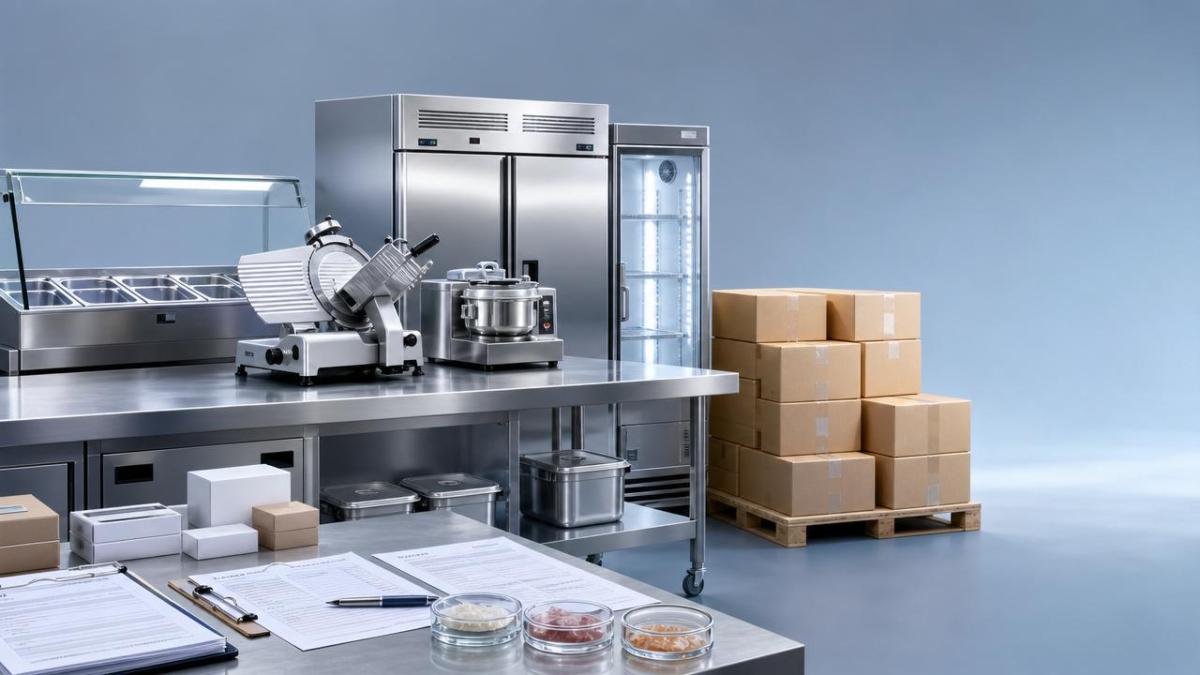
For kitchen equipment and food-contact items, compliance is not optional. A restaurant supplies supplier should be able to provide relevant documents based on your market and product type, such as CE, ETL, NSF-related references, food-contact material declarations, electrical safety reports, or energy-efficiency data where applicable. Procurement teams should verify not only that certificates exist, but that they match the exact model, revision, and exporting entity. Expired, borrowed, or unrelated certificates are a common sourcing risk.
4. Quality consistency and inspection system
Sample quality can be misleading if the supplier lacks process discipline. Ask for incoming material controls, in-process checks, final inspection records, defect classification standards, and packaging inspection procedures. A reliable restaurant supplies supplier should also be able to explain how they handle non-conforming products and whether they track corrective actions. For repeat orders, consistency matters more than a single successful sample.
5. Lead time realism and delivery resilience
A quotation with an unrealistic lead time can disrupt an entire restaurant project. Confirm production cycle, component dependency, order queue, seasonal constraints, and shipping assumptions. Also ask what happens if there is a sudden increase in demand or a port delay. The best restaurant supplies supplier is not the one promising the fastest delivery, but the one giving a believable plan with backup options.
6. After-sales support and spare parts access
Commercial kitchen operations cannot wait weeks for simple service parts. If you are buying equipment rather than only low-value items, confirm spare parts lists, replacement lead time, troubleshooting support, warranty terms, and technical documentation. A dependable restaurant supplies supplier should provide manuals, exploded diagrams, maintenance guidance, and a named service contact. After-sales weakness often becomes visible only after installation, when switching suppliers is costly.
7. Total cost, not just purchase price
Shortlisting should compare total procurement cost, including packaging, customs documentation, compliance testing, installation compatibility, maintenance needs, energy use, and expected replacement frequency. A lower upfront quote from one restaurant supplies supplier may become more expensive if products fail early, require frequent service, or create downtime in the kitchen. Procurement decisions should be based on lifecycle value, not only invoice value.
A practical scorecard for comparing shortlisted suppliers
To make internal decisions easier, many buyers use a weighted scorecard. This keeps evaluation objective and allows operations, engineering, finance, and procurement to contribute using the same criteria.
What to check based on your sourcing scenario
For new restaurant openings
If your project involves a new site launch, prioritize delivery coordination, installation readiness, and complete order management. In this case, the right restaurant supplies supplier should support phased shipments, packing identification, and cross-category consolidation. Delays on one essential item can hold up the entire kitchen handover.
For chain expansion or repeat purchasing
For multi-site programs, consistency becomes the main priority. Procurement should verify whether the restaurant supplies supplier can maintain stable specs, finishes, components, and branding requirements across repeated orders. You should also confirm whether price agreements and supply planning can be locked for a defined period.
For international sourcing
Cross-border purchasing requires closer attention to export packaging, customs documents, labeling, voltage or plug compatibility, and destination compliance. A restaurant supplies supplier with global experience should be able to explain Incoterms, transit packaging, cargo claim procedures, and how they reduce damage risk during long-distance shipping.
Commonly overlooked risks during shortlisting
- Assuming all stainless steel grades are the same. Material differences affect corrosion resistance, durability, and hygiene.
- Accepting generic certificates without model matching. Documents must correspond to actual products shipped.
- Ignoring packaging standards. Poor export packaging can turn acceptable products into damaged deliveries.
- Overlooking spare parts availability. This is critical for refrigeration, heating, and motor-driven equipment.
- Comparing quotations with different scopes. One restaurant supplies supplier may include accessories, while another may not.
- Failing to test communication speed and clarity. Slow responses during bidding often predict slower problem-solving later.
Execution steps: how to move from longlist to final shortlist
A simple execution flow can make supplier selection more reliable and easier to audit internally.
- Define the purchasing scope by category, quantity, market, budget, and expected delivery window.
- Create a pre-qualification form covering product range, compliance, manufacturing model, and export capability.
- Request technical data sheets, sample photos, certification files, and reference projects.
- Score each restaurant supplies supplier using weighted criteria agreed by procurement and operations.
- Conduct sample review, video audit, or factory visit for top candidates where order value justifies it.
- Clarify commercial terms, warranty process, claim handling, and spare parts support before nomination.
FAQ for procurement teams
How many suppliers should be on a shortlist?
In most cases, two to four qualified candidates are enough. More than that can slow evaluation without improving decision quality, especially if requirements are already clear.
Should I always prefer a manufacturer over a trader?
Not always. A strong integrated restaurant supplies supplier or experienced trader may offer better category consolidation and service. What matters is transparency, control, accountability, and execution capability.
What is the fastest way to identify hidden risk?
Check whether the supplier can provide consistent answers across quotation, technical details, certifications, lead times, and after-sales support. Contradictions usually indicate control gaps.
Final action points before you engage a restaurant supplies supplier
A good shortlist is not simply a list of low-priced vendors. It is a filtered group of partners that can support safe, efficient, and scalable purchasing. Before moving forward with any restaurant supplies supplier, prepare your product list, target market requirements, estimated order volume, delivery timeline, installation conditions, and service expectations. Then ask direct questions about compliance, category specialization, production control, packaging, spare parts, and warranty handling.
If you need to confirm parameters, solution fit, project timing, budget range, or cooperation model, prioritize discussions around technical specifications, certification validity, lead-time assumptions, claim procedures, and post-sale support responsibilities. Those points will tell you far more about long-term risk than a quotation alone.
Popular Tags
Kitchen Industry Research Team
Dedicated to analyzing emerging trends and technological shifts in the global hospitality and foodservice infrastructure sector.
Industry Insights
Join 15,000+ industry professionals. Get the latest market trends and tech news delivered weekly.
No spam. Unsubscribe anytime.

Contact With us
Contact:
Anne Yin (Ceramics Dinnerware/Glassware)
Lucky Zhai(Flatware)