
How to judge a kitchen tools factory before ordering
Choosing a reliable kitchen tools factory before ordering is not only about price. It affects product safety, delivery stability, brand reputation, and future cooperation. In today’s kitchen equipment market, buyers face a wide range of suppliers, from small workshops to export-oriented plants with advanced automation. A structured evaluation process helps reduce uncertainty and makes comparison easier.
A careful review is especially important when products will enter restaurants, hotels, retail channels, or online marketplaces. A kitchen tools factory may look strong in photos, yet still fail on material traceability, finishing consistency, testing records, or packaging control. The goal is to judge what the factory can do repeatedly, not just what it can sample once.
Why a checklist matters before choosing a kitchen tools factory
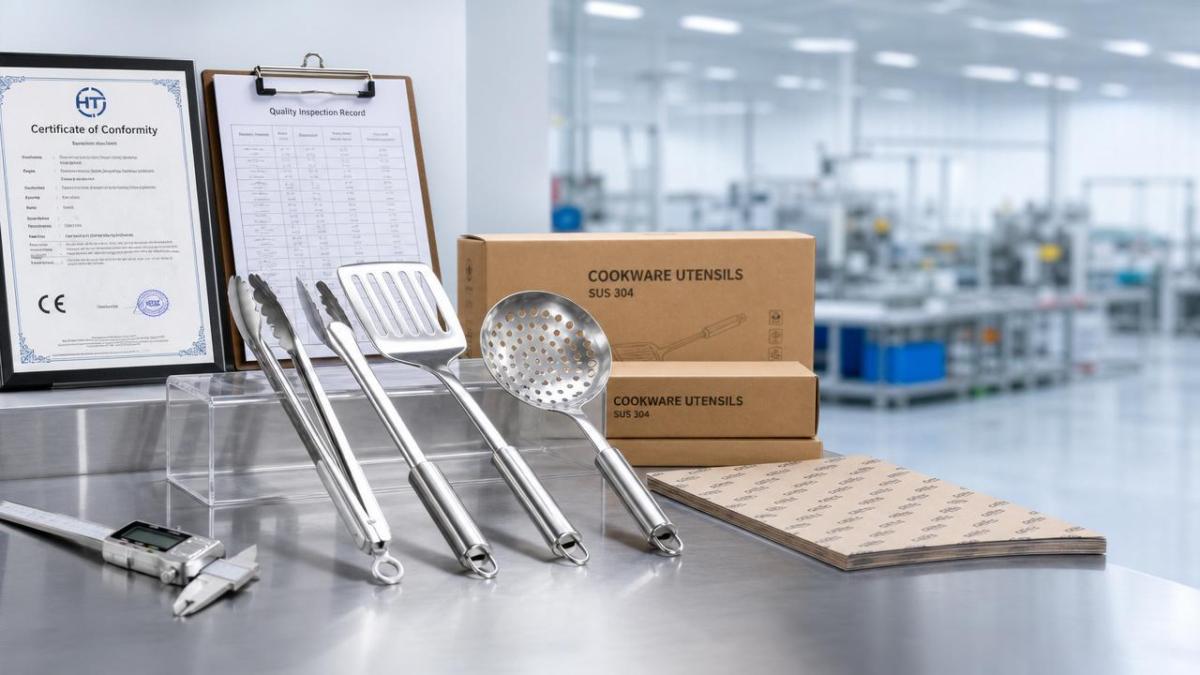
Kitchen tools are simple in appearance, but manufacturing quality depends on many linked steps. Material selection, mold control, polishing, welding, heat resistance, coating safety, and carton protection all influence final performance. Without a checklist, important details are often missed during early communication.
A checklist also creates a common standard for comparing several suppliers. Instead of relying on sales promises, it forces verification through documents, factory observations, samples, and performance records. This is the fastest way to identify whether a kitchen tools factory is suitable for long-term orders or only for low-risk trial business.
Core checklist to judge a kitchen tools factory
- Verify business scope and product focus. Confirm the kitchen tools factory regularly makes utensils, gadgets, and smallwares, not unrelated products with limited process depth.
- Check material specifications. Ask for stainless steel grades, silicone formulas, wood treatment details, and food-contact declarations matching your target market requirements.
- Inspect production flow. Review cutting, stamping, molding, welding, polishing, assembly, and packing steps to see whether output is organized and repeatable.
- Review tooling capability. Confirm whether the factory owns molds, maintains them internally, and can modify tooling efficiently for custom kitchen tools projects.
- Examine quality control points. Look for incoming inspection, in-process checks, final inspection, defect standards, and traceable records for each batch.
- Request compliance evidence. Typical files include FDA, LFGB, REACH, RoHS, or test reports based on the product type and destination country.
- Assess finishing consistency. Compare edges, burr control, surface polish, coating adhesion, handle fit, and color stability across several sample pieces.
- Confirm production capacity. Ask for monthly output, peak season scheduling, lead time under pressure, and backup plans for urgent replenishment.
- Evaluate customization ability. Test how the kitchen tools factory handles logo marking, retail packaging, color matching, bundle sets, and private label requests.
- Check export experience. Confirm shipping terms, carton labeling, barcode control, pallet standards, and experience with customs documents for different regions.
- Review communication speed. Measure how clearly technical questions, revisions, and quality issues are answered before any deposit is placed.
- Test sample discipline. See whether the delivered sample matches drawings, specification sheets, weight tolerance, and packaging instructions without repeated reminders.
Documents worth requesting early
- Business license and factory audit summary
- Material certificates and food-contact test reports
- Product specification sheet with dimensions and tolerances
- Quality inspection report and defect criteria
- Packaging specification and shipping carton details
How evaluation changes by application scenario
Retail and e-commerce products
For retail channels, product appearance and packaging quality are often as important as function. A kitchen tools factory serving this segment should control scratches, color variation, logo position, insert cards, and barcode accuracy. Even strong products can fail if shelf presentation is inconsistent.
Drop-test resistance, carton design, and mixed-pack accuracy should also be checked. Online sales generate more returns when handles loosen, coatings chip, or packaged sets arrive incomplete. Ask the factory for packing photos and shipment references for similar products.
Restaurant and commercial kitchen use
Commercial environments require stronger durability. A kitchen tools factory for this application should prove resistance to repeated washing, heat exposure, impact, and frequent handling. Thin stainless steel or weak rivets may look acceptable in samples, but fail quickly in real use.
Focus on gauge thickness, weld stability, ergonomic grip, and easy cleaning. For tongs, ladles, spatulas, strainers, and prep tools, the structure matters more than decorative finishing. Sample testing under repeated use conditions is highly recommended.
OEM and custom brand projects
Custom projects need more than production. The kitchen tools factory should manage artwork approval, pre-production samples, color references, packaging mockups, and revision control. If the internal process is weak, delays and mismatches usually appear after deposit and tooling approval.
Ask whether the factory can provide BOM control, photo confirmation during mass production, and retained golden samples. These systems help prevent disputes when scaling from pilot quantity to full commercial order.
Commonly overlooked risks when selecting a kitchen tools factory
One common mistake is accepting a good sample as proof of stable production. Many factories prepare samples manually with extra care. Real reliability is shown by batch consistency, not by one polished piece.
Another risk is ignoring subcontracting. Some suppliers present themselves as a direct kitchen tools factory but outsource polishing, coating, printing, or even full assembly. This can weaken delivery control and create hidden quality gaps.
Low price can also mask material downgrades. Stainless steel grade changes, thinner wall thickness, or cheaper handles may not be visible at first glance. Written specifications and incoming material control are essential.
Packaging is often underestimated. A strong kitchen tools factory should prevent rust, deformation, loose sets, and carton burst during export transit. Product quality loses value if goods arrive damaged.
Communication gaps create expensive errors. If technical drawings, unit weights, logo methods, or carton marks are not confirmed clearly, the final shipment may still match the quotation while failing your real requirement.
Practical steps to execute the review
- Shortlist three to five suppliers and compare them using the same checklist, document requests, and sample requirements.
- Send a detailed specification sheet before asking for final pricing from any kitchen tools factory.
- Request a video audit or on-site inspection covering workshop flow, QC stations, warehouse storage, and packing lines.
- Order pre-production samples and record measurable checkpoints such as weight, dimensions, finish, and functional strength.
- Confirm mass production standards in writing, including accepted tolerances, packaging details, and inspection method.
- Use a small pilot order first when dealing with a new kitchen tools factory, even if documents appear complete.
Final judgment and next action
The best kitchen tools factory is not always the biggest or the cheapest. It is the one that can prove stable materials, clear process control, reliable compliance, responsive communication, and consistent delivery for your exact product category.
Use a checklist, verify documents, inspect real production ability, and test sample consistency before committing to larger volume. When the evaluation is systematic, supplier selection becomes less risky and far more predictable.
As a next step, prepare one comparison sheet covering certification, quality points, customization, capacity, and export readiness. That single tool will help identify which kitchen tools factory deserves a trial order and which one should be filtered out early.
Popular Tags
Kitchen Industry Research Team
Dedicated to analyzing emerging trends and technological shifts in the global hospitality and foodservice infrastructure sector.
Industry Insights
Join 15,000+ industry professionals. Get the latest market trends and tech news delivered weekly.
No spam. Unsubscribe anytime.

Contact With us
Contact:
Anne Yin (Ceramics Dinnerware/Glassware)
Lucky Zhai(Flatware)