
Glass Canning Jar Sizes That Reduce Filling and Storage Waste
Choosing the right glass canning jar size is one of the simplest ways procurement teams can reduce overfilling, avoid half-empty storage, and improve packaging efficiency. For buyers in restaurants, hotels, and food processing operations, the best jar size is rarely the largest or cheapest unit. It is the size that matches actual fill volume, product turnover, shelf space, and handling needs.
In practical terms, smaller jars often reduce opened-product waste and improve portion control, while medium sizes usually deliver the best balance between logistics efficiency and usability. Larger jars can lower packaging cost per unit of product, but they may create hidden waste if products move slowly or require repeated opening. The right decision depends on fill accuracy, storage density, food safety practices, and customer use patterns.
This guide explains which glass canning jar sizes are most useful for commercial buyers, where each size performs best, and how to evaluate jar choices based on operational value rather than only price per piece. The goal is to help procurement teams make better packaging decisions that support cost control, inventory management, and product quality.
What procurement buyers are really trying to solve when selecting jar sizes
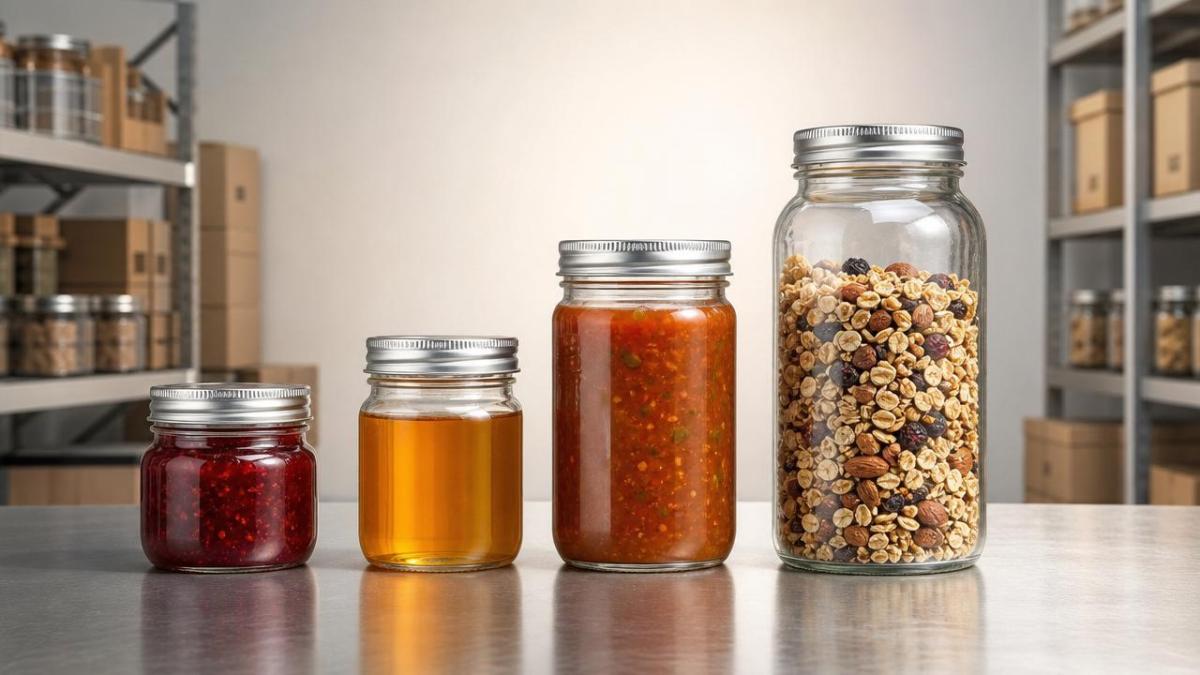
When buyers search for a glass canning jar, they are usually not looking for general packaging theory. They want to know which sizes reduce filling loss, prevent underused storage space, and fit real production and service workflows.
For procurement teams, the core issue is matching jar capacity to actual product movement. A jar that is too large can increase headspace, reduce freshness after opening, and occupy unnecessary warehouse volume. A jar that is too small can increase labor, handling frequency, and packaging line interruptions.
In hospitality and food processing settings, jar size also affects pallet planning, case configuration, labeling area, transport breakage risk, and reorder frequency. That means size selection is not only a packaging choice. It is also an inventory, quality control, and operating cost decision.
Buyers therefore need a framework that connects jar size with fill yield, storage efficiency, serving patterns, and procurement economics. The most useful evaluation is not “Which jar is standard?” but “Which jar minimizes total waste in this application?”
Which glass canning jar sizes usually reduce the most waste
For most commercial and institutional use cases, the most efficient range is often between 4 oz and 32 oz. That range covers sample packs, sauces, condiments, preserves, dry ingredients, and specialty food products without creating excessive empty space or oversized opened containers.
4 oz to 8 oz jars are highly effective for premium condiments, jams, honey, spice blends, gift packs, tasting portions, and high-value products. They reduce product exposure after opening and support better portion control. They are especially useful when product turnover is moderate or when minimizing leftovers matters more than packaging count.
12 oz to 16 oz jars are often the most versatile option for foodservice buyers. They work well for sauces, pickled vegetables, dessert ingredients, spreads, and retail-ready packaged foods. These sizes offer a strong balance between filling efficiency, shelf presence, and manageable opened-product life.
24 oz to 32 oz jars are usually best when product turnover is fast and back-of-house teams can use contents quickly after opening. They can reduce packaging material cost per kilogram or pound of product, but only when demand is consistent enough to avoid spoilage, flavor degradation, or repeated exposure.
Above 32 oz, buyers should be cautious unless they are serving bulk applications, central kitchens, or fast-moving processing lines. Larger containers often look economical on paper, but they can create avoidable waste through partial use, poor rotation, and inefficient shelf allocation.
How jar size affects filling loss on production lines
Filling loss is one of the least visible but most expensive packaging inefficiencies. If jar size does not align with actual product viscosity, fill tolerance, and equipment capability, overfill becomes more common. Even a small average overfill per unit becomes costly at scale.
Smaller and mid-size jars often improve fill consistency because they are easier to calibrate for standard portion targets. This is especially important for sauces, preserves, marinades, and viscous products where exact filling can vary depending on temperature and flow behavior.
Very large jars may require more headspace planning and more careful fill adjustments to maintain safety and presentation. If operators compensate for variation by slightly overfilling every jar, material loss increases across the batch. Procurement should therefore review not only jar dimensions, but also how each size performs on existing filling equipment.
Buyers should ask suppliers and internal production teams for data on nominal capacity, recommended fill volume, finish compatibility, and line-speed performance. A jar that appears efficient by specification may still generate excess product giveaway if it does not match process capability.
How the right size reduces storage waste in warehouses, kitchens, and service areas
Storage waste happens when packaging takes more room than necessary relative to usable product. This occurs in central warehouses, cold rooms, prep areas, and front-of-house storage. Jar selection directly affects how much cubic space is consumed per unit of saleable or usable contents.
Taller jars may improve footprint efficiency on shelves, but they can create stacking limitations or instability in transport. Wider jars may be easier to access and label, yet they can reduce case density and leave more dead space in storage systems. Buyers should compare both internal volume and external dimensions.
Mid-size jars frequently provide the best storage efficiency because they fit common shelving layouts and can be packed in practical case quantities. They also tend to support better stock rotation than very large formats, especially when multiple flavors or SKUs share the same space.
For kitchens and foodservice operations, opened-container storage matters as much as unopened inventory. If a large jar remains half used in refrigeration, it occupies space while increasing contamination and quality risks. Smaller jars may raise unit count, but they can lower total storage waste when products are opened intermittently.
Best jar size choices by common commercial application
Restaurants and cafés: 8 oz to 16 oz sizes are often the most practical for sauces, syrups, toppings, and specialty ingredients. They support manageable usage windows and reduce the chance of products sitting too long after opening.
Hotels and buffets: 4 oz to 12 oz jars work well for portioned condiments, preserves, and guest-facing items, while 16 oz to 32 oz may suit high-turnover back-of-house ingredients. The right choice depends on service frequency and replenishment labor.
Food processors: 12 oz, 16 oz, and 32 oz jars are common because they fit both retail and foodservice channels. Buyers should prioritize fill accuracy, closure compatibility, thermal performance, and pallet efficiency over simple volume preference.
Specialty food brands: 4 oz to 8 oz jars are strong for premium positioning, giftable products, and trial sizes. They reduce waste for consumers and can increase perceived value, especially for high-margin items where freshness and presentation matter.
Bulk ingredient programs: 24 oz to 32 oz jars make sense only when demand is predictable and product is consumed quickly. Otherwise, the apparent savings from larger packaging may be offset by spoilage, handling inconvenience, and reduced rotation discipline.
Questions buyers should ask before choosing a glass canning jar supplier
Procurement decisions should go beyond capacity alone. Buyers should confirm actual brimful volume, recommended fill volume, neck finish standards, closure options, carton configuration, and whether jars are optimized for hot fill, pasteurization, or other processing requirements.
It is also important to ask about dimensional consistency. Small variations in height, diameter, or thread finish can affect capping performance, label application, secondary packaging, and shelf fit. Reliable repeatability is especially important for large-volume purchasing programs.
Another key issue is breakage and logistics performance. A low-cost jar that increases transit loss, repacking labor, or customer complaints is not truly economical. Procurement teams should review case pack strength, pallet stability, and compatibility with automated handling where relevant.
Sustainability and reuse may also matter. Glass is widely valued for product safety, recyclability, and premium appearance, but heavier jars can increase freight costs. Buyers should compare weight, durability, and total delivered efficiency instead of evaluating unit price in isolation.
A simple decision framework for selecting the right jar size
Start with actual product usage, not packaging assumptions. Measure average fill volume, serving pattern, opened-container life, and weekly throughput. This shows whether your current jar is too large, too small, or appropriately matched to demand.
Next, evaluate total cost by size option. Include product overfill, spoilage after opening, storage footprint, labor for replenishment, freight efficiency, and breakage risk. Many buyers discover that a slightly higher piece price results in lower total operating cost.
Then test two or three practical sizes rather than reviewing every available format. For many operations, an 8 oz, 16 oz, and 32 oz comparison is enough to identify the best balance. Use real fill-line and storage conditions, not only spreadsheet estimates.
Finally, standardize where possible. Reducing unnecessary size variation can simplify purchasing, closures, labels, case packing, and inventory control. The most efficient packaging portfolio is usually not the one with the most options, but the one with the best-fit options.
Common mistakes that increase waste
One common mistake is choosing jars based only on purchase price per unit. This often leads to oversized containers that reduce turnover efficiency and increase product exposure after opening. Cheap packaging can become expensive when waste is measured correctly.
Another mistake is treating all products the same. Thick sauces, dry mixes, pickled items, and premium spreads have different fill, storage, and usage requirements. A single standard jar may simplify sourcing, but it can create losses across multiple categories.
Buyers also sometimes ignore downstream users. Kitchen staff, line operators, and warehouse teams often know which sizes are awkward to handle, difficult to rotate, or inefficient to store. Their practical feedback can prevent costly procurement errors.
Finally, some teams overlook the role of forecasting. A larger glass canning jar may work well for stable high-volume demand, but not for seasonal or slower-moving SKUs. Volume planning and jar sizing should support each other.
Conclusion: the best glass canning jar size is the one that minimizes total waste
For procurement teams, the right glass canning jar size is the one that reduces product giveaway, avoids excess storage use, supports food safety, and fits actual operating speed. In many cases, 8 oz to 16 oz jars deliver the best overall balance, while 24 oz to 32 oz formats are best reserved for high-turnover applications.
The smartest buying decision comes from looking beyond capacity and considering fill accuracy, opened-product life, warehouse efficiency, and supplier consistency together. When jar size matches real usage, businesses reduce waste in both product and space.
That is why jar selection should be treated as a strategic purchasing decision, not a minor packaging detail. For restaurants, hotels, and food processing buyers, choosing the right size can produce measurable gains in cost control, inventory efficiency, and day-to-day operational reliability.
Popular Tags
Kitchen Industry Research Team
Dedicated to analyzing emerging trends and technological shifts in the global hospitality and foodservice infrastructure sector.
Industry Insights
Join 15,000+ industry professionals. Get the latest market trends and tech news delivered weekly.
No spam. Unsubscribe anytime.

Contact With us
Contact:
Anne Yin (Ceramics Dinnerware/Glassware)
Lucky Zhai(Flatware)