
Dough sheeter machine or manual rolling: where cost shifts
For bakeries, restaurants, and food processors, choosing between a dough sheeter machine and manual rolling is not just about speed—it changes labor, consistency, training, and long-term operating cost. When paired with kitchen preparation equipment such as a dough mixer machine, planetary mixer machine, or bakery oven machine, the right decision can improve workflow, reduce waste, and support smarter purchasing.
For researchers, operators, buyers, and business leaders, the real question is where cost moves after the decision is made. A lower entry price for manual rolling can increase labor hours, product variation, and physical strain. A higher upfront investment in a dough sheeter machine can reduce batch time, improve thickness control, and stabilize production planning, but only when the machine matches output, dough type, and maintenance capacity.
In commercial kitchens and food processing environments, this choice also affects upstream and downstream equipment utilization. A dough mixer machine that prepares 20 kg to 50 kg batches efficiently can become a bottleneck if rolling remains manual. Likewise, a bakery oven machine with high throughput may sit idle if dough preparation cannot keep pace. Understanding total operating cost, not just purchase price, is the key to better equipment decisions.
Understanding where cost really shifts
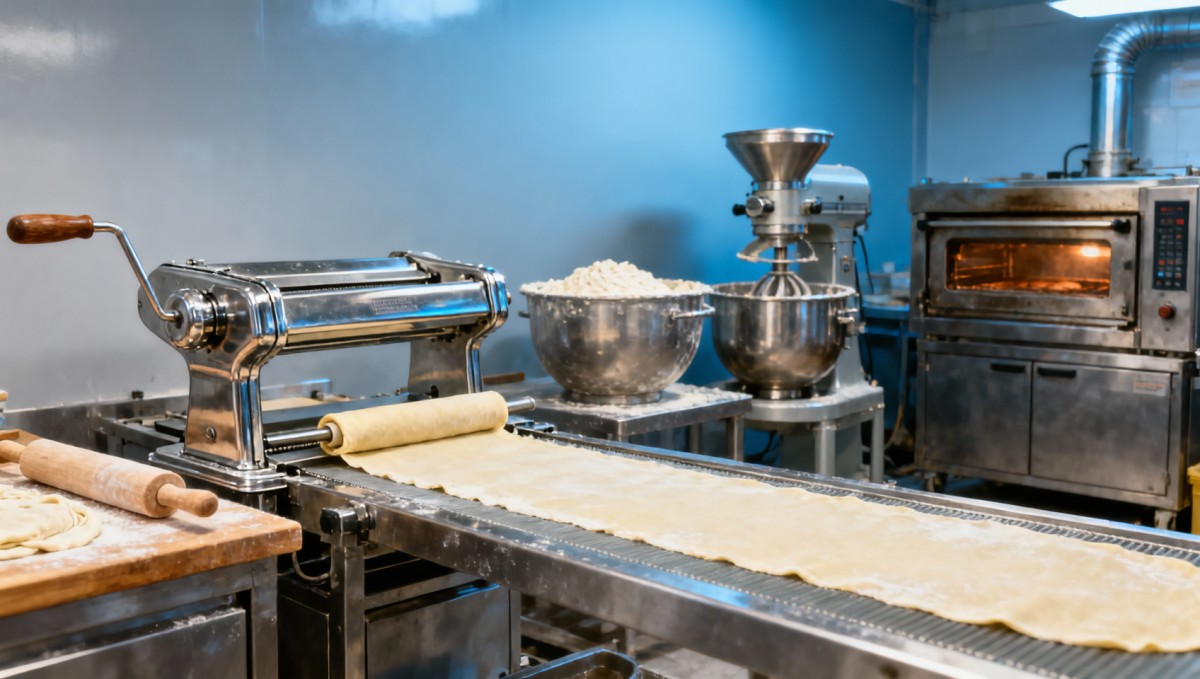
The first cost difference between a dough sheeter machine and manual rolling is visible at purchase. Manual rolling needs only basic tools such as rolling pins, worktables, and more labor time, while a commercial sheeter may require a larger capital outlay. However, the more important cost shift appears over 12 to 36 months, when labor hours, waste rate, output consistency, and training frequency begin to reshape the true cost per tray, per batch, or per unit.
Manual rolling often looks flexible in small kitchens producing limited volumes, especially below 30 kg of dough per day. Once output rises to 80 kg, 120 kg, or multiple product lines per shift, labor becomes a recurring expense rather than a manageable task. Rework from uneven thickness, slower bench time, and operator fatigue can quietly raise costs that are rarely listed in the original purchasing budget.
A dough sheeter machine shifts spending toward equipment ownership, preventive maintenance, and operator familiarization. In return, it can reduce rolling variability to a tighter tolerance range, often around predictable sheet thickness settings for pastries, pizza dough, laminated dough, or flatbread preparation. This supports better portion control, more consistent baking results, and smoother workflow between mixing, resting, sheeting, proofing, and baking stages.
The table below compares the main cost centers. It is useful for procurement teams that need to explain why the lowest initial cost is not always the lowest operating cost.
The key takeaway is that manual rolling usually concentrates cost in people and process variability, while a dough sheeter machine concentrates cost in equipment ownership and maintenance. For many B2B kitchens, the better option depends on daily volume, product mix, and how costly inconsistency is to the business model.
Why the shift matters in commercial kitchen planning
Commercial kitchens do not buy equipment in isolation. A sheeter affects how quickly a dough mixer machine can unload the next batch, how long product waits before proofing, and whether bakery oven machine capacity is fully used. In facilities running 2 shifts or more, even a 10 to 15 minute saving per batch can accumulate into meaningful daily capacity gains.
For enterprise buyers, this means equipment ROI should be measured not just by hourly output, but by line balance. A faster sheeter that reduces queue time between prep stations may create more value than a cheaper manual method that appears economical only on paper.
Labor, training, and operator impact
One of the biggest hidden costs in manual rolling is labor dependence. Skilled operators can produce excellent results, but consistency often varies between shifts, between employees, and even across the same day as fatigue increases. For bakeries handling puff pastry, croissants, pizza bases, or pie sheets, repeated manual rolling can become physically demanding after several hours, especially in hot production environments.
A dough sheeter machine changes the skill profile. Instead of depending mainly on hand technique, the operation relies more on correct feeding, thickness adjustment, sanitation routines, and safe handling. This can shorten onboarding for new staff. In many commercial settings, core operating familiarity can be built in 1 to 3 days, while advanced product-specific technique may take 1 to 2 weeks.
That does not mean machines eliminate training. Operators still need to understand dough temperature, rest time, flour dusting levels, and safe loading width. If dough is overmixed, too warm, or insufficiently rested, even a well-built machine will not solve product quality problems. The best results come when the dough sheeter machine is treated as one part of a controlled production system.
The list below shows where operator burden usually changes when moving from manual rolling to machine sheeting.
- Manual rolling requires stronger dependence on personal technique, wrist and shoulder endurance, and visual judgment of thickness.
- Machine sheeting requires safer workflow discipline, cleaning routines after each production cycle, and accurate setting control.
- Manual methods are easier to start but harder to standardize across 3, 5, or 10 operators.
- Machine methods need initial training but often make cross-shift performance more repeatable.
For procurement managers, this labor shift matters in regions with high turnover or rising wage pressure. A process that depends on 1 or 2 highly experienced staff members can create continuity risk. Equipment that reduces skill concentration may improve resilience, especially in central kitchens, chain bakeries, and food processing sites managing standardized menus.
Training cost is not only about hours
Training cost includes scrap during learning, temporary slowdowns, supervision time, and quality inspection. In manual operations, new staff may need repeated correction to keep dough thickness within a usable range. With a machine, early losses usually come from incorrect gap settings, uneven feeding, or missed cleaning steps. Both systems require training, but the training risk appears in different forms.
When manual rolling still makes sense
Manual rolling remains practical for low-volume shops, specialty artisan products, test kitchens, and menus with highly variable shapes. If production is below 20 to 30 portions per cycle and product changeovers are frequent, the simplicity of manual work can still be cost-effective, especially where space and power supply are limited.
Throughput, consistency, and product quality trade-offs
Production efficiency is not only about how fast dough becomes flat. It also includes how repeatably the target thickness is reached, how often dough tears, how much flour is used during processing, and how smoothly the product moves to the next station. In high-output kitchens, a dough sheeter machine often improves throughput because it reduces repeated hand adjustments and supports a more predictable sequence of passes.
Consistency is especially important when dough proceeds to cutting, filling, laminating, or baking. A thickness difference of even 1 mm to 2 mm can influence bake color, internal texture, fill balance, and finished weight. For standardized menu operations, this affects cost control as much as product appearance. Uneven dough sheets can also create irregular proofing and underused oven tray space.
The relationship with upstream equipment should also be considered. A planetary mixer machine may support smaller specialty batches, while a larger dough mixer machine can prepare more dough than manual rolling can process within the dough’s ideal working window. If rest time exceeds the target or if dough warms too much before sheeting, downstream quality can decline. That is where equipment synchronization becomes commercially important.
The comparison below helps illustrate how quality and output factors shift under common production conditions.
The practical conclusion is that the machine advantage increases as output standardization becomes more valuable. If the business sells premium handcrafted products in short runs, manual rolling may preserve flexibility. If the business depends on repeatable thickness across 100, 300, or 1,000 units, a dough sheeter machine usually shifts cost toward more controlled, scalable production.
Application scenarios by business type
- Retail bakery: machine sheeting supports daily pastry consistency and easier scheduling during morning peaks.
- Restaurant chain: standardized dough sheets improve menu uniformity across multiple sites.
- Food processor: machine-based flow better fits continuous or semi-continuous production with higher output targets.
- Artisan shop: manual rolling may remain viable for low-volume specialty lines with frequent recipe changes.
How buyers should evaluate total cost of ownership
A smart purchasing decision compares total cost of ownership rather than machine price alone. Buyers should estimate labor hours saved per day, expected maintenance intervals, cleaning time, waste reduction potential, and how the dough sheeter machine fits with existing kitchen equipment. A sheeter that is oversized for the site can add idle asset cost, while an undersized unit can force overtime and create production queues.
In practical terms, many procurement reviews use a 4-part framework: capacity, product compatibility, operating cost, and service support. Capacity should be matched to actual peak demand, not average demand alone. Product compatibility should include dough hydration, desired thickness range, and whether laminated or delicate doughs are part of the menu. Operating cost includes power use, labor effect, and consumables. Service support includes spare parts lead time and maintenance responsiveness.
For buyers comparing multiple options, a structured checklist helps prevent overbuying and underbuying. It also improves communication between production teams, finance teams, and business decision-makers.
This type of evaluation often reveals that the best choice is neither the cheapest manual setup nor the most advanced machine, but the option that fits production reality. A well-matched machine can offer a payback path through lower labor intensity, better batch control, and more reliable scheduling. A mismatched machine can become an underused asset.
Common procurement mistakes
- Buying based only on upfront quotation without estimating 12-month labor impact.
- Ignoring sanitation and cleaning time in a busy multi-product kitchen.
- Assuming all dough types behave the same under sheeting pressure.
- Failing to confirm service response expectations before purchase.
Implementation, maintenance, and decision guidance
Once the decision is made, implementation quality determines whether expected savings actually appear. A dough sheeter machine should be introduced with a short validation process: confirm dough recipe suitability, test thickness settings, measure cycle time, verify cleaning access, and train operators on safe use. This can often be completed in 3 to 5 steps over several production runs, rather than relying on a single trial batch.
Maintenance planning is equally important. Preventive checks on belts, rollers, guards, and adjustment systems should be scheduled according to usage intensity. A site operating 6 days per week will need more frequent inspection than a low-volume operation using the machine only during weekly production peaks. Daily cleaning and weekly inspection routines help protect hygiene and maintain rolling accuracy.
Manual rolling also has maintenance implications, though they are less obvious. Worktables must stay sanitary and flat, tools wear over time, and production quality depends on operator condition. If repeated manual work leads to slower output, inconsistent yield, or staff turnover, those operational issues function as hidden maintenance costs within the labor system.
For decision-makers, the simplest rule is this: if your business values standardization, output stability, and scalable labor use, a dough sheeter machine usually shifts cost in a productive direction. If your business depends on highly customized, low-volume production with limited floor space, manual rolling may still be the more rational process. The right choice should align with current demand and the next 12 to 24 months of growth, not only today’s budget.
Quick decision checklist
- Measure actual daily dough volume and peak-hour pressure before comparing options.
- Review product range, especially whether laminated or delicate doughs require tighter control.
- Map the process from dough mixer machine to baking to identify hidden bottlenecks.
- Calculate labor, waste, training, and service cost over at least 12 months.
- Confirm operator training, spare parts supply, and cleaning practicality before final approval.
FAQ: Is a dough sheeter always better for commercial use?
Not always. It is usually better when production is repeated, volume is medium to high, and consistency affects yield or brand standards. It is less decisive in very small operations, pilot kitchens, or artisan environments where product variety changes daily and manual flexibility remains valuable.
FAQ: How soon can cost advantages appear?
That depends on volume, labor rates, and waste reduction. In busy bakeries or food processing lines, benefits may become visible within the first few months through lower manual effort and smoother production flow. In lower-volume sites, the return period is usually longer and should be reviewed against actual demand growth.
Choosing between a dough sheeter machine and manual rolling is really a decision about where your operation will carry cost: in labor, training, and variation, or in equipment ownership, maintenance, and controlled throughput. When evaluated together with a dough mixer machine, planetary mixer machine, and bakery oven machine, the decision becomes part of a complete kitchen equipment strategy rather than a single-tool purchase.
If you are comparing equipment for a bakery, restaurant, central kitchen, or food processing facility, now is the right time to review your workflow, output targets, and cost structure in detail. Contact us to get a tailored solution, discuss product specifications, or learn more about kitchen preparation equipment that fits your production goals.
Popular Tags
Kitchen Industry Research Team
Dedicated to analyzing emerging trends and technological shifts in the global hospitality and foodservice infrastructure sector.
Industry Insights
Join 15,000+ industry professionals. Get the latest market trends and tech news delivered weekly.
No spam. Unsubscribe anytime.

Contact With us
Contact:
Anne Yin (Ceramics Dinnerware/Glassware)
Lucky Zhai(Flatware)