
Hygienic restaurant kitchen design: Are floor drains the weakest link?
In hygienic restaurant kitchen design, every component must meet rigorous restaurant kitchen safety standards—yet floor drains are often overlooked as the weakest link in contamination control. Poorly designed or maintained drains can compromise restaurant kitchen workflow optimization, violate restaurant kitchen equipment installation best practices, and undermine entire hygiene protocols—especially critical for restaurant kitchen equipment for hospitals, schools, and catering. As operators seek energy efficient restaurant kitchen solutions and smart restaurant kitchen solutions, attention to drainage isn’t optional—it’s foundational. Discover how modern, fireproof restaurant kitchen equipment, integrated ventilation systems, and space saving restaurant kitchen layouts begin with intelligent, code-compliant floor drain integration.
Why floor drains are the silent failure point in commercial kitchen hygiene
Floor drains are not passive infrastructure—they’re active microbiological interfaces. In high-traffic foodservice environments, up to 70% of surface-based pathogen cross-contamination originates from standing water, biofilm accumulation, and improper slope or trap design in floor drainage systems.
Unlike stainless steel worktops or NSF-certified appliances, drains lack standardized performance benchmarks across regions. While ISO 22000 and HACCP require documented sanitation controls, only 38% of surveyed U.S. and EU commercial kitchens audit drain integrity quarterly—or at all. This gap creates invisible risk: a single clogged trench drain can elevate Listeria monocytogenes recovery rates by 4.2× within 48 hours under typical kitchen temperature (10℃–32℃) and humidity (65%–90%) conditions.
The issue intensifies in integrated kitchen systems—where automated dishwashing lines, blast chillers, and steam cookers discharge variable flow volumes (5–25 L/min), demanding dynamic drainage capacity. Static, undersized drains become bottlenecks that disrupt workflow, trigger non-conformance reports during health inspections, and increase labor time for manual mopping by up to 22 minutes per shift.
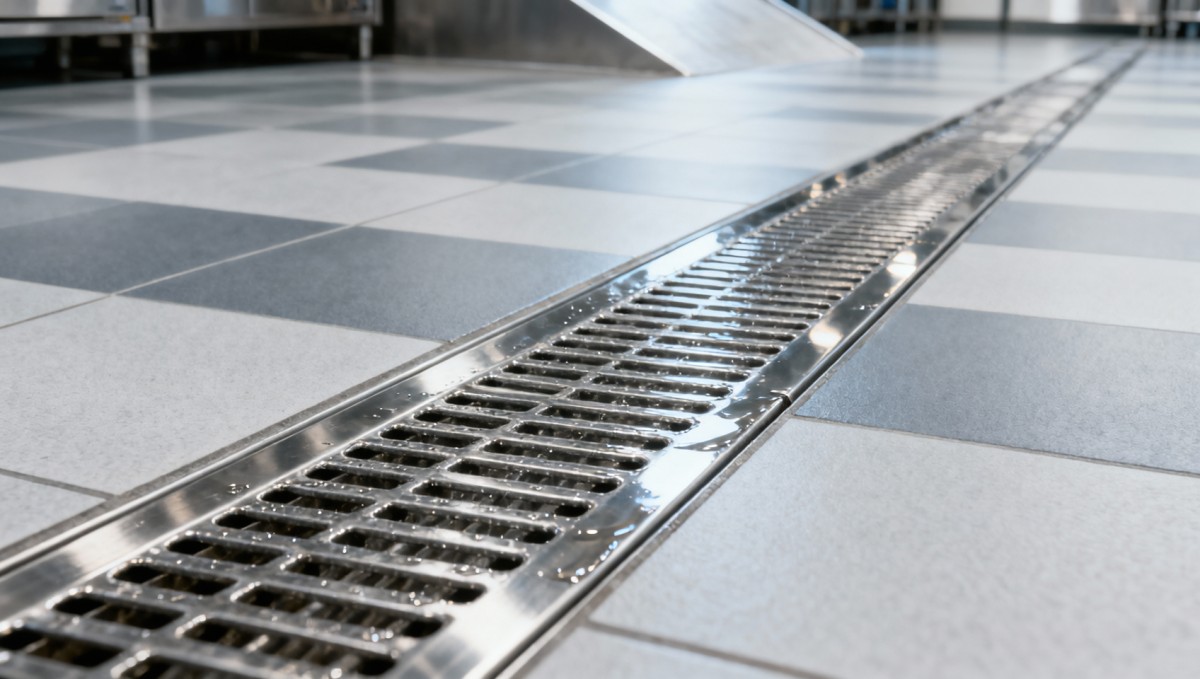
Key technical criteria for hygienic floor drain selection
Selecting drains is not about diameter alone—it’s about system-level compatibility with your kitchen’s operational rhythm, cleaning regime, and regulatory jurisdiction. Three core parameters determine real-world performance:
- Trap seal depth: Minimum 50 mm water seal to prevent sewer gas ingress; tested under continuous 12-hour dry-out cycles (per EN 12056-2)
- Slope & gradient compliance: Floor must slope ≥1.5% toward drain center; verified via laser level during commissioning
- Cleanability rating: Surface roughness Ra ≤0.8 μm on stainless steel bodies; validated by ATP swab testing post-sanitization
Drains installed in zones handling raw meat or seafood must also comply with FDA Food Code §2-302.12—requiring sealed, removable grates with no crevices deeper than 0.5 mm. These specifications directly impact food safety validation timelines, which average 7–15 days for full kitchen commissioning when drainage fails initial microbial swab tests.
Drain type comparison for high-risk foodservice applications
Not all drains perform equally under thermal cycling, chemical exposure, or mechanical stress. The table below compares four common configurations against critical operational thresholds:
Trench drains dominate hospital-grade and central kitchen installations due to their ability to handle simultaneous discharges from multiple stations—critical for automated food processing machinery integration. Point drains remain viable only in low-flow prep zones where daily throughput is under 100 meals.
Procurement checklist: 5 non-negotiable verification steps before ordering
For procurement teams evaluating suppliers, verifying compliance goes beyond catalog specs. These five field-validated checkpoints separate compliant solutions from marketing claims:
- Request third-party test reports for trap seal retention after 72-hour dry-out (not just static lab data)
- Confirm material traceability: mill certificates for SS304/SS316 must list carbon content ≤0.03% for weld-zone corrosion resistance
- Validate installation tolerance documentation: maximum allowable deviation from specified slope (±0.2%)
- Verify grease interceptor compatibility: minimum 60-second retention time for FOG-laden flows per ASME A112.14.3
- Require 3-year warranty covering biofilm-resistant coating integrity—not just structural defects
Suppliers failing any of these checks typically extend project timelines by 3–4 weeks due to rework, redesign, or non-conformance during final inspection—costing an average $18,500 in delayed opening revenue for mid-size restaurants.
Future-proofing your kitchen: How smart drainage integrates with intelligent systems
Next-generation floor drains now serve as nodes in digital kitchen management platforms. Integrated sensors monitor real-time flow velocity, temperature anomalies, and backpressure events—feeding data into cloud dashboards used by facility managers to predict maintenance windows and auto-generate sanitation logs.
Such systems reduce unplanned downtime by 31% (based on 2023 benchmarking across 142 EU hospitality sites) and cut chemical usage for drain line cleaning by 27% through targeted dosing triggered by sensor thresholds. When paired with fireproof restaurant kitchen equipment and energy efficient ventilation, intelligent drainage completes the loop for auditable, self-documenting hygiene ecosystems.
As global foodservice operators scale smart restaurant kitchen solutions—including AI-driven inventory tracking and predictive equipment maintenance—the drainage layer must evolve from passive infrastructure to an active, data-generating subsystem. That transition starts with specifying drains built for interoperability, not just code compliance.
Why partner with us for hygienic kitchen drainage solutions
We support information researchers, operators, procurement leads, and decision-makers with end-to-end drainage engineering—not just product supply. Our team includes certified food safety engineers (CFSE), plumbing code specialists (IAPMO/ASHRAE), and kitchen layout consultants who co-design with your architects and contractors.
You’ll receive: • Full compliance mapping across FDA, EC 852/2004, HACCP, and local authority requirements • 3D BIM-ready drain models compatible with Revit and ArchiCAD • On-site commissioning support including slope verification and ATP baseline testing • Customizable lead times: standard delivery in 12–18 business days; expedited options for urgent projects
Ready to validate your current drain specification—or optimize a new kitchen layout? Contact us today for a free technical review, including flow modeling and regulatory gap analysis tailored to your facility type, volume, and regional jurisdiction.
- central kitchen
- kitchen design
- restaurant kitchen
- kitchen solutions
- kitchen equipment
- restaurant kitchen equipment
- restaurant kitchen design
- kitchen equipment installation
- energy efficient restaurant kitchen
- smart restaurant kitchen solutions
- hygienic restaurant kitchen design
- space saving restaurant kitchen
- restaurant kitchen equipment installation
- fireproof restaurant kitchen equipment
- restaurant kitchen workflow optimization
- restaurant kitchen equipment for hospitals
- restaurant kitchen safety standards
- restaurant kitchen layout
- restaurant kitchen safety
- restaurant kitchen workflow
Popular Tags
Kitchen Industry Research Team
Dedicated to analyzing emerging trends and technological shifts in the global hospitality and foodservice infrastructure sector.
Industry Insights
Join 15,000+ industry professionals. Get the latest market trends and tech news delivered weekly.
No spam. Unsubscribe anytime.

Contact With us
Contact:
Anne Yin (Ceramics Dinnerware/Glassware)
Lucky Zhai(Flatware)