
How Long Does Central Kitchen Equipment Integration Take? Key Project Milestones
Central kitchen equipment integration should be planned over several months when the scope includes design coordination, equipment procurement, site preparation, installation, and commissioning. A shorter window measured in weeks is credible only when equipment is available, the building is ready, utilities are proven, and automation changes are limited. Custom fabrication, imported equipment, major building work, or connected production lines extend the schedule beyond the physical installation period.
To answer “how long does central kitchen equipment integration typically take?” use two separate dates: the start of coordinated design and the release for routine production. Measuring only from equipment arrival hides procurement and construction dependencies. Measuring completion at first power-on leaves production testing, sanitation verification, training, and acceptance outside the plan.
A workable opening date comes from confirmed delivery commitments and clear milestone acceptance criteria. Until those exist, a duration estimate remains a planning allowance rather than a dependable completion forecast.
Set the schedule boundary before estimating duration
“Integration” can describe anything from connecting standalone appliances to coordinating cooking, chilling, conveying, packaging, and production software. These scopes require different schedules. Establish whether the work includes extraction, refrigeration plant, drainage alterations, electrical distribution, fire protection interfaces, and production data exchange. An excluded package still affects completion if the kitchen depends on it.
Define the required production condition as well. Producing one successful batch demonstrates less than completing a representative production shift with cleaning, product changeovers, traceability, and recovery from routine stoppages. Acceptance conditions determine how much testing belongs between installation and operational release.
These are scheduling categories, not supplier lead-time commitments. Replace them with equipment-specific dates and verified site dependencies before fixing an opening date.
The milestones that determine the completion date
1. Process and layout approval
The first release point is a coordinated production layout. It should establish the menu or product range, batch sizes, required output, movement of ingredients and finished food, and separation between raw and ready-to-eat activities. Equipment selected before these decisions settle is exposed to resizing, relocation, or replacement.
Space reservations must include door swings, maintenance access, cleaning clearances, trolley movement, and removal routes for major components. A machine that fits its footprint can still be impossible to service or position. Confirm the delivery route against the largest shipping section, including lifts, turning space, floor loading, and temporary openings.
This milestone closes when equipment positions and connection requirements are coordinated with the building design. Late changes to kettle discharge positions or conveyor heights can force drainage, platform, and fabrication revisions together.
2. Procurement release and interface confirmation
A purchase order does not necessarily start fabrication. Suppliers may require approved drawings, selected options, confirmed utility characteristics, or other contractual release conditions. Record the actual release-to-manufacture date separately from the order date.
Request lead times for the configured equipment, including controls and accessories. A standard appliance with an unusual electrical configuration or custom discharge arrangement can follow a different delivery path from the catalogue model. Distinguish factory completion, readiness for dispatch, site arrival, and availability for installation.
For connected systems, settle responsibility for each interface before manufacture: mechanical transfer points, start and stop signals, emergency-stop behaviour, data fields, and recovery after a fault. Equipment packages can each function independently while the combined line remains unable to run.
3. Site readiness and utility verification
Delivery should follow a defined readiness review. Floors, drainage, access routes, foundations where required, and equipment supports must be suitable for the planned installation sequence. Unfinished overhead work can prevent equipment positioning or expose installed equipment to contamination and damage.
Utility readiness requires more evidence than a connection point on a drawing. Confirm electrical capacity under expected simultaneous demand, water pressure and flow at the equipment, hot-water availability, gas supply where applicable, and the required drainage arrangement. Steam equipment also needs coordinated condensate handling.
Ventilation creates a frequent dependency: extraction, replacement air, and room pressure relationships must work together under operating conditions. An appliance test with inadequate ventilation does not establish readiness for a production shift. Identify which tests require the building systems to be fully operational.
4. Delivery, positioning, and connection
Installation duration follows the physical sequence. Large vessels, cold-room panels, or conveyor sections may need positioning before smaller appliances close access routes. Equipment that requires lifting or specialist alignment should arrive against a coordinated access plan.
After positioning, allow for levelling, anchoring where specified, service connections, insulation, guards, and inspection before energisation. Packaging removal and damage inspection belong in this stage, with a process for resolving missing parts. A missing sensor or mounting bracket can block commissioning even when the main equipment has arrived.
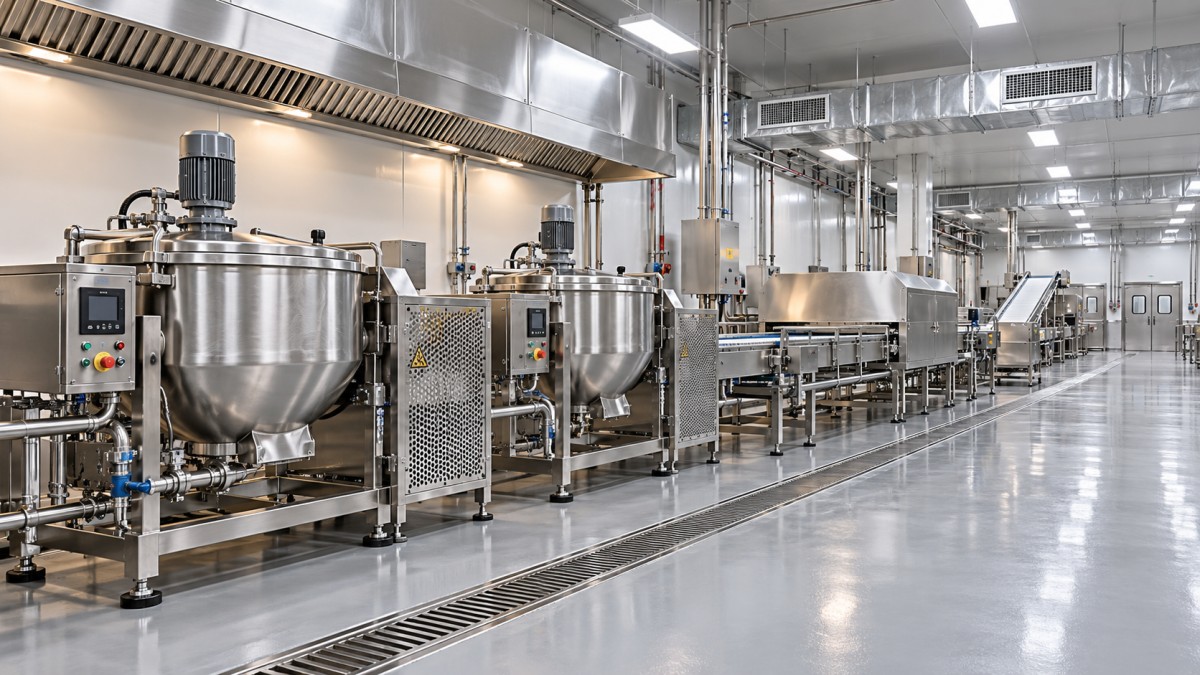
5. Commissioning and integrated production trials
Commissioning begins with safe startup and individual equipment checks, then progresses to coordinated operation. Verify rotation, instrumentation, protective functions, alarms, and control responses before introducing representative production loads.
The integrated trial must expose interactions. A cooking vessel might achieve its specified batch performance while downstream chilling cannot accept the discharge pattern. Packaging equipment might handle individual items correctly but struggle when upstream output arrives unevenly. Testing the complete flow reveals these mismatches.
Use representative products, loads, containers, and starting conditions. Water trials are useful for initial checks, but they do not reproduce the viscosity, solids content, heat transfer, or handling characteristics of every food. Agree in advance which performance claims require product trials and how results will be recorded.
6. Operational release and handover
Handover requires an agreed operating condition supported by completed records. This includes approved settings, equipment documentation, maintenance requirements, training, and access to the information needed to troubleshoot faults. Outstanding defects should have an owner, a completion date, and an explicit assessment of their effect on production.
Where food safety depends on a heating, cooling, or holding process, release requires evidence that the intended process works under defined conditions. Equipment commissioning alone does not establish that every recipe, load pattern, or production method is suitable.
Build the programme around dependencies, not added durations
Adding every package duration produces a misleading total because some activities overlap. Building preparation can progress during equipment manufacture once the required information is stable. Other activities remain sequential: a production trial cannot establish sustained output before utilities and downstream equipment are available.
The critical path is the chain of dependent activities that currently controls completion. It may run through a custom cooking line, an electrical supply upgrade, ventilation completion, or access to a shutdown window. The most expensive machine is not automatically the schedule driver.
Use a dependency schedule with an owner and release condition for each controlling milestone. “Services complete” is too broad to manage. “Power available, inspected, and ready for energisation at the designated connection” gives the next activity a usable starting condition.
Include separately identified allowances for delivery uncertainty, defect correction, and repeat trials. Do not treat every allowance as interchangeable. Extra time before equipment arrival will not help if the only available production trial slot occurs before refrigeration commissioning is complete.
Where apparent progress hides unfinished integration
Equipment delivered: Delivery confirms location, not installation readiness. Equipment in storage may still require assembly, lifting, factory attendance, or additional components. Track whether each item is ready for its next activity.
Utilities connected: A connection can pass an initial inspection while failing under concurrent load. Assess the planned operating combination, including cooking, washing, refrigeration, and extraction. Symptoms such as slow heat-up or unstable water supply need investigation before equipment performance is judged.
Automation communicating: Successful data exchange proves only part of an interface. Test interrupted communications, rejected products, downstream stoppages, and restart behaviour. Otherwise, a line can pass a demonstration and still require manual intervention during ordinary disruptions.
Production target reached: A brief peak rate is different from sustainable output. Include loading, unloading, cleaning interruptions, replenishment, and changeovers in the agreed test boundary. This prevents acceptance discussions from relying on incompatible definitions of capacity.
Shorten the timeline at the points that matter
The strongest opportunity to save time often comes before equipment reaches site. Freeze information that controls fabrication and building services early, while keeping genuinely independent details open. A staged design release works only when later decisions cannot invalidate released work.
For complex equipment, factory acceptance testing can resolve control sequences, mechanical operation, and documentation issues before shipment. Its value depends on a defined test scope and recorded defect closure. Site tests still need to address installed utilities, surrounding equipment, and actual production conditions.
Phased commissioning is useful when zones have independent utilities, safe access, and clear separation from construction. It becomes ineffective when every zone relies on the same unfinished refrigeration plant, ventilation system, or control network. Assess shared dependencies before assuming that partial installation creates an earlier production date.
Protect commissioning access in the programme. Repeatedly borrowing that period to absorb construction delays leaves unresolved integration work immediately before launch. Where the opening date remains fixed, reducing the initial production scope is a concrete option: fewer recipes, a limited line configuration, or a smaller operating schedule, provided the released scope has been tested and is safe.
The final release decision should refer to evidence: completed representative trials, acceptable process results, functioning safety controls, and defects resolved or formally assessed. The remaining interval to opening then covers preparation for the agreed operating scope, with any unfinished work visible and assigned.
Popular Tags
Kitchen Industry Research Team
Dedicated to analyzing emerging trends and technological shifts in the global hospitality and foodservice infrastructure sector.
Industry Insights
Join 15,000+ industry professionals. Get the latest market trends and tech news delivered weekly.
No spam. Unsubscribe anytime.
Hot Articles
 How Long Does Central Kitchen Equipment Integration Take? Key Project Milestones
 Midera Food Processing Acquires Phoenix Innovations to Expand Poultry Equipment Business
- Essential Baking Equipment for a Home Kitchen and What Each Tool Does
- Macau Firm Introduces Smart Cooking Equipment to Free Up Kitchen Space


Contact With us
Contact:
Anne Yin (Ceramics Dinnerware/Glassware)
Lucky Zhai(Flatware)