
How to Choose a Glass Juice Dispenser for Buffets, Cafes, and Breakfast Service
Choosing a glass juice dispenser for buffet lines, café counters, or breakfast stations looks simple at first glance. In practice, the right choice affects speed, cleanliness, visual appeal, and how smoothly service runs during busy periods.
That matters even more in today’s kitchen equipment market, where foodservice operations are expected to balance hygiene, efficiency, energy awareness, and consistent guest experience. A well-matched dispenser is a small piece of equipment, but it supports those larger goals every day.
Why this equipment deserves closer attention
A glass juice dispenser does more than hold beverages. It becomes part of the service system, especially where self-service or high-turnover breakfast traffic is common.
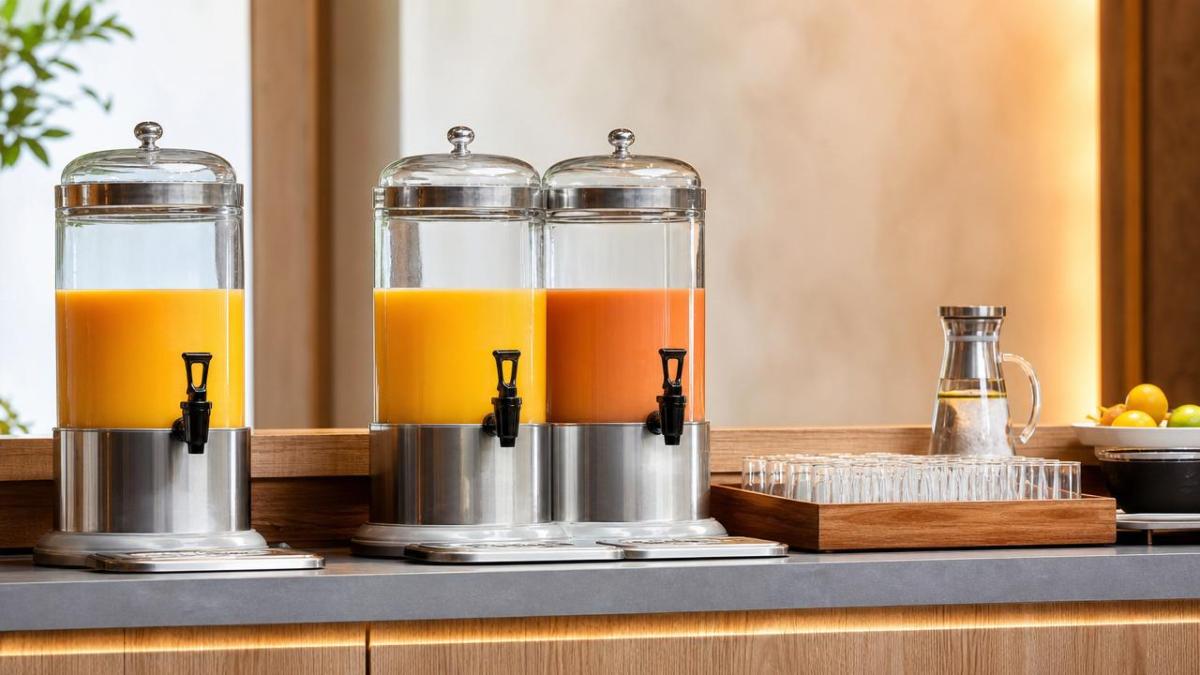
In buffets, it helps reduce repeated refilling and keeps the beverage area organized. In cafés, it can support product presentation. In hotel breakfast service, it shapes the first visual impression of freshness and order.
The wider kitchen equipment industry is moving toward smarter, cleaner, and more efficient operations. Even traditional serving tools are now judged by practical standards such as easier sanitation, better material performance, and lower service disruption.
That is why choosing a glass juice dispenser should not be based on appearance alone. Capacity, structure, and maintenance demands often matter more than decorative styling.
What a good glass juice dispenser should actually do
The best model is not always the largest or most expensive one. It is the unit that fits the service pattern without creating extra work.
A useful glass juice dispenser should pour cleanly, stay stable during use, preserve beverage temperature for a reasonable period, and allow fast cleaning between service cycles.
Transparent glass remains popular because it presents juice clearly. Guests can see color, pulp level, and fill volume. That visual trust is valuable in open-service environments.
At the same time, glass introduces practical questions. Weight, breakage risk, and handling requirements become more important in operations with frequent movement or limited staff time.
Capacity should match service rhythm
Capacity is often the first filter. A dispenser that is too small creates constant refilling. One that is too large may waste product, occupy too much counter space, or leave juice sitting too long.
For breakfast areas with sharp peak periods, medium-to-large capacity usually works better. For cafés offering a limited fresh beverage selection, smaller dispensers may keep the setup more flexible.
Simple volume planning helps avoid guesswork.
Usually, it is better to estimate demand by service window rather than total daily volume. That gives a more realistic picture of refill pressure.
Material quality is about safety, not only appearance
Not all glass is equal. Thick, food-safe glass with good impact resistance is better suited to commercial service. Thin decorative glass may look elegant, but it can become a weakness in daily operation.
The frame, lid, faucet, and base also deserve attention. Stainless steel parts are common because they support hygiene and resist corrosion. Plastic fittings may reduce cost, but they can wear faster under repeated use.
A glass juice dispenser should feel balanced when full. If the base is too light, the unit may wobble during self-service. That becomes a real risk around crowded beverage stations.
In the broader kitchen equipment industry, durability is increasingly linked to lifecycle value. A unit that lasts longer and needs fewer replacements often becomes the more economical choice.
Hygiene and cleaning often decide long-term value
This is where many purchasing decisions succeed or fail. A stylish glass juice dispenser loses value quickly if it is difficult to empty, hard to disassemble, or prone to residue buildup around the tap.
Smooth inner surfaces, removable components, and accessible spigots make daily cleaning faster. That supports food safety and reduces labor pressure during setup and closing tasks.
Cold beverages containing pulp, sugar, or dairy alternatives need even closer attention. These liquids can leave deposits in valves and narrow openings if the design is not maintenance-friendly.
- Check whether the faucet can be removed without tools.
- Look for wide openings that allow full interior access.
- Confirm whether drip trays are easy to empty and wash.
- Review how many parts need handling during cleaning.
In practical use, saving five minutes on each cleaning cycle can matter more than a minor difference in purchase price.
Cooling method and beverage quality need a realistic view
Many operators focus on visual design, then later notice that juice warms too quickly. Temperature control deserves attention, especially in long breakfast service or warm indoor conditions.
Some glass juice dispenser models use an ice core or central cooling tube. This helps keep beverages cool without direct ice dilution. That approach is useful for orange juice, infused water, and similar drinks.
Still, passive cooling has limits. It can support freshness for a service period, but it is not a substitute for proper cold storage before filling the unit.
Where beverage quality is closely tied to freshness, it is worth checking how long the dispenser can maintain an acceptable serving temperature under real traffic conditions.
Design should support the counter, not dominate it
Presentation matters, especially in cafés and hotel breakfast spaces where food display contributes to perceived quality. A glass juice dispenser often works best when it complements the line rather than trying to become the centerpiece.
Height clearance is important. Glasses must fit under the tap comfortably. If guests need to tilt cups awkwardly, spills increase and service slows down.
The footprint matters too. A narrow counter may benefit from vertical designs. Wider buffet tables can support paired dispensers for different juices without crowding nearby items.
From an operational angle, good design means easier movement around the station, cleaner lines of sight, and fewer bottlenecks when several guests serve themselves at once.
Single, double, or multiple tanks
Single-tank units suit simple menus and tighter spaces. Double dispensers support choice without doubling the footprint. Multi-tank setups work best when beverage variety is part of the service offer.
The right format depends less on style preference and more on menu strategy, refill workflow, and available counter length.
A practical checklist before deciding
A useful buying decision usually comes from comparing several operational details together. Looking at one feature in isolation rarely gives the full answer.
- Match capacity to peak service periods, not average daily consumption.
- Check glass thickness and overall stability when the unit is full.
- Test faucet flow for speed, drip control, and ease of cleaning.
- Review assembly time for setup, refill, and end-of-day washing.
- Measure counter depth, glass clearance, and staff working space.
- Consider whether an ice core is useful for the actual service duration.
- Compare replacement part availability if the unit is for daily use.
This kind of checklist reflects a broader shift in kitchen equipment selection. Buyers increasingly look beyond purchase cost and focus on workflow fit, maintenance effort, and service consistency.
Choosing with the next few years in mind
The kitchen equipment sector is moving toward integrated, efficient, and easier-to-manage operations. Even simple serving equipment is now expected to support cleaner routines and better resource use.
A glass juice dispenser may not be a smart device, yet it still fits into that larger trend. Better design reduces waste, limits unnecessary replacement, and helps keep beverage service consistent without added complexity.
When comparing options, it helps to think beyond the display table. Consider how the dispenser will be filled, moved, washed, stored, and used during the busiest hour, not the quietest one.
That approach usually leads to a more reliable choice. Start with the service setting, measure the daily demands, and compare each glass juice dispenser against real operating conditions. A short evaluation now can prevent many small problems later.
Popular Tags
Kitchen Industry Research Team
Dedicated to analyzing emerging trends and technological shifts in the global hospitality and foodservice infrastructure sector.
Industry Insights
Join 15,000+ industry professionals. Get the latest market trends and tech news delivered weekly.
No spam. Unsubscribe anytime.

Contact With us
Contact:
Anne Yin (Ceramics Dinnerware/Glassware)
Lucky Zhai(Flatware)