
How Do You Troubleshoot Uneven Temperatures in Commercial Ovens?
A commercial oven can look perfectly normal during a busy shift and still create a frustrating pattern: trays near the door are pale, products at the back are overbaked, one rack cooks quickly while another lags behind. For a restaurant, bakery, hotel kitchen, or food-production operation, that inconsistency is more than an inconvenience. It affects portion appearance, food safety, ticket times, energy use, and the confidence of the team working the line.
Knowing how to troubleshoot inconsistent cooking temperatures in commercial ovens starts with separating a true temperature-control problem from issues caused by loading, airflow, cookware, or cooking procedures. The oven may be producing enough heat overall, but delivering it unevenly. A systematic check prevents operators from replacing parts too early—and helps identify when a qualified service technician is needed.
Start by Defining What “Uneven” Looks Like
Before opening a service panel or adjusting a thermostat, record the symptoms. “The oven runs hot” is useful, but it does not point to a single cause. A better observation might be: “The top-left pan burns while the center rack is underdone,” or “The right side is 25 minutes behind the left side on identical sheet pans.”
Look for patterns across several cooking cycles. Is the issue present at every temperature setting? Does it happen only in convection mode? Is it worse with a fully loaded oven? Does the problem begin after preheating, or only after the door has been opened repeatedly during service?
These details help narrow the source:
- One area consistently hotter or cooler: often related to airflow, a fan, a blocked vent, a damaged baffle, or a heating zone.
- The whole cavity too hot or too cool: may indicate calibration, a sensor, thermostat, controller, or heating-system issue.
- Temperature swings during a cycle: can point to a faulty probe, relay, contactor, gas-control component, or door seal.
- Uneven results only with certain products: may be caused by pan type, rack placement, product loading, or moisture release rather than the oven itself.
A short log of set temperature, actual readings, rack positions, load size, and visible results gives maintenance staff much better information than a general complaint.
Verify the Temperature Before Assuming the Oven Has Failed
The display on a commercial oven is not always the same as the air temperature at every point in the cavity. It reflects the oven’s sensor location and control logic. In a convection oven, for example, the controller may cycle heat intentionally while the fan distributes air through the chamber. A brief variation is normal; a persistent hot spot or major difference between rack positions is not.
Use a reliable oven thermometer, thermocouple, or calibrated temperature data logger designed for commercial-kitchen use. Avoid relying on a low-cost household dial thermometer as the only diagnostic tool. Place measurement points in several positions: center, front, rear, upper rack, and lower rack. Let the oven fully preheat and stabilize before recording readings.
For meaningful results, test the oven empty first. Then repeat the test with a typical load if needed. An empty cavity can reveal a mechanical or control issue, while a loaded test may expose airflow restrictions that appear only during production.
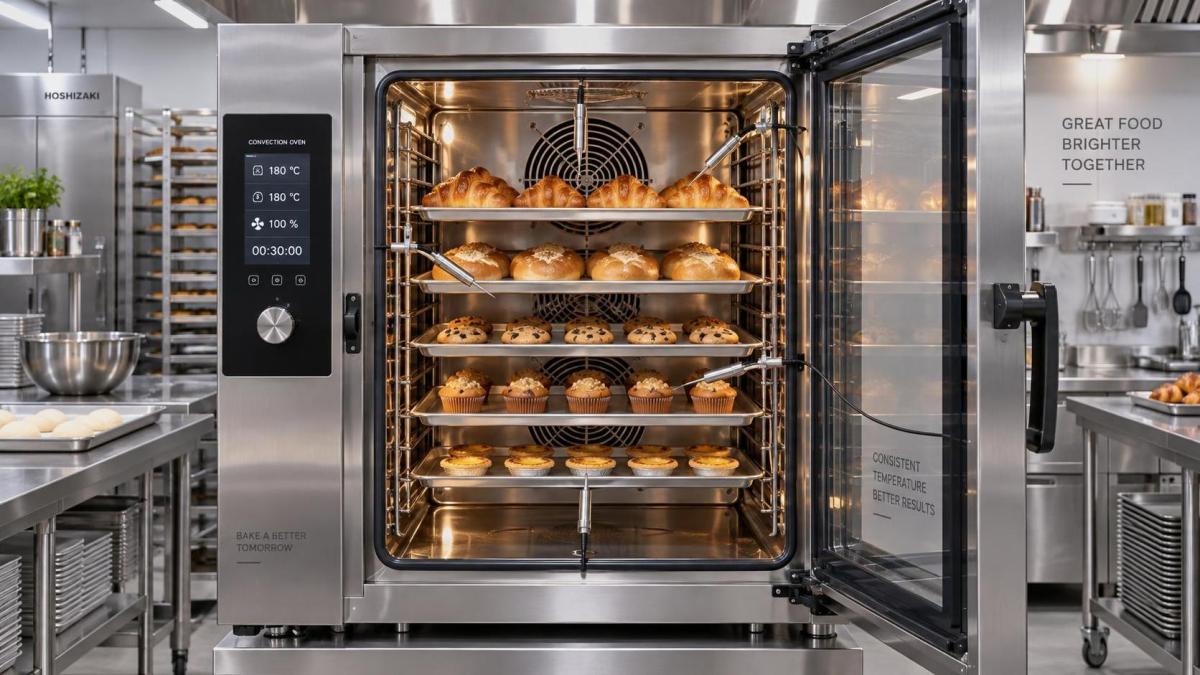
Do not judge performance by a single opening of the door. Every door opening releases heat, and recovery time differs by oven type, fuel source, insulation condition, and load. Instead, compare readings over a complete cycle after the cavity has had time to recover.
A Practical Inspection Sequence for Commercial Ovens
Once the temperature pattern has been confirmed, work from simple operational causes toward technical components. This approach is safer, faster, and less expensive than immediately changing sensors or control boards.
1. Check loading practices and rack spacing
Commercial ovens need room for heat to move. Sheet pans pushed tightly together, covered hotel pans stacked without clearance, oversized roasting pans, or products placed directly in front of air outlets can create apparent temperature problems. In convection ovens, blocked airflow is especially common. The fan may be operating, but the air cannot circulate around the food evenly.
Use the same pan material and size when testing. Dark pans absorb and radiate heat differently from shiny aluminum pans, while warped pans can sit unevenly and distort results. Dense food loads also absorb heat faster than light loads, so a cavity that performs well with pastries may behave differently when packed with cold prepared meals.
Leave space between pans, avoid covering circulation openings, and use the rack positions recommended by the oven manufacturer. If rotating pans solves the issue temporarily, that is a clue—not necessarily a complete solution. Frequent rotation may be normal for certain products, but it should not be required to compensate for severe hot and cold zones.
2. Inspect the door, gasket, and latch
A worn door gasket allows hot air to escape and pulls cooler kitchen air into the cavity. This can create uneven cooking near the door side and force the heating system to cycle more aggressively. On busy lines, a door that does not close firmly can also increase recovery time enough to disrupt batch consistency.
Inspect the gasket for cracks, flattening, hard spots, loose sections, grease buildup, or gaps at the corners. Check whether the door is aligned and whether the latch pulls it securely against the frame. Clean residue from contact surfaces, but do not use sharp tools that could damage the gasket.
If steam, heat, or smoke visibly escapes from a closed door during normal operation, schedule service. Replacing a gasket is often a relatively straightforward maintenance task, but an underlying hinge or alignment problem should also be corrected.
3. Examine airflow components in convection and combi ovens
For convection, combi, and many high-performance commercial baking ovens, air movement is central to temperature uniformity. A fan that is noisy, slow, intermittent, or turning in only one direction can produce dramatically uneven results. Grease accumulation, food debris, damaged fan blades, or a loose baffle can also disrupt the intended air path.
With power safely isolated according to the manufacturer’s instructions, inspect accessible fan covers and baffles for blockage or damage. During operation, listen for unusual scraping, rattling, or cycling noises. Some units have reversible fans or programmed fan-speed settings; verify that the selected cooking mode matches the product being prepared.
Do not reach into a fan area while the oven is energized or attempt to bypass safety switches. If the fan motor, capacitor, wiring, or control circuit is suspected, a trained technician should perform the electrical diagnosis.
4. Look at heating elements, burners, and heat distribution
Electric ovens may use separate elements for baking, broiling, and convection heat. A partially failed element can still warm the oven enough to seem functional while leaving one section underheated. Signs include visible blistering, cracks, uneven glowing, repeated tripping, or unusually long preheat times.
Gas ovens require a different level of caution. Uneven burner flames, delayed ignition, burner ports blocked by grease or debris, weak flame carryover, or irregular heat exchanger performance can all affect cavity temperature. A healthy burner flame is generally stable and consistent; irregular flame behavior should be treated as a service concern, not a cleaning experiment during a shift.
If you smell gas, hear persistent ignition clicking, see flame rollout, or suspect a combustion issue, stop using the appliance, follow site safety procedures, and contact an authorized gas-service professional. Do not attempt to adjust gas valves or combustion settings without proper training and equipment.
Calibration Is Important, but It Is Not the Answer to Every Problem
Oven calibration adjusts the relationship between the displayed setpoint and the actual temperature measured at the sensor. It can correct a consistent offset—for example, when an oven set to 350°F repeatedly stabilizes closer to 325°F. Calibration will not fix a failed fan, an air leak, a blocked vent, or a heating element that is cycling incorrectly.
Before calibrating, confirm that the test instrument is accurate and that the oven is clean, empty, fully preheated, and operated under normal utility conditions. Follow the manufacturer’s procedure, since control interfaces differ widely. Some modern digital ovens allow a programmed offset; others require a technician menu, software access, or physical thermostat adjustment.
A useful rule is this: if the entire cavity is consistently offset by a similar amount, calibration may help. If readings vary widely from front to back or rack to rack, investigate airflow and heat distribution first.
When Sensors, Thermostats, and Controls Become Suspects
If the oven has clean airflow paths, an intact door seal, proper loading, and verified heat sources, the fault may lie in the temperature-control system. Depending on the equipment, this can include a thermostat, RTD probe, thermocouple, electronic controller, relay, contactor, solid-state relay, ignition module, or wiring connection.
A sensor that has drifted or become coated with grease may report the wrong temperature to the controller. A relay or contactor may stick, causing the heating circuit to remain on too long or shut off too early. In programmable ovens, a control configuration issue may affect fan speed, humidity, staged cooking, or temperature limits.
These problems often create recognizable behavior: overshooting setpoint, cycling erratically, displaying an error code, failing to recover after the door opens, or producing different results from one cycle to the next. Record any error messages and note when they occur. That information can reduce diagnostic time when service arrives.
Because commercial ovens combine high voltage, high heat, moving components, and, in some models, gas or steam systems, internal electrical and fuel-system repairs should be handled by qualified personnel. Replacing a part without confirming the cause can create repeat failures and extended downtime.
Common Troubleshooting Mistakes That Waste Time
- Testing with only one thermometer: a single reading cannot reveal a hot spot pattern.
- Adjusting calibration before checking airflow: this can mask the problem and make another area worse.
- Ignoring pan and load differences: mismatched cookware can look like an equipment failure.
- Cleaning only visible surfaces: hidden grease and debris around fan covers, vents, and door edges can affect performance.
- Continuing to operate with a damaged gasket or weak fan: small issues can raise energy use and become larger repairs.
- Using unauthorized replacement parts: incorrect sensors, elements, or control components may not match the oven’s designed specifications.
FAQ: Troubleshooting Uneven Commercial Oven Temperatures
How much temperature variation is acceptable in a commercial oven?
Some variation is normal because ovens cycle heat and recover after door openings. Acceptable tolerance depends on the oven design, cooking mode, manufacturer specification, and the sensitivity of the product being made. Delicate baked goods require tighter uniformity than many roasting applications. Persistent differences that visibly affect product quality, cooking time, or food-safety procedures should be investigated.
Why is my convection oven hotter on one side?
The most likely causes are restricted airflow, a dirty or damaged fan assembly, a loose baffle, incorrect fan direction, overloaded racks, or a door seal leak. Start with pan spacing and visible airflow components before assuming the temperature probe is faulty.
Can a dirty oven cause inconsistent temperatures?
Yes. Grease, carbon buildup, food debris, and blocked vents can interfere with air movement, heat transfer, door sealing, and burner performance. Routine cleaning is not only about appearance; it supports stable cooking and safer operation.
When should I call a commercial oven technician?
Call for service when testing confirms large temperature differences, calibration does not correct a consistent offset, the fan is not operating correctly, electrical components show damage, error codes persist, or any gas, ignition, steam, or combustion concern is present. Remove the oven from service immediately if there is a safety risk.
Keep the Fix from Becoming a Repeat Problem
Once the oven is performing evenly again, turn the diagnosis into a maintenance habit. Clean airflow areas and door surfaces on schedule, inspect gaskets regularly, verify temperature performance at planned intervals, and train staff not to block vents or overload racks. Kitchens using connected or digitally managed equipment can also benefit from tracking error codes, maintenance events, and recurring temperature complaints in one place.
Consistent oven performance protects much more than a single batch. It supports predictable production, reduces remakes, limits unnecessary energy loss, and gives cooks the confidence that a proven recipe will deliver the same result from the first tray to the last. A careful troubleshooting process makes that reliability easier to maintain.
Popular Tags
Kitchen Industry Research Team
Dedicated to analyzing emerging trends and technological shifts in the global hospitality and foodservice infrastructure sector.
Industry Insights
Join 15,000+ industry professionals. Get the latest market trends and tech news delivered weekly.
No spam. Unsubscribe anytime.
Hot Articles
 How to Size a Commercial Oven for Peak Production Without Wasting Energy
- How to Evaluate Foodservice Equipment Suppliers for Reliability, Service, and Total Cost
- How to Choose a Cutlery Set for Restaurants: Material, Durability, and Cost
- How to Evaluate Restaurant Supplies Distributors for Reliable Multi-Location Delivery

Contact With us
Contact:
Anne Yin (Ceramics Dinnerware/Glassware)
Lucky Zhai(Flatware)