
What matters most in a kitchen tools bulk order for busy kitchens
For busy kitchens, a kitchen tools bulk order is not only a volume decision. It directly affects speed, hygiene, consistency, replacement cycles, and long-term operating costs.
In restaurants, hotels, central kitchens, and food processing sites, tools are handled constantly. A weak bulk purchase can create breakage, delays, and uneven food preparation.
A strong kitchen tools bulk order supports stable workflow, safer handling, and better inventory planning. It also helps align equipment choices with modern demands for durability and efficiency.
Core meaning of a kitchen tools bulk order
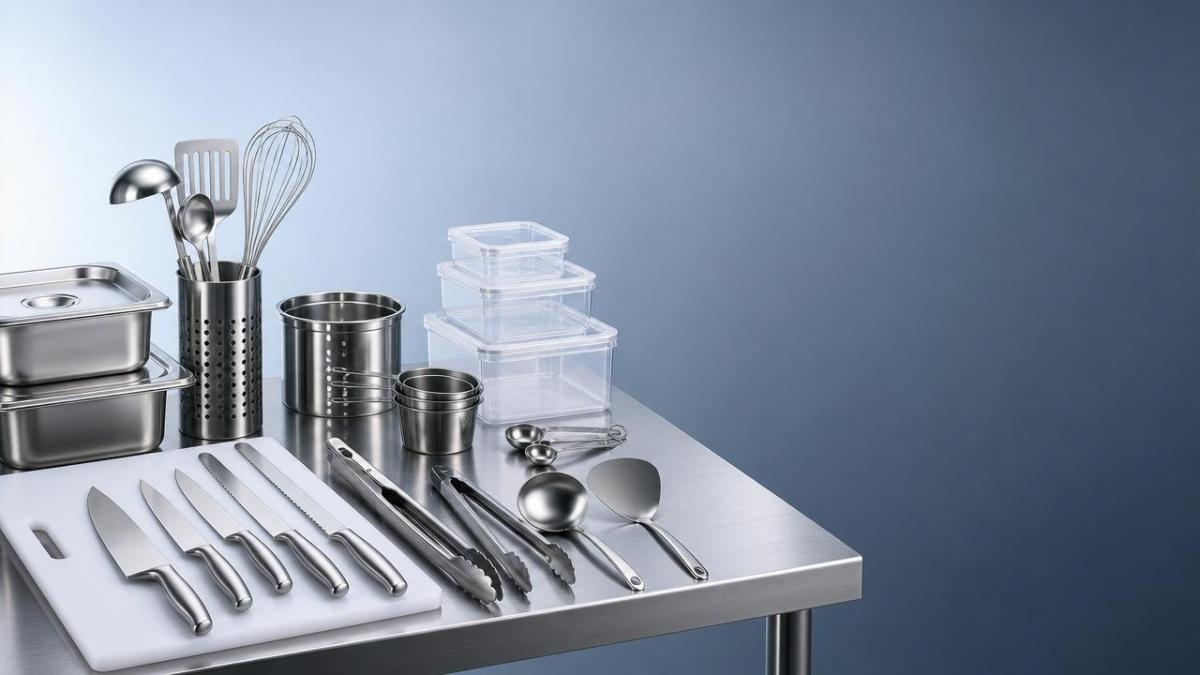
A kitchen tools bulk order means purchasing multiple units of utensils and hand tools for continuous, repeated use across one or several kitchen environments.
It usually covers knives, tongs, ladles, spatulas, peelers, whisks, measuring tools, cutting boards, storage bins, and preparation accessories.
The decision is broader than unit pricing. It includes material quality, ergonomic design, food safety compliance, cleaning efficiency, and supply continuity.
In fast-moving kitchens, tools are not secondary items. They are daily production assets that shape productivity as much as larger commercial kitchen equipment.
Why volume buying needs careful evaluation
A low-cost kitchen tools bulk order can become expensive if items bend, rust, crack, or lose precision quickly. Replacement frequency often cancels any initial savings.
Consistency also matters. Bulk sets should deliver uniform dimensions, weights, and handling, especially where standardized recipes and timed preparation are important.
Current industry priorities shaping bulk tool selection
The kitchen equipment industry is evolving toward automation, intelligence, energy efficiency, and tighter food safety control. Hand tools must support those same operational goals.
Today, a kitchen tools bulk order is often reviewed alongside workflow design, sanitation programs, digital inventory systems, and sustainability targets.
These shifts explain why the best kitchen tools bulk order balances price with performance under real kitchen pressure.
What matters most in performance and product quality
The first priority is durability. Stainless steel grades, reinforced handles, heat resistance, and corrosion protection should match the expected workload and cleaning routine.
The second priority is food safety. Surfaces should resist cracks, chips, and contamination traps. Materials should be suitable for direct food contact and repeated washing.
The third priority is ergonomics. Good grip, balanced weight, and comfortable handle shape reduce strain during repetitive tasks and improve speed in crowded stations.
The fourth priority is standardization. A kitchen tools bulk order should keep sizing and design consistent to simplify training, storage, and production control.
Key technical checkpoints
- Material grade and finish quality
- Heat, stain, and corrosion resistance
- Handle strength and anti-slip performance
- Dishwasher compatibility and cleaning ease
- Uniform dimensions across the batch
- Packaging protection during transport and storage
When these checkpoints are ignored, a kitchen tools bulk order may look efficient on paper but fail under heavy operational use.
Operational value across commercial and processing environments
A well-planned kitchen tools bulk order creates value beyond the storeroom. It improves workflow, reduces interruptions, and helps maintain output during peak service periods.
Reliable tools also support product consistency. Measured portions, stable cutting performance, and dependable handling make food quality easier to control.
In multi-shift kitchens, spare stock is essential. Bulk ordering helps keep reserve tools available without disrupting standardization across stations.
From a financial view, the right kitchen tools bulk order lowers emergency replacement costs, cuts downtime, and simplifies replenishment planning.
Business benefits often seen in practice
- Faster preparation and smoother handoff between tasks
- Lower breakage and fewer urgent replacements
- More consistent sanitation procedures
- Simpler inventory counting and reorder timing
- Better support for expansion or new site opening
Typical tool categories and usage scenarios
Not every kitchen tools bulk order should contain the same mix. Tool selection should reflect menu structure, production scale, service speed, and cleaning intensity.
This scenario approach keeps a kitchen tools bulk order practical. It avoids overbuying attractive items that add little operational value.
Practical evaluation points before placing the order
Before confirming a kitchen tools bulk order, compare the expected service life against usage intensity. High-frequency tools deserve stricter review than occasional-use items.
Sample testing is useful. A short trial often reveals handle weakness, poor balance, surface defects, or cleaning problems that catalogs do not show clearly.
Supply stability also matters. A strong source should support repeat orders, matching specifications, and consistent quality between batches.
Checklist for a dependable kitchen tools bulk order
- Map tools by task, station, and daily usage volume.
- Confirm food-contact material suitability and finish quality.
- Check cleaning method compatibility, including dishwashing cycles.
- Review replacement rate and reserve stock needs.
- Compare total lifecycle cost, not just unit price.
- Verify packaging, delivery timing, and reorder support.
- Keep specifications documented for future expansion.
This process makes a kitchen tools bulk order more resilient and easier to scale across changing operational needs.
Long-term planning and next-step considerations
A kitchen tools bulk order works best when linked to broader kitchen planning. That includes storage layout, cleaning systems, replacement schedules, and future capacity growth.
As the global kitchen equipment industry moves toward smarter and more integrated systems, hand tools still remain essential operational foundations.
The most effective kitchen tools bulk order is durable, safe, standardized, and easy to replenish. It supports both immediate workflow and long-term cost control.
Start by auditing high-use tools, documenting failure points, and grouping needs by scenario. Then build a kitchen tools bulk order that matches real kitchen pressure, not assumptions.
Popular Tags
Kitchen Industry Research Team
Dedicated to analyzing emerging trends and technological shifts in the global hospitality and foodservice infrastructure sector.
Industry Insights
Join 15,000+ industry professionals. Get the latest market trends and tech news delivered weekly.
No spam. Unsubscribe anytime.

Contact With us
Contact:
Anne Yin (Ceramics Dinnerware/Glassware)
Lucky Zhai(Flatware)