
Restaurant Kitchen Equipment Prices by Region and Supply Source
Restaurant kitchen equipment prices vary widely by region, supplier type, and product category, making smart sourcing essential for procurement teams. From China and Europe to local distributors and direct manufacturers, each supply source affects cost, lead time, quality, and after-sales support. This article explores key pricing differences and sourcing factors to help buyers compare options and make more cost-effective purchasing decisions.
Why do restaurant kitchen equipment prices differ so much by region?
The biggest reason restaurant kitchen equipment prices vary by region is that buyers are not paying only for the machine itself. They are also paying for labor costs, factory scale, raw materials, certification requirements, logistics, import duty, currency fluctuations, and local service networks. A stainless steel worktable produced in one country may appear similar to another, yet the final landed cost can differ sharply once freight, tax, and compliance are added.
China often offers competitive pricing because of manufacturing scale, integrated supply chains, and strong export capacity. European suppliers usually command higher prices due to labor costs, design standards, energy efficiency requirements, and brand positioning. North American sourcing may cost more on unit price, but local inventory and faster support can reduce downtime expenses. In Southeast Asia, India, and the Middle East, pricing can be mixed, depending on whether products are imported, locally assembled, or distributed through trading companies.
For procurement teams, the practical lesson is simple: compare total acquisition cost instead of factory price alone. A lower quote may become expensive if spare parts are slow to obtain or if the equipment fails local electrical and food safety standards.
Which regions are usually most competitive for different equipment categories?
Not every region is equally strong in every product line. Restaurant kitchen equipment prices are closely linked to regional manufacturing specialization. Buyers usually get the best value when they match the equipment category with the supply base that has technical depth and production volume.
For example, China is highly competitive in refrigeration units, stainless steel fabrication, sinks, prep tables, shelving, induction equipment, and many general commercial kitchen appliances. Italy and Germany are often preferred for premium ovens, coffee equipment, bakery lines, and precision food processing systems. Japan is respected for reliability and engineering quality in selected cooking and preparation equipment. Turkey and some Eastern European countries may provide attractive pricing for stainless fabrication and mid-range commercial kitchen products serving nearby export markets.
This does not mean one country is always cheaper. It means that procurement teams should source by category. A project involving cold storage, fryers, and exhaust hoods may benefit from multiple sourcing strategies rather than a single supplier origin.
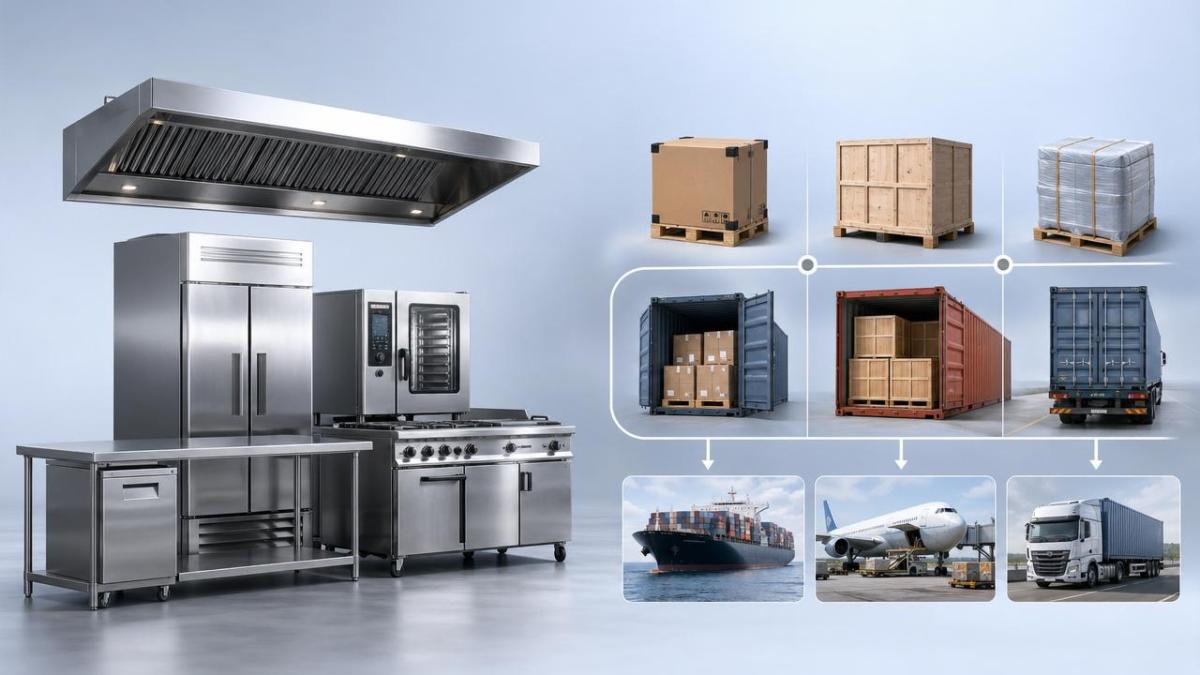
How do supply sources change restaurant kitchen equipment prices?
Supply source has a direct effect on restaurant kitchen equipment prices because each channel adds or removes cost layers. In most procurement cases, buyers choose among direct manufacturers, export trading companies, regional distributors, local dealers, or integrated project contractors.
Buying directly from a manufacturer usually offers the lowest ex-factory price, especially for large orders or customized equipment. This route can work well for chains, hotel groups, central kitchens, and buyers with international procurement experience. However, direct sourcing often requires more effort in factory verification, technical communication, shipping coordination, and after-sales planning.
Trading companies can simplify communication, combine products from several factories, and support mixed-container purchasing. Their pricing is higher than direct factory sourcing, but they may reduce hidden coordination costs. Regional distributors typically offer stocked items, warranty handling, and local compliance support. Their prices are higher still, yet they can be the most efficient option when installation speed and local service are critical. Project contractors usually provide the highest price level because they bundle design, sourcing, installation, commissioning, and sometimes maintenance.
For procurement professionals, the right question is not “Which source is cheapest?” but “Which source gives the best balance of price, risk, speed, and accountability?”
What price ranges should buyers expect across common restaurant equipment items?
Restaurant kitchen equipment prices differ by specification, brand, capacity, and certification, so there is no universal rate card. Still, buyers can use broad reference ranges to screen quotations and identify outliers. Small prep tools and stainless utility items may show moderate price differences, while powered cooking and refrigeration systems usually show the largest regional spread.
Entry-level imported stainless steel tables and sinks may be significantly cheaper from Asian manufacturers than from local stocked suppliers. Commercial refrigerators, freezers, fryers, griddles, mixers, dishwashers, combi ovens, and ventilation systems often carry larger freight and compliance costs, so the gap between factory price and delivered price becomes much wider. Energy-saving models or smart kitchen equipment also cost more upfront, but they may lower operating expenses over time.
A useful procurement approach is to divide items into three groups: standard items, technical core equipment, and mission-critical service equipment. Standard items can often be globally sourced for better pricing. Technical core equipment should be evaluated on lifecycle value, not just purchase price. Mission-critical equipment, such as refrigeration in high-volume operations, may justify a stronger local service network even at a higher purchase cost.
Quick comparison table for buyers
The table below helps procurement teams compare how supply source and region typically influence restaurant kitchen equipment prices and sourcing decisions.
What hidden costs are often missed when comparing quotes?
One of the most common procurement mistakes is comparing restaurant kitchen equipment prices without normalizing the quote structure. Two suppliers may appear far apart on price simply because one includes accessories, freight, documentation, or installation advice while the other does not.
Hidden costs usually include inland transport, export packing, ocean or air freight, insurance, customs clearance, import duties, local taxes, commissioning, spare parts, voltage conversion, and certification upgrades. Some buyers also overlook the cost of project delays. If a low-cost overseas supplier misses a delivery window, the restaurant opening may be delayed, creating losses that far exceed the original price difference.
Energy usage is another major factor. A cheaper fryer, oven, or refrigeration unit may consume more electricity or gas over several years. Procurement teams responsible for total cost of ownership should ask for power consumption data, maintenance intervals, expected service life, and spare part availability.
How can buyers judge whether a lower price is actually a good deal?
A lower quote only becomes a good deal when it matches the required specification, quality level, and operating conditions. In the restaurant equipment sector, very low pricing can signal thinner stainless steel, lower-grade compressors, simplified insulation, weaker burners, lower control accuracy, or limited warranty support.
Procurement teams should verify several points before accepting a low offer. First, confirm material grade, thickness, and component brand. Second, check electrical standards, gas standards, and food-contact compliance for the destination market. Third, ask whether spare parts are stocked locally or can be shipped quickly. Fourth, review production lead time and packaging method, especially for fragile refrigeration and cooking equipment. Fifth, compare warranty terms in writing rather than relying on verbal promises.
When evaluating restaurant kitchen equipment prices, many experienced buyers create a weighted scorecard. Price may account for only part of the decision, while durability, efficiency, supplier responsiveness, and service capacity carry the rest. This method reduces the risk of choosing the cheapest option that later becomes the most expensive.
Which sourcing strategy works best for chains, independent restaurants, and central kitchens?
The best sourcing strategy depends on scale, standardization, and operational risk. Independent restaurants often benefit from local distributors for key appliances because support speed matters more than shaving every dollar from the purchase price. They may still import selected stainless items or smallwares if the order size justifies the effort.
Restaurant chains usually gain the most from hybrid sourcing. They can buy standardized fabrication, shelving, sinks, and some refrigeration units directly from manufacturing regions with better pricing, while relying on local partners for installation-sensitive or service-critical equipment. This approach helps control restaurant kitchen equipment prices across multiple sites without losing local execution quality.
Central kitchens and food processing-oriented operations often prioritize durability, automation, capacity, and compliance. For these buyers, factory-direct sourcing may be highly effective, particularly when ordering production lines, preparation systems, or custom layouts. However, technical validation and after-sales planning become even more important because downtime affects a larger volume of output.
What are the most common mistakes buyers make when reviewing restaurant kitchen equipment prices?
A frequent mistake is comparing equipment that looks similar but is not technically equivalent. Capacity, power rating, material thickness, insulation, compressor type, burner design, and controller quality can all change performance and price. Another common error is buying a full kitchen from a single source only for convenience, even when different categories would be more cost-effective from specialized suppliers.
Buyers also underestimate communication risk. In international sourcing, unclear drawings, inconsistent terminology, or missing utility details can lead to costly rework. Some teams ignore after-sales obligations until a breakdown occurs, while others accept very short warranty terms for critical equipment. Finally, procurement staff sometimes focus only on first cost and forget operating life, maintenance demand, and resale value.
The safest approach is to request a detailed quotation, approved technical sheet, production timeline, accessory list, packaging plan, and after-sales commitment before issuing the purchase order.
How should procurement teams compare quotes more effectively?
To compare restaurant kitchen equipment prices properly, build a quote matrix that standardizes every supplier response. Include item description, dimensions, power or gas requirements, construction material, certification, accessories, lead time, Incoterms, freight assumption, warranty, spare parts policy, and payment terms. This makes it easier to identify real price differences rather than formatting differences.
It is also useful to split evaluation into three stages. First, screen for technical compliance. Second, compare total landed cost. Third, assess supplier reliability through factory credentials, references, sample quality, or service commitments. If the project is large, ask shortlisted suppliers for value-engineering suggestions. In many cases, a supplier can recommend a more efficient configuration that lowers overall project cost without reducing operating performance.
If you need to move from price research to actual purchasing, the first questions to clarify are: What exact performance level is required? Which items are standard and which need customization? What certifications are mandatory in the destination market? How fast must the kitchen be operational? Who will handle installation, maintenance, and emergency replacement parts? Answering these points early will make restaurant kitchen equipment prices easier to interpret and will lead to better sourcing decisions, stronger supplier discussions, and lower long-term procurement risk.
- kitchen appliances
- restaurant equipment
- smart kitchen
- cooking equipment
- central kitchen
- restaurant kitchen
- Griddle
- Commercial Refrigerator
- Freezer
- Mixer
- Stainless Steel Worktable
- kitchen equipment
- restaurant kitchen equipment
- commercial kitchen appliances
- smart kitchen equipment
- restaurant kitchen equipment prices
Popular Tags
Kitchen Industry Research Team
Dedicated to analyzing emerging trends and technological shifts in the global hospitality and foodservice infrastructure sector.
Industry Insights
Join 15,000+ industry professionals. Get the latest market trends and tech news delivered weekly.
No spam. Unsubscribe anytime.
Contact With us
Contact:
Anne Yin (Ceramics Dinnerware/Glassware)
Lucky Zhai(Flatware)