
How to compare restaurant kitchen equipment wholesale quotes
Comparing restaurant kitchen equipment wholesale quotes is more than checking the lowest price. For procurement professionals, the right supplier decision depends on equipment quality, energy efficiency, warranty terms, delivery timelines, and long-term operating costs. In a fast-changing market shaped by smart and automated solutions, understanding how to evaluate quotes systematically can help you reduce risk, control budgets, and secure better value for your commercial kitchen projects.
Why is comparing restaurant kitchen equipment wholesale quotes so important?
For buyers, a quote is not just a number. In restaurant kitchen equipment wholesale, quotations often include hidden differences in material grade, power specifications, accessories, compliance standards, packaging, after-sales support, and shipping responsibility. Two suppliers may appear to offer the same fryer, oven, refrigerator, or prep table, but the actual commercial value can vary significantly.
This matters because commercial kitchens operate under pressure. Equipment failure can interrupt service, increase labor costs, affect food safety, and damage customer experience. A lower upfront quote may become more expensive if the equipment consumes more energy, requires frequent repair, or arrives late to a new opening project. That is why experienced procurement teams evaluate restaurant kitchen equipment wholesale offers through a total-cost and risk-control lens.
The market also adds complexity. Global suppliers from China, Germany, Italy, Japan, and other manufacturing hubs may use different pricing structures. Some quote EXW, some FOB, some CIF, and others provide delivered pricing. Without standardizing quote comparisons, buyers can make decisions based on incomplete cost visibility.
What should be included in a restaurant kitchen equipment wholesale quote before you compare suppliers?
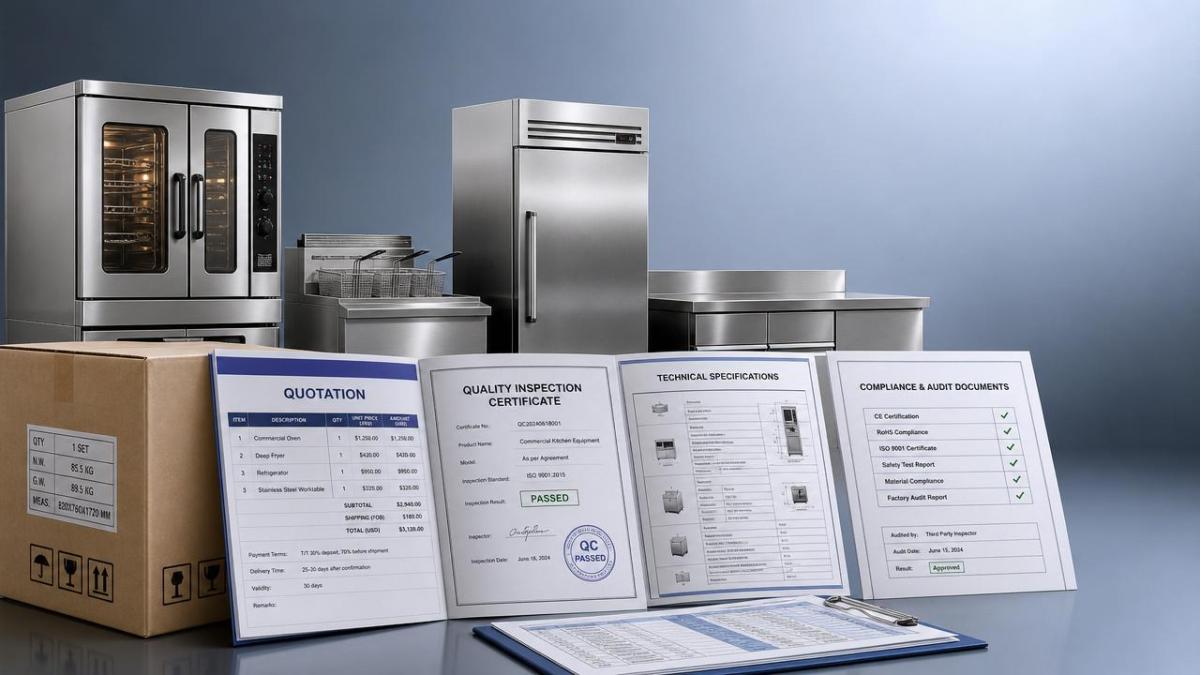
Before comparing prices, make sure every supplier is quoting on the same basis. If one quote includes installation kits, stainless steel shelving, and user training while another excludes them, the comparison is distorted. A reliable restaurant kitchen equipment wholesale quote should be detailed enough to support technical review and commercial negotiation.
Key items to confirm include product model, dimensions, voltage, frequency, power load, production capacity, material thickness, insulation type, refrigeration gas where relevant, certification, unit price, minimum order quantity, packaging method, lead time, spare parts support, warranty, and payment terms. If the project involves a full kitchen line, ask whether the quote also covers layout support, line matching, and commissioning requirements.
Procurement teams should also verify whether the supplier has matched the application scenario. Equipment for a hotel breakfast kitchen, central kitchen, quick-service restaurant, bakery, and fine dining operation may require different output levels and durability standards. A quote that looks attractive but does not fit the operational environment is not a true saving.
A structured quote review sheet can save time and improve fairness across vendors. It also helps internal stakeholders such as operations, finance, engineering, and management approve restaurant kitchen equipment wholesale purchasing decisions with more confidence.
How do you compare price without ignoring total cost of ownership?
The best procurement decision is rarely based on sticker price alone. In restaurant kitchen equipment wholesale, total cost of ownership includes acquisition cost, freight, import duty, installation expense, energy usage, water consumption, cleaning time, spare parts cost, downtime risk, and replacement cycle. These factors can turn a cheap machine into an expensive asset.
For example, a lower-cost commercial refrigerator may use less efficient compressors or thinner insulation. That can raise electricity bills over years of operation. A combi oven with a higher quote may offer programmable controls, lower water consumption, and more consistent cooking results, reducing both labor waste and food waste. Over time, those operational gains may justify the premium.
Procurement professionals should estimate annual operating costs for high-usage categories such as refrigeration, cooking, dishwashing, and ventilation. If possible, calculate payback periods for energy-efficient models. This approach is especially relevant as the kitchen equipment industry moves toward smart, automated, and energy-saving solutions. Restaurant operators are increasingly willing to pay more upfront when lifecycle savings are measurable.
A practical method is to create a weighted scorecard. Price may account for 30% or 40% of the decision, but technical suitability, service reliability, efficiency, and delivery performance should carry substantial weight as well. That keeps restaurant kitchen equipment wholesale selection aligned with long-term business outcomes rather than short-term budget pressure.
Which quality and compliance issues should buyers verify in wholesale quotes?
Quality review starts with materials and construction. For stainless steel equipment, buyers should confirm whether the quoted material is 201 or 304 stainless steel, the gauge or thickness, weld quality, and surface finish. In heavy-use restaurant environments, these details affect hygiene, corrosion resistance, and service life. Similar attention should be paid to motors, burners, thermostats, compressors, hinges, and control panels.
Compliance is equally important. Depending on the destination market, restaurant kitchen equipment wholesale products may need food-contact safety approval, electrical certification, gas safety certification, or sanitation compliance. If the supplier cannot provide valid documentation, customs clearance or local inspection issues may delay the project. Even worse, the equipment may not be legally installable.
Ask suppliers for test reports, certification copies, factory audit information, and reference projects in similar markets. Buyers handling chain restaurant expansion or hotel projects should also confirm standardization capability. A supplier that delivers consistent quality across multiple batches is often more valuable than one offering a single low quote.
If your procurement scope includes smart kitchen equipment or automated food processing systems, verify software compatibility, interface language, control system stability, and remote diagnostic capability. These features are increasingly relevant in modern kitchens, but they must be reliable and usable, not just attractive on a brochure.
How can you assess supplier reliability beyond the quotation sheet?
A strong quote from a weak supplier can still create major purchasing problems. In restaurant kitchen equipment wholesale, supplier reliability affects production accuracy, communication speed, packaging quality, shipment coordination, and post-sale support. This is why procurement should evaluate the company behind the quote, not only the quote itself.
Start by reviewing business credentials, export experience, factory capability, and response quality. Does the supplier answer technical questions clearly? Can they revise drawings or specifications quickly? Do they identify possible installation conflicts before shipment? Professional communication often indicates stronger project management.
You should also ask for customer references, production photos, quality control procedures, and parts availability plans. If the order includes custom fabrication, request approval drawings and milestone updates. For larger restaurant kitchen equipment wholesale purchases, video factory audits or third-party inspections are worthwhile risk controls.
After-sales support deserves special attention. A supplier offering one-year warranty coverage is not automatically better than one offering six months if claims handling is unclear. Ask practical questions: Who pays for replacement parts? How fast can parts be shipped? Is there remote troubleshooting? Are manuals and diagrams included? Strong support reduces downtime and gives buyers leverage when operational issues arise.
What are the most common mistakes when comparing restaurant kitchen equipment wholesale quotes?
One common mistake is comparing non-equivalent products. Buyers may assume two griddles or freezers are the same because the dimensions are similar, while ignoring differences in internal components, insulation, output, or certification. Always compare functional performance, not just appearance.
Another mistake is overlooking logistics terms. A lower EXW quote may end up costing more than a higher FOB or CIF quote once inland transport, export handling, freight, insurance, and customs charges are added. In global restaurant kitchen equipment wholesale transactions, landed cost transparency is essential.
Buyers also sometimes neglect lead time risk. If one supplier can deliver in 20 days and another in 60 days, the lower quote may cause costly delays in restaurant opening, contractor scheduling, or revenue generation. Timing has financial value and should be priced into the decision.
A further mistake is underestimating maintenance needs. Equipment with limited spare parts access, poor local service coverage, or non-standard components can become a long-term burden. The cheapest initial quote may create frequent disruptions for kitchen teams and maintenance staff.
Finally, some procurement teams skip stakeholder alignment. Operations may prioritize durability, chefs may focus on output and usability, finance may watch cash flow, and engineering may care about utilities and installation. If restaurant kitchen equipment wholesale quotes are reviewed in isolation, the final purchase may not satisfy the people who actually use and maintain the equipment.
What is a practical process for evaluating multiple quotes efficiently?
An efficient process starts with a clear specification package. Define the equipment list, intended use, utility requirements, compliance needs, preferred trade terms, and delivery schedule before requesting quotations. The more precise your RFQ, the easier it is to compare restaurant kitchen equipment wholesale offers on equal terms.
Next, normalize all quotes into a single comparison sheet. Convert currencies, align trade terms where possible, note missing items, and separate base price from logistics and optional accessories. Then score each supplier against agreed criteria such as price, technical compliance, energy efficiency, warranty, lead time, and service responsiveness.
After shortlisting, move into clarification and negotiation. Ask suppliers to explain cost differences, improve commercial terms, confirm production schedules, and provide final documentation. In many cases, the best result comes not from choosing the lowest original quote, but from using a structured comparison to negotiate better value from a qualified supplier.
For repeat buyers, keep records of actual field performance after purchase. Compare promised lead time versus actual delivery, quoted energy claims versus real use, and warranty promises versus service experience. This historical data improves future restaurant kitchen equipment wholesale sourcing decisions and strengthens supplier management.
Quick FAQ: what should procurement teams ask before approving a supplier?
How should you move forward after comparing quotes?
Once you finish comparing restaurant kitchen equipment wholesale quotes, the next step is not simply issuing a purchase order. It is confirming the commercial and technical assumptions behind the preferred offer. Recheck utility compatibility, kitchen layout integration, compliance documents, packaging details, shipping responsibility, and spare parts commitments. Then align internal stakeholders so the selected equipment supports operational goals as well as budget targets.
For procurement professionals, the most effective sourcing decisions come from balancing price, quality, service, and long-term performance. If you need to confirm a specific solution, parameter set, delivery timeline, quote structure, or cooperation model, start by asking suppliers for a complete technical breakdown, final trade terms, warranty procedure, lead-time commitment, and evidence from similar commercial kitchen projects. Those conversations will reveal which restaurant kitchen equipment wholesale partner offers real value rather than just a low number.
Popular Tags
Kitchen Industry Research Team
Dedicated to analyzing emerging trends and technological shifts in the global hospitality and foodservice infrastructure sector.
Industry Insights
Join 15,000+ industry professionals. Get the latest market trends and tech news delivered weekly.
No spam. Unsubscribe anytime.


Contact With us
Contact:
Anne Yin (Ceramics Dinnerware/Glassware)
Lucky Zhai(Flatware)