
Glass whiskey tumbler styles now shaping barware demand
As barware demand becomes more design- and performance-driven, the glass whiskey tumbler is emerging as a key product for distributors, agents, and wholesalers serving hospitality and retail markets. From premium aesthetics to durability, stackability, and gifting appeal, evolving tumbler styles are influencing purchasing decisions and creating new opportunities across global kitchen and beverage equipment supply chains.
Understanding the role of the glass whiskey tumbler in modern barware
A glass whiskey tumbler is no longer viewed as a simple drinking vessel. In today’s market, it represents a product category where design language, material quality, user experience, and operational efficiency come together. For distributors and channel partners in the broader kitchen equipment industry, this matters because barware is increasingly evaluated in the same way as other professional service tools: by durability, presentation value, storage compatibility, and fit with end-user workflow.
The rise of premium dining, hotel lounge concepts, home entertaining, and curated gifting has expanded demand for the glass whiskey tumbler across several segments. Restaurants want glasses that support table aesthetics without increasing replacement costs. Hotels look for consistency across guest rooms, bars, and banquet operations. Retailers want styles that photograph well and communicate lifestyle value. Importers and agents, meanwhile, are looking for product lines that are easy to position across multiple price points.
Because the kitchen equipment sector is becoming more design-aware, data-driven, and efficiency-focused, barware trends now influence sourcing decisions in a meaningful way. The glass whiskey tumbler sits at the intersection of beverage service, visual merchandising, and durable equipment planning, making it a practical category for long-term portfolio development.
Why tumbler styles are getting more attention across the supply chain
Style evolution is not just about fashion. It reflects how end markets are changing. In hospitality, consumers increasingly expect visual distinction even in everyday service items. In retail, product differentiation often depends on shape, finish, weight, and packaging rather than function alone. In e-commerce, the glass whiskey tumbler must also perform well in photos, survive logistics pressure, and align with trend categories such as vintage barware, minimalist tabletop, or premium gifting sets.
For distributors, changing styles create both opportunity and complexity. A classic heavy-bottom glass may still sell steadily, but newer demand is spreading toward crystal-look patterns, contemporary straight-wall silhouettes, stackable commercial formats, and mixed-use tumblers suitable for whiskey, cocktails, water service, or tasting flights. This means the strongest assortments are no longer built around one shape. They are built around use cases and buyer intent.
Another reason for greater attention is the convergence of beverage service and kitchen equipment strategy. Buyers increasingly want products that support efficiency, reduce breakage, simplify replenishment, and fit broader service concepts. As a result, the glass whiskey tumbler is being judged not only by appearance but also by rim strength, base stability, dishwasher performance, packing efficiency, and SKU versatility.
Current style directions shaping market demand
Several style directions are now influencing global barware demand. Understanding them helps agents and wholesalers position inventory more accurately for different customer groups.
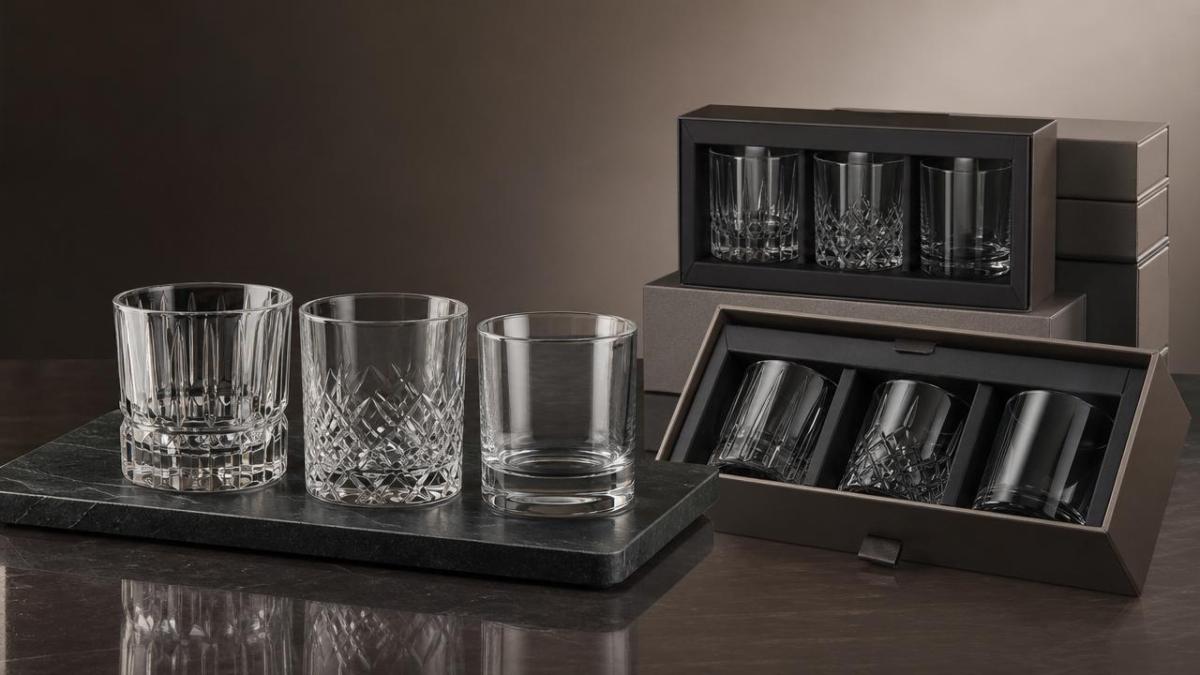
- Heavy-base premium tumblers: These communicate quality, balance, and classic whiskey service. They remain popular in upscale bars, gifting collections, and hotel beverage programs.
- Textured and patterned designs: Cut-glass effects, ribbed walls, and vintage-inspired surfaces create strong shelf appeal and support premium positioning without requiring full crystal construction.
- Minimalist contemporary forms: Straight-sided, clean-lined tumbler designs work well in modern restaurants, boutique hotels, and lifestyle retail channels.
- Stackable commercial formats: Practical for high-volume foodservice operations where storage density and service speed matter.
- Multi-purpose bar-and-table glasses: Buyers increasingly favor a glass whiskey tumbler that can serve spirits, cocktails, juice, and water, improving SKU efficiency.
These style directions reflect a broader shift in the kitchen equipment industry toward products that blend form, utility, and operational value. The most successful suppliers are responding by offering modular collections rather than isolated items.
Industry overview: what buyers are evaluating now
For channel partners, style is only one part of the decision. End buyers usually assess a glass whiskey tumbler through a broader commercial lens. The table below summarizes the main evaluation priorities now shaping demand.
Business value for distributors, agents, and wholesalers
For trade intermediaries, the glass whiskey tumbler is a strategically useful category because it can move across hospitality, retail, gifting, and household channels with relatively low complexity compared with larger kitchen equipment items. It fits container programs, seasonal launches, promotional sets, and private-label strategies. That flexibility makes it attractive in both mature and emerging markets.
It also supports cross-selling. A distributor already serving restaurants or hotels with kitchen tools, beverage equipment, tabletop items, or storage solutions can add tumbler ranges without changing the core customer profile. The result is better basket value and stronger account retention. In retail-oriented channels, the same product can be paired with decanters, ice buckets, coasters, bar spoons, or boxed gift sets to increase margin potential.
Another important advantage is assortment segmentation. A single supplier may offer an entry-level soda-lime glass whiskey tumbler for volume accounts, a textured premium line for lifestyle retailers, and a reinforced stackable version for foodservice groups. This allows agents and distributors to speak to different customer needs while keeping the product family coherent.
Common application segments and style fit
Different end markets do not value the same tumbler characteristics equally. Matching style to application is one of the most practical ways to improve sell-through and reduce customer hesitation.
Key product considerations before building a tumbler range
Although style drives attention, practical product decisions determine whether a glass whiskey tumbler performs well in distribution. Material composition should match target use. High-clarity glass can strengthen visual appeal, but commercial accounts may prioritize impact resistance and replacement economics. Weight must feel premium without increasing freight cost too sharply. Surface texture can improve differentiation, but it should not make washing or storage difficult.
Capacity planning is equally important. Some buyers want a true whiskey tumbler for neat pours and ice service, while others prefer a larger format suitable for cocktails or dual use. Rim thickness influences drinking comfort and break resistance. Base thickness affects stability and premium perception. Carton configuration also matters, especially for export and wholesale programs where inner pack logic can shape warehouse efficiency and order flexibility.
In the wider kitchen equipment ecosystem, consistency and documentation are also growing in importance. Buyers may ask about food-contact compliance, dishwasher suitability, packaging tests, or production consistency across batches. Suppliers that can provide these details tend to build more trust with professional channel partners.
Practical market guidance for channel partners
A practical approach is to organize a glass whiskey tumbler portfolio into clear commercial tiers. The first tier can focus on dependable volume products for hospitality and replenishment business. The second can target retail and boutique hospitality with stronger design elements. The third can address gifting or premium signature collections. This structure makes sales conversations easier and helps customers compare options without confusion.
It is also wise to avoid presenting the category as whiskey-only. In many markets, the same tumbler is used for spirits, cocktails, sparkling water, juice, and dessert service. Positioning it as a versatile beverage glass can increase demand from restaurants and household channels. For e-commerce and catalog sales, specification clarity is essential: dimensions, weight, stacking information, pack size, and recommended use should be easy to understand.
Finally, watch regional preference patterns. Some markets favor heavier and more ornate barware, while others respond better to lighter minimalist designs. Since global kitchen equipment trade is increasingly interconnected, distributors who combine local style awareness with stable sourcing can turn the glass whiskey tumbler into a repeat-order category instead of a one-time novelty item.
Conclusion and next-step perspective
The growing attention around glass whiskey tumbler styles reflects a larger shift in barware and kitchen equipment demand: buyers want products that are visually relevant, operationally sound, and commercially adaptable. For distributors, agents, and wholesalers, this category offers a useful balance of trend sensitivity and practical repeat demand. It can serve hospitality accounts, retail programs, gifting channels, and home-focused buyers with the right assortment strategy.
The most effective way to respond is not to chase every design trend, but to build a structured offering based on application, durability, style direction, and channel fit. When a glass whiskey tumbler range is selected with these factors in mind, it becomes more than barware. It becomes a scalable product line within the broader foodservice and kitchen equipment supply chain. If your business is reviewing portfolio expansion, now is a practical time to assess which tumbler styles best align with your target markets and customer segments.
Popular Tags
Kitchen Industry Research Team
Dedicated to analyzing emerging trends and technological shifts in the global hospitality and foodservice infrastructure sector.
Industry Insights
Join 15,000+ industry professionals. Get the latest market trends and tech news delivered weekly.
No spam. Unsubscribe anytime.

Contact With us
Contact:
Anne Yin (Ceramics Dinnerware/Glassware)
Lucky Zhai(Flatware)