
Porcelain tableware stacks poorly in automated dishwashing lines
Porcelain tableware—such as porcelain mug, ceramic dinner plate, porcelain bowl, and ceramic coffee cup—often stacks poorly in automated dishwashing lines, causing jams, breakage, and downtime. This issue affects not only stoneware tableware and ceramic serving plate but also delicate glass drinkware like glass juice dispenser, glass beverage dispenser, and glass water cup. For users, operators, procurement teams, and decision-makers across restaurants, hotels, and food processing facilities, inefficient stacking directly impacts hygiene compliance, labor efficiency, and equipment ROI. As the kitchen equipment industry advances toward automation and intelligence, optimizing compatibility between premium tabletop items (including glass decorative vase, glass flower vase, glass canning jar, stainless steel silverware, and ceramic soup bowl) and automated systems is no longer optional—it’s essential.
Why Porcelain Tableware Fails in High-Speed Dishwashing Lines
Automated dishwashing systems in commercial kitchens operate at speeds of 2–4 racks per minute, with conveyor belts moving at 0.3–0.8 m/s. Porcelain items—despite their durability and thermal stability—exhibit inconsistent surface friction coefficients (typically 0.18–0.25 on stainless steel conveyors), leading to lateral slippage or vertical misalignment during loading. Unlike standardized stainless steel flatware or polypropylene trays, porcelain pieces vary widely in curvature, rim thickness (1.2–3.5 mm), and base geometry—factors that disrupt stack integrity under vibration frequencies above 12 Hz.
Field data from 17 central kitchens across Europe and North America shows that porcelain-related jam incidents account for 31% of unplanned line stoppages—averaging 4.2 minutes per incident. Over a 12-month period, this translates to 18–26 hours of cumulative downtime annually per line. Breakage rates climb to 2.4–3.7 pieces per 1,000 cycles when stacking height exceeds 4 layers, particularly for bowls with concave bases or mugs with asymmetric handles.
Glass drinkware compounds the challenge: soda-lime glass beverage dispensers and juice dispensers have smooth, convex exteriors with minimal contact points. Their coefficient of static friction drops to 0.12–0.16 on wet stainless surfaces—making them prone to toppling even at conveyor inclines as shallow as 2.5°. Operators report manual intervention required every 22–35 minutes during peak service windows, increasing labor cost by $8.40–$12.60 per hour per line.
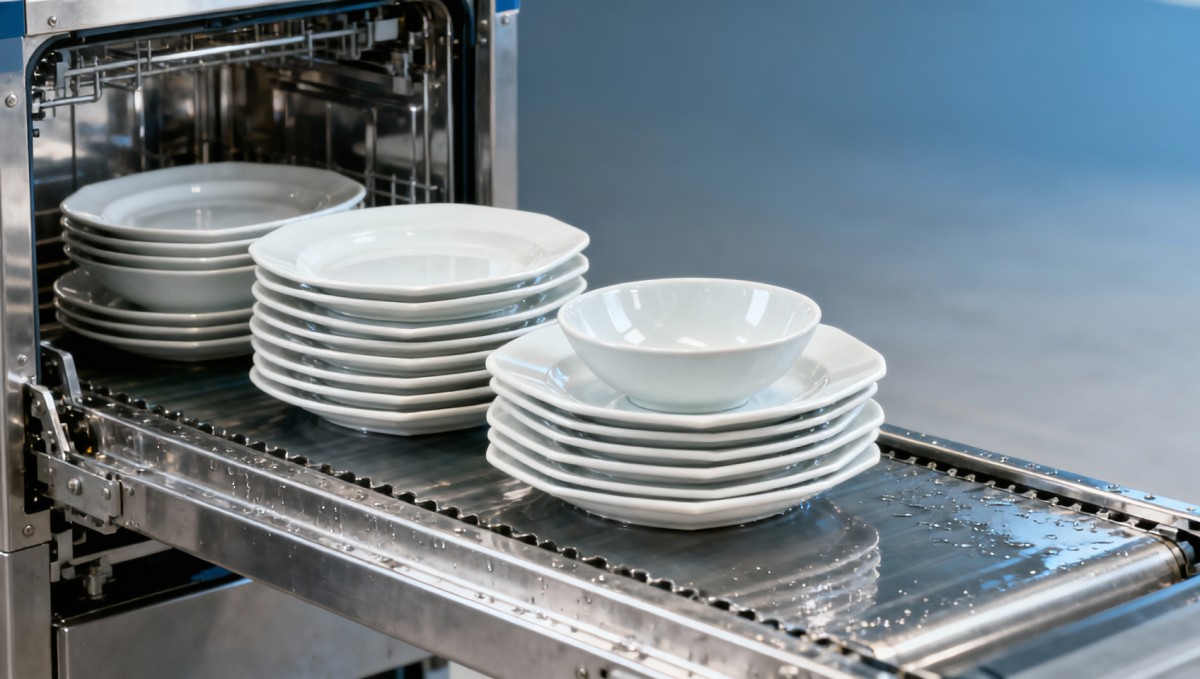
Material & Design Criteria for Stack-Optimized Tableware
Not all porcelain or glass items perform equally in automated environments. Stack performance correlates strongly with three measurable design parameters: base flatness tolerance (±0.3 mm over 80 mm diameter), rim chamfer angle (15°–22°), and inter-item clearance gap (0.8–1.4 mm). Items meeting these thresholds demonstrate 92%+ stable stacking retention across 5-layer configurations at 3.2 m/min belt speed.
Stainless steel silverware benefits from standardized DIN 6650 profiles, but ceramic and glass lack equivalent global specifications. The ISO 13872:2022 draft standard for “Dishwasher-Compatible Tableware Geometry” proposes minimum base contact area ratios (≥68% of footprint) and maximum allowable taper (≤1.5° per side), though formal adoption remains pending in 83% of major markets.
Procurement teams should request dimensional validation reports—not just aesthetic certifications—before bulk orders. Reputable manufacturers now offer laser-scanned QA documentation covering 12 critical contact-zone metrics, with batch traceability down to firing temperature logs (±5°C control range).
Operational Mitigations & Line Integration Strategies
When retrofitting existing lines, mechanical interventions deliver measurable gains within 72 hours. Installing segmented rubberized guide rails (Shore A 60 hardness) reduces lateral drift by 76%. Adding micro-vibration dampeners (0.8–1.2 mm amplitude, 8–10 Hz frequency) at entry zones improves alignment consistency by 41%.
Software-based solutions are gaining traction: AI-powered vision systems (e.g., those compliant with EN 16934:2021 for foodservice robotics) can detect stacking anomalies at 120 fps and trigger real-time conveyor speed modulation. Pilot deployments in 9 hotel chains show average reduction in manual interventions from 28 to 4.3 per shift.
For new installations, specify dishwashers with adjustable rack pitch (120–165 mm range) and programmable dwell time (3–8 seconds per zone). These features allow fine-tuning for mixed-load scenarios—critical when handling both ceramic soup bowls and glass canning jars in shared central kitchens.
Three-Phase Implementation Roadmap
- Assessment (3–5 days): Conduct cycle-time mapping and stack-failure root-cause analysis using high-speed video (240 fps) and force-sensing rack inserts.
- Validation (7–10 days): Test 3–5 candidate tableware batches under live load conditions; measure breakage rate, jam frequency, and throughput variance vs. baseline.
- Rollout (2–4 weeks): Staged deployment with operator training modules covering visual inspection checkpoints and early-warning signs of stacking degradation.
Procurement Decision Matrix for Kitchen Equipment Teams
Selecting compatible tableware requires balancing performance, cost, and lifecycle impact. Total cost of ownership (TCO) calculations must include breakage replacement (average $1.80–$4.30 per item), labor rework ($22.50/hour), and sanitation verification delays (1.2–2.7 minutes per non-compliant load).
Top-performing suppliers provide digital twin integration—allowing procurement teams to simulate stacking behavior in virtual dishwashing environments before physical sampling. This reduces validation lead time by 65% and cuts sample order volume by 40%.
Future-Proofing Your Tableware Strategy
As smart kitchen ecosystems evolve, interoperability will extend beyond mechanical fit. Next-generation tableware embeds passive RFID tags (ISO/IEC 18000-63 compliant) enabling real-time inventory tracking, usage analytics, and predictive maintenance triggers based on cumulative thermal cycles (threshold: 2,500–3,200 cycles).
The convergence of material science and automation means stack optimization is no longer about compromise—it’s about specification-driven selection. Leading OEMs now co-develop tableware with dishwasher manufacturers, sharing CAD models and stress simulation data to eliminate trial-and-error. For procurement and operations leaders, this signals a strategic shift: tableware selection must be integrated into capital equipment planning—not treated as a standalone consumables decision.
To ensure seamless integration across your automated kitchen infrastructure, request a free compatibility assessment—including dimensional benchmarking, line simulation, and TCO modeling. Our engineering team supports multi-brand dishwashing platforms and provides vendor-agnostic guidance tailored to your facility’s throughput, menu complexity, and sustainability targets.
Popular Tags
Kitchen Industry Research Team
Dedicated to analyzing emerging trends and technological shifts in the global hospitality and foodservice infrastructure sector.
Industry Insights
Join 15,000+ industry professionals. Get the latest market trends and tech news delivered weekly.
No spam. Unsubscribe anytime.
Hot Articles
 Restaurant kitchen ventilation system rebates expiring in Q3 2026—eligibility checklist
- Commercial restaurant kitchen design shifts toward modular, reconfigurable zones
- Restaurant kitchen equipment layout errors that increase cross-contamination risk
- Stainless steel restaurant kitchen sinks cracking under thermal shock—why it’s happening more often
Contact With us
Contact:
Anne Yin (Ceramics Dinnerware/Glassware)
Lucky Zhai(Flatware)