
Non-stick kitchen tools: which surfaces scratch too soon?
Non-stick kitchen tools promise easy cooking and faster cleanup, but not all surfaces deliver the same durability. For buyers comparing kitchen tools wholesale options, kitchen tools price list details, or durable kitchen tools for catering, baking, and home use, understanding which coatings scratch too soon is essential. This guide helps users, procurement teams, and decision-makers evaluate non-stick kitchen tools alongside stainless steel kitchen tools and professional kitchen tools for long-term value.
In commercial kitchens, central food preparation units, hotels, bakeries, and household cooking environments, surface failure is not a minor cosmetic issue. A scratched spoon, spatula, ladle, or tong can shorten service life, affect food handling, increase replacement frequency, and create uncertainty during procurement. For B2B buyers, the real question is not simply whether a tool is non-stick, but which surface technology stands up to repeated use, cleaning cycles, heat exposure, and operator habits.
This article focuses on practical evaluation rather than marketing claims. It compares common non-stick surfaces, explains why some scratch too soon, and outlines how operators and procurement teams can reduce premature failure. It also considers when stainless steel kitchen tools may be a better fit than coated tools in high-turnover service environments.
Why some non-stick kitchen tool surfaces fail earlier than expected
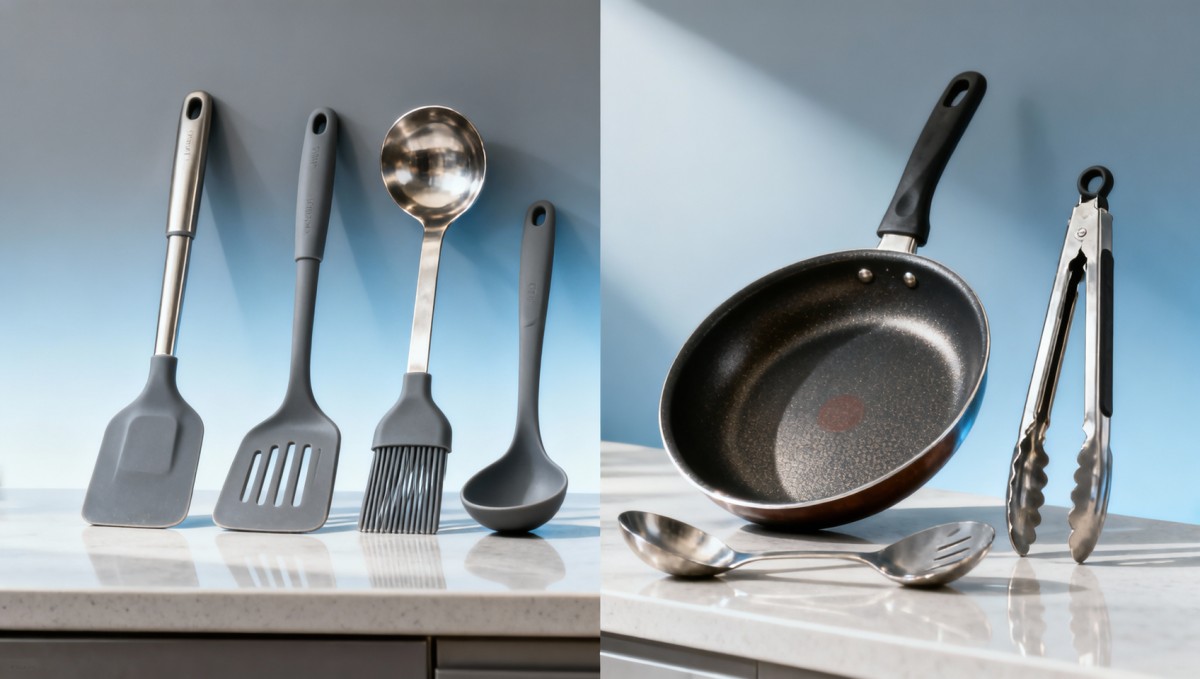
Not all non-stick kitchen tools use the same base material or coating process. In the market, buyers commonly see nylon-coated, silicone-covered, PTFE-based, ceramic-style, and enamel-like surface treatments. Some are designed for light home use of 3 to 5 cooking cycles per week, while others are marketed for professional kitchen tools used 30 to 80 times per day. When tools are used outside their intended duty level, scratching often appears much sooner than expected.
The earliest surface damage usually comes from four causes: contact with sharp edges, abrasion during storage, aggressive cleaning, and heat degradation. In restaurant operations, tools are frequently dropped into bus tubs, stacked in bins, or washed in mixed loads with metal utensils. A coating that performs well in a home kitchen may show visible wear within 2 to 6 weeks in a commercial workflow if the coating thickness is limited or the bond to the substrate is weak.
Another overlooked factor is tool geometry. Flat spatulas, turners, and scrapers often suffer edge wear first because the front lip repeatedly meets grill plates, pans, sheet trays, or mixing bowls. Ladles and serving spoons may resist scratching longer because their contact points are broader and less concentrated. Procurement teams should therefore evaluate scratching risk by both material and use pattern, not by coating label alone.
For buyers reviewing a kitchen tools price list, the lowest-cost coated option can become the highest-cost choice over a 6- to 12-month period if replacement rates are high. In catering, baking, and buffet service, it is often more economical to purchase fewer but more durable tools with documented temperature ranges, substrate thickness, and cleaning recommendations.
Common reasons surfaces scratch too soon
- Thin top layers that wear quickly after repeated friction against pan rims, tray edges, or mixing vessels.
- Weak adhesion between coating and base material, especially on low-cost stamped tools.
- Improper storage, such as loose bulk bins where 20 to 50 pieces rub against each other every shift.
- Use above recommended heat limits, often beyond 180°C to 260°C depending on the material.
- Hard scouring pads, alkaline detergents, or dishwashing cycles not suited to the coating.
Which surfaces usually scratch first
In everyday procurement discussions, soft decorative coatings and low-grade ceramic-style finishes often show visible scratching earlier than high-quality silicone-over-core designs or plain stainless steel kitchen tools. PTFE-style surfaces can remain smooth for a reasonable period when used correctly, but they are vulnerable to sharp-edge damage. Nylon can resist light contact well, yet under high heat or repeated scraping, it may roughen, nick, or deform before a buyer expects.
Surface-by-surface comparison for buyers and operators
The best way to compare non-stick kitchen tools is to assess three variables together: scratch resistance, heat tolerance, and use environment. A tool that performs acceptably in a home kitchen may not survive a production kitchen with 3 shifts per day. The table below summarizes common surface categories used in kitchen tools wholesale procurement.
The key takeaway is that “non-stick” does not automatically mean “durable.” In many kitchens, silicone tools offer a practical balance between pan protection and service life. However, where scraping force is high, stainless steel kitchen tools often provide a longer replacement cycle, especially for prep and transfer tasks rather than cookware contact.
Operators should also distinguish between surface scratching and structural failure. A silicone spatula may keep its surface appearance but fail where the head meets the handle after 4 to 8 months. A cheaper coated tong may keep its shape but lose surface integrity in 30 to 60 days. Purchasing teams need both durability metrics.
Heat and cleaning thresholds to verify
Before placing volume orders, ask suppliers for usable temperature range, dishwasher suitability, and recommended cleaning chemistry. In practical terms, buyers often compare tools rated around 180°C, 220°C, and 260°C. Those ranges matter because a line cook or baker may leave a tool resting near a hot pan edge, steam table, or oven-side surface for 10 to 20 minutes during peak service.
Minimum technical questions for a supplier
- What is the base material: stainless steel core, nylon, polypropylene, or another substrate?
- What is the recommended maximum operating temperature and exposure duration?
- Is the tool intended for home use, light commercial use, or full commercial rotation?
- Can the surface tolerate daily dishwashing over 200 to 500 cycles?
- Is replacement risk highest at the edge, bowl, coating layer, or handle joint?
How to choose the right tool for restaurants, catering, baking, and home channels
Selection should begin with application intensity rather than appearance. Restaurants with breakfast, lunch, and dinner turnover need tools that can handle repeated washing, wet storage, and operator variation. Catering teams need portability, low breakage, and quick replacement planning. Bakeries often prioritize flexible edges and surface safety for bowls, trays, and coated pans. Home-focused retail or distribution channels may place more weight on comfort, color assortment, and price-point segmentation.
A practical procurement model is to divide kitchen tools into 3 use categories: cookware-contact tools, prep tools, and serving tools. Cookware-contact tools need the highest surface protection and controlled heat resistance. Prep tools may shift toward stainless steel for durability. Serving tools may balance appearance, hygiene, and replacement cost. This category-based approach usually produces better results than ordering one material across all stations.
For enterprise decision-makers, expected service life should be matched to replacement cost and purchasing volume. If a low-cost non-stick turner lasts 2 months in a commercial setting and a higher-grade silicone tool lasts 8 months, the annualized spend may favor the premium option even if the unit price is 1.8 to 2.5 times higher. This is especially relevant when buying 100 to 500 pieces per quarter.
The next table can help buyers align tool type with use case and risk level instead of relying only on a kitchen tools price list. It is particularly useful for distributors, hospitality groups, and foodservice procurement teams standardizing SKUs across sites.
This comparison shows that no single material wins every category. The strongest purchasing strategy is a mixed portfolio: non-stick kitchen tools where cookware protection matters most, and stainless steel kitchen tools where abrasion resistance and structural longevity matter more.
Four evaluation checkpoints before approval
- Run a 7- to 14-day pilot in one kitchen station instead of approving a large order immediately.
- Record visible surface damage, edge wear, handle looseness, and wash performance.
- Compare at least 2 price tiers and 2 material categories under the same workflow.
- Include operator feedback on grip comfort, control, and resistance during real service.
Maintenance, storage, and workflow changes that extend tool life
Many scratched tools are not poor products; they are poorly handled products. In large kitchens, the fastest gains often come from better storage and wash discipline rather than a complete supplier switch. If coated tools are dumped into a single deep bin with steel whisks, peelers, and knives, even a good surface will fail earlier than it should. Segmented storage can reduce friction damage immediately.
Cleaning procedures matter just as much. Use soft or medium sponges instead of aggressive metallic scrubbers, and avoid detergent concentrations above what the cleaning supplier recommends. Repeated exposure to strong alkali, very high rinse temperatures, or rough machine loads can age surfaces faster. For professional kitchen tools, a simple handling protocol can extend usable life by 20% to 40% in many routine environments.
Replacement planning should be formal, not reactive. Instead of waiting for tools to fail mid-service, operators should inspect high-use items every 30 days and classify them into 3 groups: serviceable, limited-life, and replace-now. This is especially useful in multi-site operations where each location may use 30 to 100 hand tools and surface degradation is otherwise hard to track.
Training also reduces unnecessary damage. New staff often use coated tools for tasks better suited to metal prep tools, such as prying, cutting, or scraping burnt residue. A 10-minute station briefing can prevent misuse and reduce avoidable wear in the first 90 days after deployment.
Practical care rules for non-stick kitchen tools
- Store coated tools separately from sharp or all-metal utensils.
- Do not use the edge as a cutter or pry tool.
- Match the tool to its temperature range and station duty.
- Inspect for cuts, peeling, rough edges, or joint weakness every 2 to 4 weeks.
- Replace tools with exposed substrate or torn edges before they return to food contact use.
Warning signs that a surface is near end of life
Watch for matte patches where the finish was formerly smooth, visible lines across working edges, sticky feel after washing, or localized peeling near the corners. If these signs appear after only a short cycle such as 30 to 45 days in moderate use, the issue may be material mismatch or supplier quality inconsistency rather than normal wear.
Procurement risks, FAQs, and how to make a better long-term decision
For buyers and enterprise decision-makers, the biggest mistake is selecting tools from appearance and price alone. A complete evaluation should include material compatibility, operating temperature, storage method, expected daily use, replacement interval, and total annual cost. In the kitchen equipment industry, where automation and efficiency are growing priorities, even small hand tools affect productivity, hygiene control, and workflow consistency.
When comparing suppliers, ask for clear product scope: is the item built for occasional household use, hospitality service, or repeated commercial rotation? Also check whether spare stock, batch consistency, and reordering lead time are manageable. For many importers and distributors, a 15- to 45-day replenishment cycle changes how much safety inventory should be held for fast-moving SKUs.
It is also wise to compare mixed-material programs instead of a single-material catalog. Many efficient kitchens use coated tools only where pan protection is essential and rely on stainless steel kitchen tools for prep, transfer, and robust utility tasks. This reduces coating-related replacement waste while still protecting expensive cookware.
How do I know if a non-stick surface is too delicate for commercial use?
Ask for a use classification and run a short pilot. If visible scratching appears within 2 to 4 weeks under normal line use, or if the tool loses smoothness after fewer than 100 to 200 wash cycles, it may be better suited to home channels than foodservice operations.
Are stainless steel kitchen tools always the better option?
No. Stainless steel is often stronger against abrasion, but it can damage non-stick cookware and delicate surfaces. It works best in prep zones, transfer tasks, and heavy-duty handling. For direct cookware contact, silicone or other pan-safe professional kitchen tools are often the safer choice.
What should procurement teams put on a comparison sheet?
Include at least 6 items: substrate material, surface type, heat range, wash tolerance, expected service life, and replacement lead time. A seventh item, operator acceptance, is useful because poor grip or balance often leads to misuse and faster damage.
Recommended decision workflow
- Define 3 to 5 core applications by kitchen station.
- Shortlist 2 to 3 material options for each application.
- Run limited trials for 1 to 2 weeks.
- Track wear, wash results, and user feedback.
- Approve a mixed portfolio based on total cost and operational fit.
Non-stick kitchen tools deliver real value when the surface matches the task, cleaning method, and workload. The surfaces that scratch too soon are usually thin, poorly bonded, overheated, or used in the wrong station. For buyers managing kitchen tools wholesale sourcing, kitchen tools price list comparisons, or long-life equipment planning, the strongest strategy is to test by application, combine coated and stainless options intelligently, and build replacement planning into the procurement process from day one.
If you are evaluating durable kitchen tools for restaurants, hotels, catering, baking, food processing support, or retail distribution, now is the right time to review your material mix and supplier criteria. Contact us to discuss product details, request a tailored selection plan, or explore more kitchen equipment solutions designed for long-term operational value.
Popular Tags
Kitchen Industry Research Team
Dedicated to analyzing emerging trends and technological shifts in the global hospitality and foodservice infrastructure sector.
Industry Insights
Join 15,000+ industry professionals. Get the latest market trends and tech news delivered weekly.
No spam. Unsubscribe anytime.


Contact With us
Contact:
Anne Yin (Ceramics Dinnerware/Glassware)
Lucky Zhai(Flatware)