
Kitchen tools for catering that are easier to sanitize
Choosing kitchen tools for catering that are easier to sanitize is essential for food safety, workflow efficiency, and long-term cost control. From stainless steel kitchen tools to durable kitchen tools designed for restaurants, hospitals, and food processing environments, buyers increasingly compare hygiene, performance, and value. This guide helps purchasers, operators, and decision-makers evaluate professional kitchen tools, kitchen tools wholesale options, and restaurant supplies for catering companies with greater confidence.
In commercial catering, sanitation is not a minor detail. It directly affects cross-contamination control, labor time, audit readiness, and tool replacement frequency. A knife handle with deep grooves, a scoop with riveted joints, or a whisk with hard-to-clean wire intersections can add minutes to each wash cycle and create hidden hygiene risks over hundreds of uses per week.
For research-driven buyers and operational teams, the right question is not only which kitchen tools perform well, but which tools are easier to clean, faster to inspect, and more reliable under high-turnover conditions. That is particularly important in central kitchens, hotel catering, airline meal preparation, institutional foodservice, and high-volume restaurant operations where cleaning may occur 3 to 10 times per shift.
The broader kitchen equipment industry is also moving toward smarter, safer, and more energy-efficient systems. Within that shift, hand tools and smallwares remain foundational. Even in automated kitchens, prep tools, serving tools, pans, tongs, ladles, cutting boards, and storage utensils still influence hygiene outcomes every day. Selecting easy-to-sanitize catering tools is therefore a practical procurement decision, not just a housekeeping preference.
Why sanitization-friendly kitchen tools matter in modern catering operations
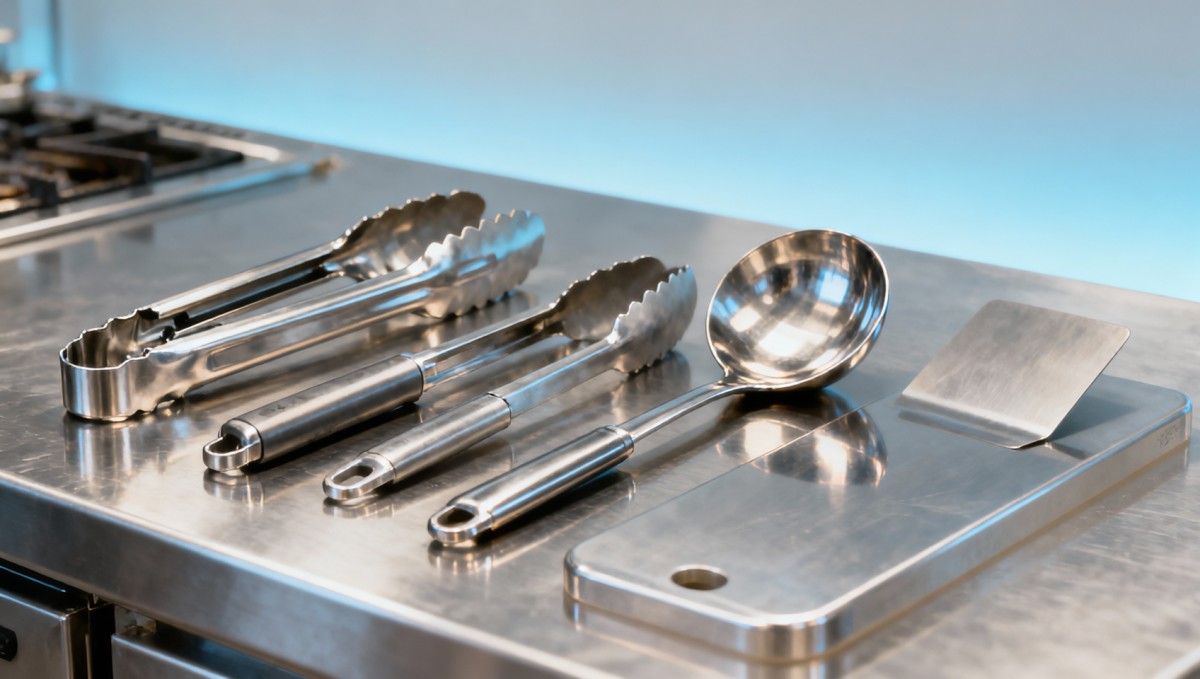
In catering environments, tools often move between raw preparation, hot holding, service, and post-event cleaning within a few hours. When designs are difficult to sanitize, residue can accumulate in seams, joints, textured grips, and absorbent materials. Over time, these surfaces become harder to inspect visually and more expensive to maintain. For operations serving 200 to 2,000 meals per day, even small sanitation delays can affect the full production schedule.
Ease of sanitization also supports consistency. Operators work under pressure, especially during banquet service, hospital meal production, school catering, and event catering. A tool that can be washed, rinsed, and sanitized in a standard 3-step cleaning routine without disassembly reduces training complexity. It also lowers the chance of shortcuts during peak hours when teams may process dozens of utensils in less than 15 minutes.
Procurement teams should also consider lifecycle cost. A cheaper tool with hollow handles, low-grade plating, or weak welds may trap moisture, corrode, or crack after 6 to 12 months. By contrast, well-finished stainless steel kitchen tools with smooth transitions and fewer joints can remain serviceable for 2 to 5 years, depending on frequency of use and wash method. That difference affects replacement budgets, downtime, and sanitation compliance.
For decision-makers, sanitization-friendly tools are part of a broader risk-control strategy. Foodservice audits, internal hygiene checks, and customer expectations all favor tools that are easy to verify as clean. In export-oriented food processing or international hotel groups, standardized tool specifications also simplify purchasing across multiple sites and reduce variation between branches.
Operational risks linked to poor tool design
The most common sanitation problems come from four design issues: hidden gaps, absorbent materials, rough surface finishes, and multi-part construction that is difficult to inspect. These issues may not be obvious during initial purchase, but they become visible after repeated washing, thermal cycling, and daily handling.
- Riveted or layered handles can trap food particles and moisture after repeated use.
- Wood or low-density plastic may absorb liquids, odors, and stains within weeks in humid kitchens.
- Decorative textures improve grip but may increase cleaning time by 20% to 40% in manual wash routines.
- Tools with detachable components can support repair, but poorly designed joints increase inspection burden.
When these factors appear across hundreds of items, the cumulative effect on labor and hygiene control becomes significant. That is why professional kitchen tools for catering should be specified using sanitation criteria at the same level as durability and ergonomics.
Key material and design features that make catering tools easier to sanitize
Material choice is the first filter in selecting easy-to-sanitize kitchen tools. In most commercial applications, stainless steel remains the preferred base material because it is non-porous, corrosion-resistant, and compatible with repeated washing. For many catering tools, grades commonly used in food environments offer better long-term performance than coated or painted surfaces that may chip over time.
However, material alone is not enough. Surface finish, weld quality, handle construction, and geometry are equally important. A polished or smoothly brushed surface is generally easier to clean than a rough cast finish. Rounded corners are easier to rinse than sharp internal angles. One-piece construction is often preferable for scrapers, tongs, and serving spoons because it reduces the number of residue traps.
Buyers comparing kitchen tools wholesale options should ask whether the tool is dishwasher-safe, whether it tolerates frequent chemical sanitizers, and whether it can withstand repeated exposure to temperatures ranging from cold room conditions near 0°C to hot wash or service conditions above 80°C. For high-throughput kitchens, resistance to warping and corrosion after 500 or more cleaning cycles is a practical benchmark.
Below is a comparison table that helps teams assess common material and construction choices used in restaurant supplies and catering tools.
The table shows that the easiest tools to sanitize are not always the cheapest, but they are usually the most predictable in daily operation. In catering businesses with repeated wash cycles, smoother surfaces and fewer components often reduce both labor time and hygiene uncertainty.
Design checkpoints for buyers and operators
When evaluating professional kitchen tools, a simple inspection checklist can prevent costly mistakes. Teams should review a sample item under bright light, run fingers over edges and joints, and check whether the tool can be fully cleaned without narrow brushes or tool-specific disassembly. If cleaning requires more than 2 or 3 extra steps, the design may not suit a fast-paced catering environment.
Practical selection criteria
- Prefer seamless or low-joint construction for tools used more than 50 times per day.
- Check whether handles remain stable after repeated hot wash cycles and sanitizer exposure.
- Avoid deep decorative grooves, exposed fasteners, and hollow sections without sealed ends.
- Ask suppliers about cleaning compatibility with dishwashing, chemical sanitation, and manual scrubbing.
These checkpoints are especially useful when sourcing restaurant supplies for catering companies that need repeatable quality across multiple sites, franchise locations, or institutional kitchens.
How to choose the right tools for different catering environments
Not every catering operation needs the same sanitation-focused tool specification. A hotel banquet kitchen, a hospital catering unit, a school meal provider, and a food processing support kitchen each face different cleaning frequency, staffing, and audit requirements. That is why selection should start with the operating environment rather than product appearance alone.
For example, hospital and care facility kitchens often prioritize strict separation between allergens, special diets, and ready-to-serve foods. In these environments, color-coded tools and smooth polymer or stainless steel surfaces can simplify zoning and reduce mistakes. Event catering companies, by contrast, may prioritize portable, impact-resistant tools that can handle transport, temporary wash stations, and fast turnaround within 4 to 8 hours.
Central kitchens and food processing-linked catering units usually benefit from standardized tools with defined replacement cycles. A consistent fleet of ladles, tongs, scoops, scrapers, and knives allows training teams to establish one sanitation routine across multiple shifts. This reduces variation and makes it easier to manage bulk purchasing, spare inventory, and operator onboarding.
The following table maps typical application needs to recommended sanitation-oriented tool characteristics.
This comparison highlights a key procurement principle: the best easy-to-sanitize kitchen tools are context-specific. A product that works in a restaurant prep line may not perform as well in a hospital meal distribution unit or in off-site catering logistics.
Questions to ask before placing a wholesale order
- How many wash cycles per day will the tool experience: 1 to 2, 3 to 5, or more than 5?
- Will the tools be washed manually, in commercial dishwashers, or with both methods?
- Do you need color segmentation for raw meat, vegetables, allergens, or ready-to-eat zones?
- Is operator training standardized across one site or multiple branches?
- What is the acceptable replacement cycle: 6 months, 12 months, or 24 months and beyond?
These questions help purchasing teams move beyond unit price and focus on sanitation efficiency, total cost of ownership, and process fit.
Procurement, maintenance, and implementation tips for long-term hygiene control
A sanitation-friendly tool only delivers value when procurement, onboarding, and maintenance are aligned. Many catering companies buy tools in bulk but fail to define inspection routines, replacement thresholds, or cleaning method compatibility. As a result, durable kitchen tools may be mixed with lower-grade items, making sanitation practices inconsistent across teams and shifts.
A better approach is to build a 4-part implementation plan: specification review, sample testing, operator feedback, and replacement tracking. During sample testing, teams should simulate actual use for at least 7 to 14 days. This period helps identify whether handles loosen, surfaces scratch easily, or residues remain visible after normal cleaning. It also gives operators a chance to compare comfort and washability under real conditions.
Maintenance standards should be practical and measurable. For example, visual inspection can be conducted daily, full condition checks weekly, and replacement reviews every 3 to 6 months for high-use items. Tools showing cracks, loose joints, deep scoring, corrosion, or permanent staining should be removed quickly, even if they still appear functional. Hygiene failure often begins before total product failure.
For buyers working with kitchen tools wholesale suppliers, it is useful to define packaging, replenishment, and lot consistency requirements upfront. Consistent dimensions, materials, and finish quality help maintain uniform cleaning procedures. This is especially important when scaling across multi-site catering operations or when integrating tools into broader kitchen equipment procurement plans.
Recommended implementation workflow
- Define the use case by station: prep, cooking, holding, service, transport, or cleaning return.
- Request samples and inspect 6 key points: seams, grip, finish, balance, cleanability, and heat resistance.
- Run a short field test over 1 to 2 weeks with operators from at least 2 shifts.
- Record cleaning time, visible residue issues, and damage after repeated wash cycles.
- Approve standardized purchasing and set review intervals for reordering and replacement.
This workflow reduces procurement risk and helps decision-makers compare suppliers using operational evidence instead of catalog descriptions alone.
Common purchasing mistakes to avoid
One common mistake is buying mixed tool sets with inconsistent materials and finishes. Another is prioritizing ergonomic styling without checking sanitation impact. A third is ignoring operator feedback during trial use. In practice, a tool that saves 10 seconds in prep but adds 30 seconds in cleaning is often a poor fit for high-volume catering. Procurement teams should measure both performance and cleanability before finalizing orders.
FAQ: practical questions buyers ask about easy-to-sanitize kitchen tools
How do I know if a kitchen tool is truly easy to sanitize?
Check for non-porous materials, minimal seams, smooth edges, and no hidden cavities. A practical test is whether the tool can be fully cleaned and visually inspected in a normal wash process without narrow-detail brushing on multiple joints. If the tool needs special disassembly or retains residue after 1 routine cleaning cycle, it may not be ideal for catering use.
Are stainless steel kitchen tools always the best option?
Not always, but they are often a strong choice for professional catering because of corrosion resistance, durability, and smooth cleanable surfaces. In some cases, high-quality food-grade polymers are useful for color coding, reduced weight, or lower noise. The decision should depend on temperature exposure, wash method, duty cycle, and whether the tool will be used more than 20, 50, or 100 times per day.
What should wholesale buyers focus on besides price?
Focus on construction consistency, cleaning compatibility, replacement cycle, and usability across different shifts or locations. Ask whether the supplier can provide stable batches, repeatable dimensions, and predictable lead times such as 2 to 4 weeks for replenishment. Unit price matters, but sanitation efficiency and service life often determine the real cost.
Which tools usually create the most sanitation issues in catering kitchens?
Tools with wire intersections, riveted grips, absorbent handles, rough cutting surfaces, and hollow components often create the most problems. Whisks, peelers, handled spatulas, cutting boards, tongs, and scoops should receive extra review. If these are used in raw-product zones, inspection standards should be even tighter.
How often should catering tools be replaced?
There is no single answer, but high-use tools may need review every 3 months and replacement within 6 to 18 months depending on wear, wash intensity, and material. Lower-use serving tools may last longer. Replacement should be based on condition, not only age. Cracks, corrosion, looseness, warping, or surfaces that no longer clean fully are clear triggers for removal.
Easy-to-sanitize kitchen tools for catering improve more than hygiene. They support faster turnaround, lower labor pressure, more consistent cleaning routines, and better control over replacement cost. For purchasers, operators, and business decision-makers, the best results come from matching tool design, material, and maintenance practice to the actual catering environment.
If you are comparing professional kitchen tools, planning kitchen tools wholesale purchases, or upgrading restaurant supplies for catering companies, a structured evaluation process will deliver better long-term value than choosing on price alone. Contact us to discuss your application, request a tailored product recommendation, or learn more about sanitation-focused kitchen equipment solutions for commercial foodservice.
- stainless steel kitchen
- central kitchen
- kitchen tools
- restaurant supplies
- Commercial Dishwasher
- kitchen equipment
- restaurant supplies for catering
- restaurant supplies for catering companies
- professional kitchen tools
- stainless steel kitchen tools
- durable kitchen tools
- kitchen tools for catering
- kitchen tools wholesale
Popular Tags
Kitchen Industry Research Team
Dedicated to analyzing emerging trends and technological shifts in the global hospitality and foodservice infrastructure sector.
Industry Insights
Join 15,000+ industry professionals. Get the latest market trends and tech news delivered weekly.
No spam. Unsubscribe anytime.

Contact With us
Contact:
Anne Yin (Ceramics Dinnerware/Glassware)
Lucky Zhai(Flatware)