
Meat grinder machine output drops for reasons you can fix
When a meat grinder machine output drops, the cause is often easier to fix than it seems. For after-sales maintenance teams, identifying whether the issue comes from blade wear, plate blockage, feeding speed, or motor load can prevent unnecessary downtime and parts replacement. This guide explains the most common reasons behind reduced output and the practical solutions that restore stable performance fast.
Understanding output loss in a meat grinder machine
In commercial kitchens, food processing rooms, hotel back-of-house operations, and central preparation facilities, a meat grinder machine is expected to deliver stable throughput, consistent particle size, and safe operation over long working hours. When output falls, the problem is not only a mechanical issue. It also affects production planning, labor use, hygiene timing, product texture, and energy efficiency. For after-sales maintenance personnel, reduced grinding capacity is one of the most common service complaints because it is easy for operators to notice and costly for users to ignore.
A drop in output usually means the machine is no longer processing raw material at its designed rate. In practice, this may appear as slow feeding, smearing instead of cutting, motor strain, repeated clogging, inconsistent mince, or frequent stop-and-clean cycles. The good news is that many of these causes are correctable on site. A systematic inspection often reveals wear, setup errors, raw material problems, or operating habits rather than major equipment failure.
Why the kitchen equipment industry pays close attention to this issue
The kitchen equipment industry is moving toward automation, smart monitoring, and energy-saving performance. In that environment, a meat grinder machine is not judged only by whether it runs. It is judged by how efficiently it supports workflow, food safety, and product consistency. Restaurants need fast prep during rush periods. Hotels require stable output across different menus. Food processing companies depend on predictable grinding rates to keep downstream mixing, forming, or packaging lines balanced.
That is why output loss matters across the broader kitchen equipment sector. Lower throughput increases labor cost, causes temperature rise in the product, may reduce cut quality, and can shorten the effective service life of wear parts. For maintenance teams, the ability to diagnose output issues quickly strengthens customer trust and lowers unnecessary replacement of motors, gear sets, and electrical parts.
A practical overview of the most common causes
Most output problems in a meat grinder machine come from five practical areas: cutting system condition, plate obstruction, feeding conditions, drive performance, and assembly accuracy. These categories are useful because they match the way after-sales teams inspect equipment in the field. Instead of starting with expensive components, technicians can begin with the high-frequency causes that are easiest to verify.
This structured view helps maintenance staff separate mechanical wear from process-related causes. In many service visits, the machine itself is functional, but the output of the meat grinder machine falls because the operating condition has changed.
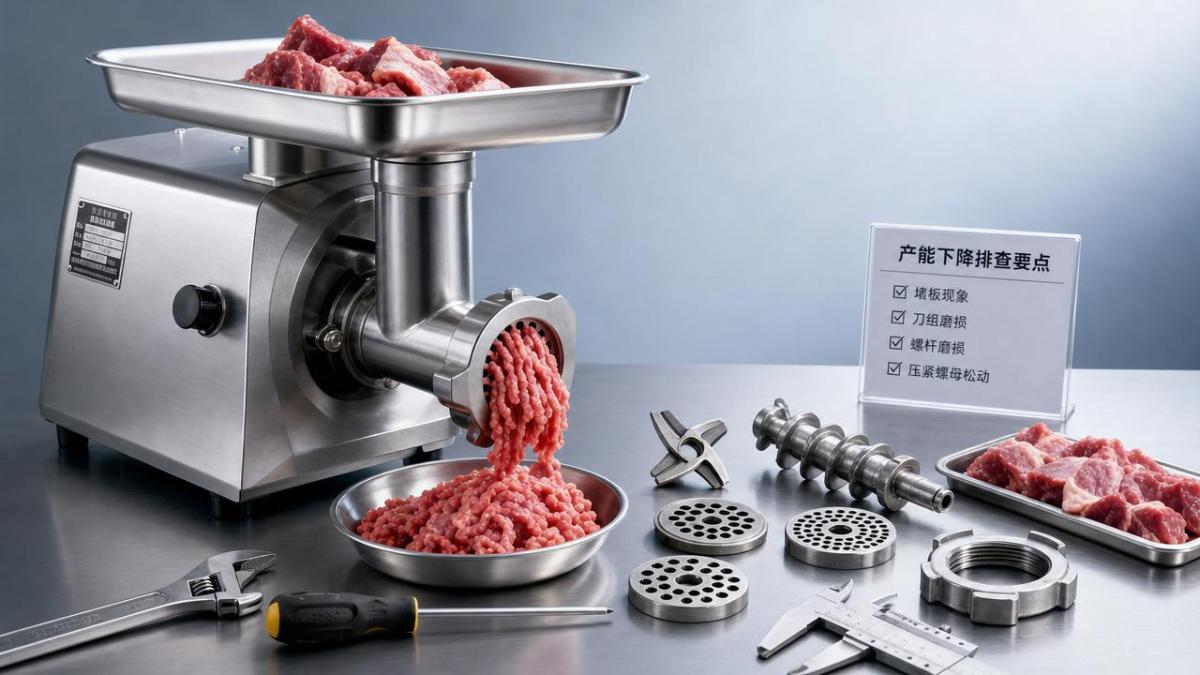
Blade wear and plate condition are often the first root causes
The cutting set is the heart of a meat grinder machine. If the knife edge is dull or the plate face is scored, the unit stops cutting efficiently and starts pushing or smearing material. Output may still continue, but at a slower rate and with a noticeable decline in texture. Operators sometimes interpret this as a motor weakness, yet the actual problem is poor cutting contact.
A simple field check is to inspect whether the knife and plate surfaces sit flat against each other. If they show uneven wear, discoloration from heat, or rounded cutting edges, throughput can drop significantly. Re-sharpening may help in some setups, but when surface flatness is lost, replacement is usually the better long-term solution. Technicians should also verify that the retaining ring is not too loose, because insufficient pressure reduces cutting efficiency even when parts are still usable.
Blocked plates and poor raw material condition reduce flow quickly
Plate blockage is another common reason a meat grinder machine slows down. Fat, connective tissue, sinew, membrane, and partially thawed product can clog the plate holes. When openings narrow, discharge decreases and pressure builds inside the head. The operator may respond by pushing harder, which often makes the problem worse.
Maintenance teams should look beyond the plate itself and review the condition of the raw material. Meat that is too warm tends to smear and stick. Product that contains excessive tendon or skin can wrap around the screw and knife. Oversized chunks can interrupt the feed path before the cutting set has a chance to work correctly. In these cases, cleaning alone will restore short-term output, but stable performance requires better trimming, pre-cut sizing, and temperature control.
Feeding speed, operator habits, and process mismatch
Not every low-output complaint is caused by worn parts. In restaurant kitchens and processing rooms, the feeding method has a major effect on the actual capacity of a meat grinder machine. If operators feed too slowly, leave gaps between batches, or use inconsistent chunk sizes, the machine will never reach normal throughput. On the other hand, overfeeding can overload the screw, increase motor draw, and trigger partial blockage.
This is especially relevant in facilities that process multiple products with one machine. A grinder set up for one plate size and one raw material may perform poorly when users switch to a different texture target without adjusting expectations. After-sales technicians add value when they explain the relationship between plate diameter, product temperature, fat ratio, and output rate. Training the user can be just as important as replacing parts.
Motor load, transmission health, and electrical stability
If the cutting system and feeding condition are acceptable, the next area is the power side. A meat grinder machine with reduced output may suffer from motor overload, unstable voltage, weak capacitor performance in single-phase systems, belt slip, gearbox wear, or coupling looseness. In these situations, the machine may sound slower, run hotter, or struggle more under normal load than it did previously.
After-sales maintenance should compare operating current with rated values, check whether the motor reaches normal speed without load, and listen for transmission noise. A belt that slips under load can mimic a major mechanical failure while being relatively easy to fix. Likewise, a poor power supply in a busy kitchen can lead to repeated complaints even though the machine passes a workshop test. Diagnosing under real operating conditions is therefore important.
Different service scenarios require different inspection priorities
The same symptom can have different root causes depending on where the meat grinder machine is used. A useful maintenance approach is to classify the service scenario before disassembly.
This classification matters because it prevents generic advice. A meat grinder machine used for short bursts in a restaurant does not fail the same way as one operating for hours in a semi-industrial food processing environment.
A practical troubleshooting sequence for after-sales teams
A clear troubleshooting sequence reduces service time and improves first-visit resolution. Start with visible and high-frequency causes. Confirm the complaint with actual product, not only a no-load test. Check the knife, plate, screw, and retaining ring assembly. Inspect for blockage, wrapped tissue, or excessive product warmth. Review feeding size and operator method. Then move to motor current, transmission components, and electrical supply.
Documenting these steps is valuable for recurring cases. If the same customer reports repeated low output from a meat grinder machine, service history often reveals a pattern: delayed blade replacement, unsuitable raw material, overloaded production expectations, or cleaning practices that shorten component life. Good records turn one repair into long-term performance improvement.
Preventive maintenance that protects output stability
The best way to avoid output loss is to treat throughput as a maintenance indicator, not just a production result. Regular inspection of cutting parts, scheduled replacement of wear items, proper lubrication where applicable, and routine checks on fasteners and transmission components can keep a meat grinder machine operating close to rated performance. Cleaning procedures should remove not only visible residue but also hidden buildup that narrows the plate holes or affects flat contact surfaces.
Customer education is equally important. Users should know the recommended raw material temperature, acceptable connective tissue level, suitable feed size, and correct assembly order after cleaning. In the wider kitchen equipment industry, this reflects a larger trend: performance is increasingly supported by smart maintenance habits, operator training, and process control, not only by hardware quality.
Frequently overlooked details
Several small details are often missed during service. A reversed knife can sharply reduce output. Mixing old and new cutting components may create poor contact. An apparently clean plate may still have narrowed holes from hardened protein or fat residue. A slightly bent screw can disturb feed consistency. Even a stable machine placement matters, because vibration can affect assembly tightness over time. These details seem minor, but together they explain many unresolved meat grinder machine complaints.
Moving from repair to performance improvement
For after-sales maintenance teams, solving low output should go beyond restoring basic function. The more valuable goal is to help the customer recover stable, repeatable performance. That means identifying whether the limiting factor is wear, blockage, process mismatch, or power delivery, then recommending the right corrective action and preventive routine. In many cases, a meat grinder machine output drop is not a sign of major failure. It is an early warning that the cutting system, feeding method, or maintenance cycle needs attention.
If you approach the issue in a structured way, most output problems can be fixed quickly and economically. Start with the simple checks, confirm the operating condition, and use the service visit to improve the customer’s daily practices. That approach reduces downtime, protects food quality, and strengthens the long-term value of every meat grinder machine in commercial kitchen and food processing applications.
Popular Tags
Kitchen Industry Research Team
Dedicated to analyzing emerging trends and technological shifts in the global hospitality and foodservice infrastructure sector.
Industry Insights
Join 15,000+ industry professionals. Get the latest market trends and tech news delivered weekly.
No spam. Unsubscribe anytime.
Hot Articles
 ASEAN FTA Upgrade Enters Text Verification Phase; Smart Kitchen Controls Added to Zero-Tariff List
- Electronics Manufacturing Leads with 13.6% Output Growth; Kitchen Appliance Chip Supply Stabilizes
- OpenCLAW-like Agent Deployment Risk Management Guidelines Released
- Green Power Stocks Rally; Overseas Buyers Prioritize Green Electricity Usage

Contact With us
Contact:
Anne Yin (Ceramics Dinnerware/Glassware)
Lucky Zhai(Flatware)