
How to compare kitchen tools for food processing by task
Choosing the right kitchen tools for food processing is not simply a matter of matching a machine to a recipe. For technical evaluators, the better approach is to compare tools by the task they must perform, the product characteristics they must handle, and the operating environment they must fit. A slicer that works well for leafy vegetables may fail on frozen meat. A mixer suitable for bakery dough may be inefficient for sauces or emulsions. The right comparison method reduces downtime, improves output consistency, and prevents overspending on features that do not add operational value.
This guide explains how to compare kitchen tools for food processing by task, with a focus on the criteria that matter most in commercial and industrial settings: throughput, precision, hygiene, safety, durability, maintenance needs, energy use, and automation compatibility. If you are evaluating equipment for a restaurant group, central kitchen, hotel, or food processing line, the goal is not to identify the “best” tool in general. It is to identify the best-fit tool for a specific workflow.
Start with the processing task, not the product category
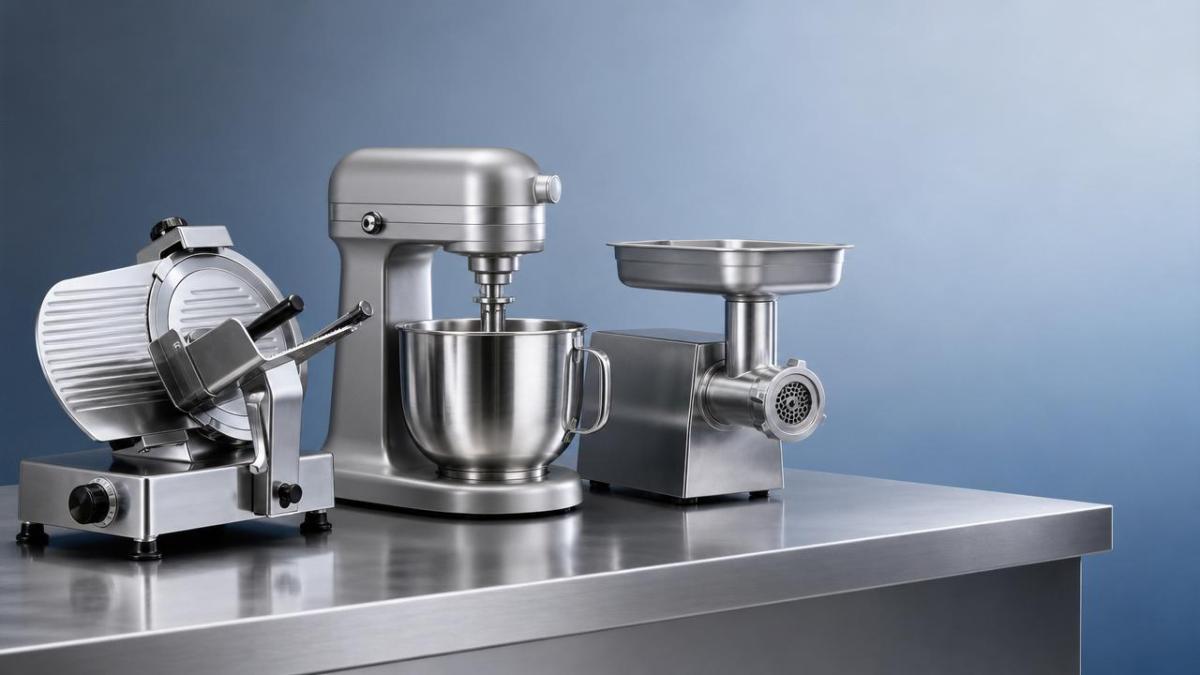
The most common evaluation mistake is comparing equipment by broad category rather than by operational task. “Food processor,” “mixer,” “grinder,” or “cutter” are useful labels, but they do not reveal whether a tool can meet the exact processing demands of your facility. Technical evaluation should begin by mapping each task in the workflow and defining what success looks like at that stage.
For example, slicing tasks require consistency of thickness, minimal product damage, acceptable yield loss, and cleaning efficiency between batches. Grinding tasks require control over particle size, feed stability, heat generation, and component wear. Mixing tasks require uniformity, batch repeatability, and appropriate torque for the product’s viscosity or density. By organizing comparison criteria around these specific outcomes, evaluators can quickly eliminate tools that look attractive on paper but do not match actual processing needs.
A practical framework is to assess each tool against five task-specific questions: What exactly must it do? How much product must it process per hour? What output quality is required? What hygiene and safety standards apply? And how will it fit upstream and downstream operations? This task-first logic is more reliable than brand-led or price-led comparisons.
Define the product characteristics before comparing tools
Even within the same task, different foods place very different demands on equipment. Product texture, moisture content, temperature, particle sensitivity, fat level, stickiness, and fiber structure all affect tool performance. Technical evaluators should create a product profile before reviewing any model.
Consider chopping as an example. Herbs, onions, nuts, cooked meat, and root vegetables all require different blade behavior, feed design, and motor performance. A tool that delivers clean cuts on firm produce may crush soft ingredients or generate excess fines. Similarly, a grinder used for chilled meat must manage temperature rise more carefully than one used for bread crumbs or dry ingredients.
Product variability also matters. If the same tool will process multiple ingredients across shifts, then quick adjustment, changeover simplicity, and cleaning access become more important than peak speed. In many facilities, the best equipment is not the one with the highest nominal capacity, but the one that performs consistently across a wider range of products with lower setup time.
How to compare slicing, cutting, and chopping tools
Slicing, dicing, julienning, and chopping are among the most common food preparation tasks, but the performance differences between tools can be significant. Technical evaluation should focus on cut quality, throughput under real load, blade life, operator safety, and waste rate.
Start with output consistency. Ask whether the tool can maintain the target size or thickness throughout a full production cycle, not just at initial startup. Inconsistent cuts affect cooking time, presentation, and downstream packaging. If the application involves pre-portioned or retail-ready output, dimensional accuracy may directly affect compliance and customer acceptance.
Next, evaluate feed mechanism design. Gravity-fed systems may be sufficient for low-volume or soft products, while powered feed systems often provide better control for high-throughput or dense materials. Blade material, sharpening frequency, and replacement cost should also be part of the analysis, since low blade durability can increase both maintenance cost and product waste.
For safety and sanitation, check whether guards, interlocks, and emergency stops are standard or optional. Also examine how easily the cutting chamber, blades, and contact surfaces can be disassembled for cleaning. In regulated environments, cleaning complexity can become a larger cost driver than purchase price.
How to compare mixing, blending, and emulsifying tools
Mixing and blending tools should be compared according to product rheology, batch size, mixing objective, and expected uniformity. A planetary mixer, ribbon blender, immersion blender, and high-shear mixer may all be used in food processing, but they solve different problems.
Technical evaluators should first define the process target. Is the goal simple ingredient incorporation, dough development, powder-liquid dispersion, sauce homogenization, or stable emulsion formation? Once that is clear, the key metrics become easier to compare: mixing time, consistency between batches, dead-zone risk, shear intensity, temperature impact, and ease of ingredient addition during operation.
Motor power alone is not enough. Torque characteristics under load are often more useful than maximum wattage, especially for dense doughs, viscous fillings, or sticky mixtures. Bowl geometry, agitator design, scraper effectiveness, and speed control range all influence actual performance. If recipes change frequently, programmable settings and repeatable controls may deliver more value than extra capacity.
For hygienic operations, pay attention to seals, shafts, and difficult-to-reach product contact points. Emulsifying and sauce applications can leave residue in narrow gaps, increasing contamination risk if the equipment is not designed for thorough cleaning. In these cases, sanitary design should be treated as a core performance criterion, not a secondary feature.
How to compare grinding, milling, and crushing tools
Grinding and milling tasks require a more technical comparison because particle size distribution, heat generation, and wear rates directly affect product quality. Evaluators should compare these tools on output specification, material compatibility, throughput stability, and maintenance burden.
The first question is whether the process requires coarse reduction, fine grinding, or tightly controlled particle distribution. Meat grinders, spice mills, grain mills, and crushers are not interchangeable simply because they all reduce size. Each has distinct feed behavior, cutting or impact mechanism, and sanitation implications.
Heat management is a major factor. Excessive temperature rise can damage texture, release unwanted moisture or oils, and shorten ingredient shelf life. For temperature-sensitive applications, ask for real operating data rather than relying on brochure claims. If possible, evaluate the tool under realistic load with the intended product.
Wear parts are another critical comparison point. Screens, burrs, plates, knives, and bearings can significantly affect total cost of ownership. A cheaper grinder with frequent replacement needs may be more expensive over time than a higher-priced unit with longer service intervals and easier maintenance access.
How to compare peeling, washing, and prep-support tools
Not all food processing tools perform direct transformation. Peeling, washing, drying, and sorting tools support quality and efficiency upstream, and they should be assessed with the same discipline. In many operations, these tools determine how much usable product reaches the next stage.
For washing tools, compare water efficiency, cleaning effectiveness, soil removal consistency, and compatibility with delicate or irregular products. For peeling equipment, measure yield loss, damage rate, speed, and adaptability to different product sizes. A fast peeler that removes too much usable material can create hidden cost far greater than labor savings.
Prep-support tools are often underestimated during capital planning. However, when they are poorly matched to the workflow, they create bottlenecks that reduce the value of downstream slicers, mixers, or packaging systems. Technical evaluators should therefore include line balance considerations in their comparison process.
Evaluate throughput in real operating conditions
Nameplate capacity rarely reflects actual production performance. When comparing kitchen tools for food processing, technical evaluators should distinguish between theoretical throughput and usable throughput. The difference often comes from loading time, changeovers, cleaning pauses, operator skill, and product variability.
A tool advertised at 300 kilograms per hour may only deliver 180 to 220 kilograms per hour in a real kitchen if product preparation is inconsistent or cleaning interruptions are frequent. That is why test conditions matter. Ask suppliers how capacity was measured, what product was used, whether the rate was continuous or batch-based, and what level of operator experience was assumed.
Where possible, compare throughput across a full cycle: loading, processing, unloading, and cleaning. This gives a much more realistic picture of operational fit. For central kitchens and industrial foodservice environments, this full-cycle view is essential for proper line design and labor planning.
Use total cost of ownership instead of purchase price
Price comparisons are necessary, but they should never be the main decision factor for technical evaluation. The better method is total cost of ownership, which includes acquisition cost, installation, utilities, maintenance, wear parts, cleaning labor, downtime risk, and expected service life.
Two tools with similar upfront prices may have very different long-term economics. One may consume more energy, require more frequent blade replacement, or need longer daily cleaning time. Another may support faster changeovers, reducing labor cost across multiple product runs. In high-volume environments, small differences in uptime and labor efficiency can outweigh the initial purchase price within months.
It is also useful to estimate the cost of poor fit. If a tool causes excessive waste, inconsistent output, or frequent stoppages, the operational loss can be much higher than the savings from choosing a cheaper unit. Technical evaluators should therefore build comparison tables that include both direct and indirect cost factors.
Do not overlook hygiene, safety, and compliance
In commercial kitchens and food processing facilities, safety and sanitation are not optional evaluation points. They are core requirements that affect audit readiness, worker protection, cleaning time, and brand risk. A tool that performs well mechanically but is difficult to sanitize may be a poor investment.
Review the material of all food-contact parts, weld quality, surface finish, sealing design, and disassembly process. Smooth, accessible surfaces reduce residue accumulation and improve cleaning reliability. If the operation requires allergen control or frequent product changeovers, simple and repeatable cleaning procedures become even more valuable.
Safety assessment should include guarding, emergency stop access, lockout compatibility, overload protection, and training complexity. Tools used by multiple operators across shifts should be especially intuitive and fail-safe. Equipment that depends too heavily on operator caution may increase accident risk over time.
Assess integration, automation, and future scalability
Because the kitchen equipment industry is moving toward smarter and more integrated systems, technical evaluators should also consider whether a tool can fit future operational upgrades. This does not mean every tool needs advanced automation, but it should at least support the level of control, monitoring, and workflow integration the facility expects over its lifecycle.
For some applications, digital speed control, programmable recipes, sensor-based monitoring, or compatibility with centralized kitchen management systems can improve consistency and traceability. In larger operations, integration with conveyors, weighing systems, or packaging lines may be a deciding factor.
Scalability also matters. If production volume is likely to grow, compare whether the tool can support additional shifts, upgraded accessories, or parallel deployment without major workflow redesign. A technically sound purchase is one that fits current demand while leaving room for efficient expansion.
A practical comparison checklist for technical evaluators
When reviewing kitchen tools for food processing, use a task-based checklist rather than a generic equipment scorecard. Start with the task, define the product, and then compare models using operational evidence. This method keeps the evaluation focused on measurable fit.
A strong checklist should include: task objective, target throughput, product characteristics, output quality standards, sanitation requirements, operator safety features, utility needs, maintenance intervals, wear-part costs, cleaning time, training demands, integration needs, and expected service life. If possible, add test results from actual product trials.
It is also helpful to assign weighted scores. For example, a central kitchen producing multiple SKUs may assign more weight to cleaning speed and changeover flexibility, while a high-volume meat processor may prioritize throughput stability and temperature control. Weighted scoring improves internal alignment and supports more defensible purchasing decisions.
Conclusion: compare by task to make better equipment decisions
The most effective way to compare kitchen tools for food processing is to evaluate them by the task they must perform, the product they must handle, and the workflow they must support. This approach gives technical evaluators a clearer basis for judging real performance than simple comparisons based on price, brand, or machine category.
Whether you are assessing slicers, mixers, grinders, peelers, or prep-support tools, the key is to focus on functional fit, output consistency, hygiene, safety, maintenance burden, and long-term operating cost. A good tool does not just process food. It supports stable production, protects quality, and fits the technical realities of the kitchen or plant.
When comparison is structured around real tasks and measurable requirements, procurement decisions become more accurate, more defensible, and more valuable over the full life of the equipment. That is the standard technical evaluators should aim for in modern food processing environments.
Popular Tags
Kitchen Industry Research Team
Dedicated to analyzing emerging trends and technological shifts in the global hospitality and foodservice infrastructure sector.
Industry Insights
Join 15,000+ industry professionals. Get the latest market trends and tech news delivered weekly.
No spam. Unsubscribe anytime.
Hot Articles
 ASEAN FTA Upgrade Enters Text Verification Phase; Smart Kitchen Controls Added to Zero-Tariff List
- Electronics Manufacturing Leads with 13.6% Output Growth; Kitchen Appliance Chip Supply Stabilizes
- OpenCLAW-like Agent Deployment Risk Management Guidelines Released
- Green Power Stocks Rally; Overseas Buyers Prioritize Green Electricity Usage

Contact With us
Contact:
Anne Yin (Ceramics Dinnerware/Glassware)
Lucky Zhai(Flatware)