
Commercial Steamers and the capacity gap many kitchens miss
Many kitchens underestimate how much a Commercial Steamer can affect output, consistency, and workflow until production bottlenecks appear. For technical evaluators, the real issue is not just cooking speed, but whether steaming capacity aligns with peak demand, energy targets, and food quality standards. This article examines the hidden capacity gap and what it means for equipment selection in modern commercial kitchens.
Why capacity gaps matter differently across kitchen scenarios
In the kitchen equipment industry, capacity is often discussed as a simple number: trays, pans, kilograms per hour, or meals per shift. Yet in real operations, the performance of a Commercial Steamer depends on the production pattern behind that number. A hotel banquet kitchen, a hospital meal line, a quick-service restaurant, and a central production kitchen may all require steam cooking, but they do not stress equipment in the same way.
This is why technical assessment should move beyond brochure capacity. Evaluators need to consider batch frequency, menu mix, loading density, regeneration needs, holding time, water quality, ventilation constraints, energy cost, and labor skill levels. The hidden capacity gap appears when nominal output looks sufficient on paper but fails under actual peak conditions.
For buyers in commercial kitchen equipment projects, the risk is not only underperformance. Oversized steam systems can also reduce energy efficiency, increase idle losses, complicate maintenance, and consume valuable floor space. The best Commercial Steamer is therefore not the biggest unit, but the one that fits the operational scenario with the least compromise.
Where the capacity gap usually appears
Most capacity mismatches emerge in one of four business situations. First, menu expansion adds steamed vegetables, seafood, rice, dumplings, or reheating functions without a matching review of steam load. Second, service peaks become shorter and more intense, especially in schools, healthcare, and canteens. Third, labor shortages push kitchens toward multi-function equipment, expecting one Commercial Steamer to replace several steps. Fourth, sustainability targets encourage lower energy use, but older specifications still rely on rough output assumptions rather than measured demand.
In practical terms, a technical evaluator should ask a basic but revealing question: is the steamer supporting continuous flow production, staggered batch production, or short peak bursts? The answer changes the ideal chamber size, steam generation method, recovery speed, control system, and installation requirements.
Typical application scenarios for a Commercial Steamer
The most effective way to evaluate a Commercial Steamer is to map it to actual use scenarios. Below is a comparison framework that helps technical teams identify where nominal capacity and usable capacity diverge.
This scenario-based view is especially relevant in integrated kitchen systems, where steamers interact with blast chillers, holding cabinets, combi ovens, prep lines, and digital kitchen management tools. A Commercial Steamer should be judged as part of a process, not as a standalone box.
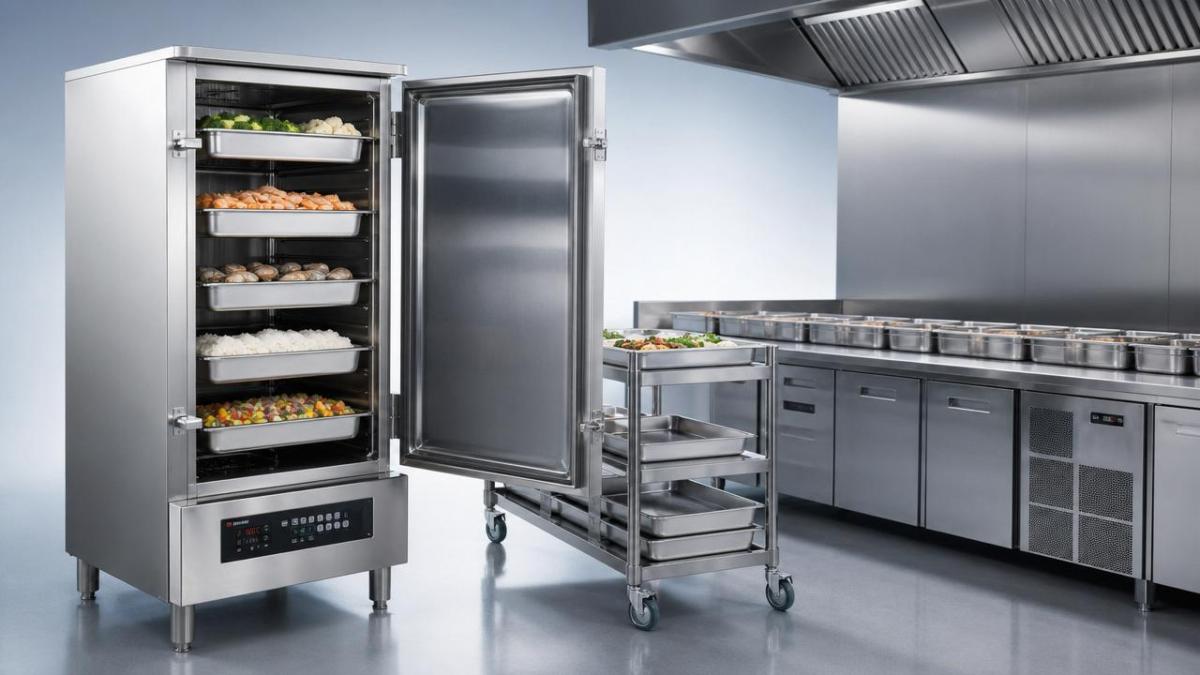
Scenario 1: Banquet and hospitality kitchens with sharp demand peaks
Hotels and banquet venues often appear well equipped, yet they are among the most vulnerable to capacity gaps. Their challenge is not average production over a day, but concentrated output during short service windows. A Commercial Steamer in this environment must recover quickly after door openings, maintain temperature stability under full-pan loading, and support menu diversity without delaying plating.
Technical evaluators should pay attention to steam generation speed, door seal performance, condensate management, and control precision. If banquet operations frequently shift between vegetables, seafood, dim sum, and reheating tasks, mixed-load performance matters more than theoretical maximum tray count. The chamber may hold many pans, but if cooking uniformity breaks down during simultaneous loads, usable capacity is lower than advertised.
In hospitality projects, a second issue is workflow congestion. If racks, landing surfaces, and pass areas are not designed around the Commercial Steamer, staff may queue around the unit, creating delays that look like cooking problems but are actually layout failures.
Scenario 2: Healthcare, education, and institutional foodservice
Hospitals, care facilities, and schools usually prioritize food safety, consistency, and meal timing. In these settings, a Commercial Steamer supports vegetables, proteins, grains, and therapeutic diet items that must be delivered with minimal variation. The capacity gap here often comes from mixed product behavior. Dense proteins, delicate vegetables, and starches do not respond identically to the same steam cycle, so a full chamber can reduce uniformity even when total volume seems acceptable.
A technical evaluation should therefore include cycle programmability, sensor accuracy, sanitation-friendly construction, and compatibility with HACCP documentation practices. Kitchens serving hundreds or thousands of meals in a narrow dispatch period need predictable cycle completion more than top-end hourly output. If a Commercial Steamer cannot repeat the same result across multiple shifts or operators, it creates quality risk and scheduling instability.
For institutional users, maintenance predictability is also critical. Water treatment, descaling access, and serviceability can directly affect uptime. An otherwise capable unit may lose practical value if scaling reduces steam performance over time.
Scenario 3: Quick-service, chain restaurants, and compact urban kitchens
Not every operation benefits from a large-capacity Commercial Steamer. In quick-service restaurants and compact kitchens, the better fit may be a smaller unit with faster responsiveness and simpler controls. These operations often handle frequent short batches, limited back-of-house space, and staff with high turnover. A large chamber can increase warm-up losses and reduce efficiency if only partially loaded most of the day.
Here, the capacity gap usually works in reverse: kitchens buy a larger steamer for future growth, but daily usage stays light. The result is unnecessary utility consumption, slower cleaning, and poor space utilization. For technical evaluators, key criteria include startup time, ease of training, compact installation, and compatibility with fast menu execution. In chain environments, standardized controls and repeatable cleaning procedures can matter as much as cooking performance.
This scenario also highlights the broader shift in commercial kitchen equipment toward energy-efficient kitchen solutions. A well-sized Commercial Steamer can support sustainability goals better than an oversized one running below its effective range.
Scenario 4: Central kitchens and food processing support lines
Central kitchens, meal prep hubs, and food processing support environments usually focus on throughput, repeatability, and integration. In these applications, the Commercial Steamer is rarely isolated; it feeds packing, chilling, holding, or dispatch systems. The main hidden gap is often not chamber volume itself, but how the unit connects to surrounding logistics.
For example, if pan loading is manual and slow, a large steamer may sit idle between cycles. If unloading areas are cramped, product temperature can drift before the next process step. If cleaning windows are short, a more complex unit may reduce net operating time. Technical evaluators should therefore analyze the full process: how product enters, how long it stays, who unloads it, where it goes next, and whether digital production scheduling supports the rhythm.
In food processing-related settings, materials, drainage, cleanability, and control traceability become more important than in many restaurant projects. The right Commercial Steamer should support industrial discipline without becoming a bottleneck.
What technical evaluators should compare beyond rated capacity
A specification sheet may list pan count, power, and dimensions, but scenario fit depends on a deeper set of indicators. The most useful evaluation points include:
- Peak-load recovery after repeated door openings
- Uniformity across top, middle, and bottom rack positions
- Cycle stability with mixed menu items and varied tray depths
- Water quality tolerance and descaling requirements
- Energy consumption under partial load, not only full load
- Operator interface clarity and training burden
- Integration with ventilation, drainage, trolley systems, and cleaning routines
These factors are increasingly important as smart kitchen technologies and automated kitchen systems become more common. Data visibility, programmable recipes, and service alerts can strengthen the value of a Commercial Steamer, especially in multi-site or high-compliance operations.
Common misjudgments that lead to poor scenario fit
Several recurring errors appear in kitchen equipment selection. One is assuming that more trays always mean better scalability. Another is using average daily meal count instead of peak-period demand. A third is ignoring product mix and loading density. A fourth is focusing on purchase price while underestimating water treatment, maintenance downtime, and workflow inefficiency.
There is also a tendency to compare a Commercial Steamer only with another steamer, rather than with the broader cooking system. In some kitchens, part of the steam load may be better handled by combi ovens, batch kettles, or regenerative systems. The goal is not to maximize one machine’s role, but to optimize the total kitchen process.
A practical scenario-fit checklist before selection
Before finalizing a Commercial Steamer specification, technical teams should confirm a few practical questions. What is the shortest and most intense service window? Which menu items must be steamed simultaneously? How often will the chamber be only partially loaded? What water treatment is available on site? Can staff clean and maintain the unit within the actual labor model? Is there enough surrounding space for safe loading and unloading? And can the equipment support future menu changes without wasting energy today?
When possible, scenario testing with real pans, real recipes, and realistic loading patterns provides more value than relying solely on catalog claims. This is especially true in the modern kitchen equipment market, where energy efficiency, digital control, and integrated workflow are now central buying criteria.
FAQ for scenario-based Commercial Steamer evaluation
How do I know if my kitchen has a capacity gap?
Typical signs include delayed service during peaks, inconsistent doneness between racks, frequent door opening to rotate trays, and staff queuing around the steamer. If these issues occur despite acceptable average output, the kitchen likely has a scenario-specific capacity gap.
Is a larger Commercial Steamer safer for future growth?
Not always. Future growth matters, but oversized equipment can reduce efficiency and complicate workflow. A better approach is to model expected demand growth against actual batch patterns, utility cost, and available space.
Which scenario needs the most precise controls?
Healthcare, education, and central production environments usually benefit most from precise controls because they depend on repeatability, compliance, and timed output across multiple cycles and operators.
Final guidance for matching the right steamer to the right kitchen
A Commercial Steamer should be selected by scenario, not by headline capacity alone. The right decision comes from understanding how a specific kitchen works at its busiest moment, how staff interact with the equipment, and how steam cooking fits into the wider production flow. For technical evaluators, the most reliable path is to compare application scenarios, identify hidden capacity losses, and confirm whether the equipment supports operational goals in quality, efficiency, energy use, and maintainability.
If your team is reviewing kitchen equipment for a new project or upgrade, start by documenting real service peaks, menu loads, utilities, and workflow constraints. That scenario-based assessment will do far more to reveal the right Commercial Steamer than any single catalog specification.
Popular Tags
Kitchen Industry Research Team
Dedicated to analyzing emerging trends and technological shifts in the global hospitality and foodservice infrastructure sector.
Industry Insights
Join 15,000+ industry professionals. Get the latest market trends and tech news delivered weekly.
No spam. Unsubscribe anytime.
Contact With us
Contact:
Anne Yin (Ceramics Dinnerware/Glassware)
Lucky Zhai(Flatware)