
Restaurant Kitchen Equipment Dimensions That Prevent Rework
Getting restaurant kitchen equipment dimensions right at the planning stage is critical for avoiding costly rework, installation delays, and workflow issues. For project managers and engineering leads, accurate sizing affects everything from utility coordination to staff efficiency and code compliance. This article outlines the key dimension considerations that help commercial kitchen projects stay buildable, efficient, and on budget.
When people search for restaurant kitchen equipment dimensions, they usually are not looking for generic appliance sizes. They need dimension rules that can be used in real projects: how much space to leave for installation, service access, aisle clearance, doors, hoods, utilities, and safe movement of staff and carts. For project leaders, the real question is simple: which dimensions prevent redesign after equipment is ordered or construction has started?
The short answer is that rework is usually caused less by the nominal width of a range or refrigerator and more by missed surrounding dimensions. Utility zones, door swing, maintenance pull-out space, hood coverage, turning radius, wall buildup, floor slope, and code-required clearance often create the conflict. A buildable kitchen layout therefore depends on system dimensions, not just equipment catalog dimensions.
Why dimension mistakes create expensive rework in commercial kitchen projects
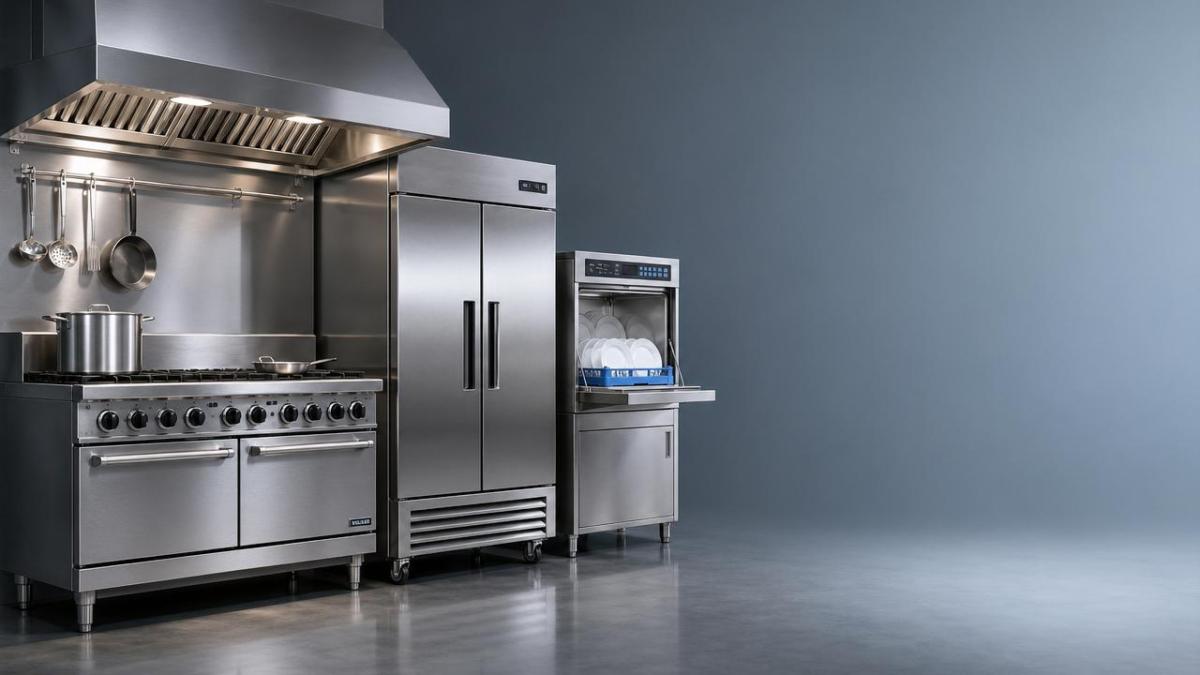
For project managers, rework rarely starts with one dramatic design error. More often, it comes from a chain of small assumptions. An undercounter refrigerator fits on paper, but its door cannot fully open because of a nearby column. A combi oven fits in the line, but the specified water treatment unit and drain location were not allowed for. A hood is centered over the cooking battery, but the manufacturer-required overhang and duct route were missed.
These conflicts trigger secondary costs quickly. Millwork must be recut, utility rough-ins moved, flooring patched, stainless fabrication revised, and installation teams rescheduled. In live projects, the impact also reaches procurement and operations. Equipment may sit on site waiting for revised supports, or opening dates may slip because inspection cannot pass.
The practical takeaway is that dimension control should be treated as a risk-management activity, not a drafting exercise. Teams that reduce rework usually validate dimensions in three layers: equipment dimensions from the manufacturer, operational dimensions for users, and construction dimensions for installers and service technicians.
What project managers should verify beyond the equipment spec sheet
Manufacturer cut sheets are essential, but they are not enough by themselves. Spec sheets commonly show overall width, depth, and height, yet many project conflicts arise from dimensions shown elsewhere in the documentation or only clarified during submittals. Before final coordination, teams should confirm the installed footprint, operating footprint, service footprint, and utility connection footprint for each critical item.
The installed footprint is the physical space the unit occupies after legs, casters, wall spacers, restraint cables, splashbacks, and manufacturer clearances are included. The operating footprint is larger. It includes door swing, drawer pull, loading/unloading space, and user standing position. The service footprint adds the space needed to access filters, motors, condenser coils, control panels, and removable components.
Utility dimensions are another frequent blind spot. Connection points are not always centered, and they may require minimum offsets from walls or floor penetrations. Gas manifolds, flexible hoses, quick disconnects, shutoff valves, grease waste piping, indirect drains, and water filtration systems all consume space. If these are coordinated too late, equipment that “fits” may still require field modification.
A strong review process asks a practical question for each major item: can it be delivered, set in place, connected, operated, cleaned, and serviced without moving adjacent equipment or rebuilding surrounding work? That is the level of dimension planning that prevents rework.
The most important restaurant kitchen equipment dimensions to plan early
Not every measurement carries equal risk. In most restaurant projects, a few dimension categories are responsible for the majority of layout failures. Prioritizing these early can prevent delays later.
1. Overall equipment width, depth, and height. This sounds obvious, but it must be checked against the final model number, not a basis-of-design assumption. Even units in the same product family can vary enough to affect lineal fit, hood length, or overhead shelf alignment.
2. Door swing and drawer extension. Refrigerators, freezers, ovens, proofers, and dishwashers need full operational clearance. A door that opens only 70 percent may prevent rack loading or pan removal. Verify whether handles, hinges, and adjacent walls reduce usable opening width.
3. Aisle and circulation clearance. The equipment line may fit tightly, but the kitchen still fails if staff cannot pass safely during service. Hot line aisles, prep aisles, landing zones near ovens, and routes for bussing carts need practical clearance, not just theoretical access.
4. Service and maintenance access. Condenser cleaning, panel access, drain maintenance, and filter replacement often require front, rear, side, or top access. If the kitchen design ignores this, service work later can mean shutting down adjacent stations or disconnecting units.
5. Hood capture and vertical coordination. Cooking equipment dimensions must align with hood overhang requirements, fire suppression coverage, and duct path. Ceiling height, structural beams, and plenum space can all affect final installation.
6. Utility connection zones. Gas, power, water, steam, drainage, and data should be dimensioned relative to the exact equipment connection points. Rough-ins based on generic centerlines often lead to relocation work.
7. Delivery path dimensions. A unit may fit in the kitchen but not through loading doors, elevators, corridors, or finished openings. Always verify crated and uncrated dimensions and required tilting or rigging space.
Clearance planning: where buildable layouts often succeed or fail
Clearance planning is where engineering intent meets daily operation. Many layouts look efficient because they compress every station, but overly tight kitchens often generate safety issues and maintenance problems. For project managers, the goal is not maximum density. It is reliable operation with enough room to move people, product, and equipment.
Line equipment is a common example. A cooking suite may be assembled tightly to save space, but adjacent heat sources, landing surfaces, and cleaning access still matter. If fryer baskets, oven doors, and refrigeration drawers interfere with one another, the layout can require late equipment swaps or field repositioning.
Corner conditions deserve special attention. Equipment placed at inside corners often loses functional access because handles, lids, and doors need space that is not obvious in plan view. The same issue occurs near columns, chase walls, and fire-rated enclosures. In many projects, the most expensive rework happens at these edge conditions rather than in the middle of the line.
Another common issue is vertical clearance. Equipment height affects not just visibility and ergonomics but also sprinkler coordination, hood mounting, top-service access, and shelf placement. Tall refrigeration units, stacked ovens, and dish machine vent assemblies can conflict with low structure or MEP systems overhead.
Dimension rules for key equipment categories
Different equipment types create different risks. Project teams should apply category-specific checks instead of using one generic dimension review for everything.
Cooking equipment. Ranges, griddles, charbroilers, fryers, and combi ovens should be coordinated with hood length, side clearances, landing space, and fire suppression coverage. If equipment is mobile for cleaning, include the travel range of gas hoses and restraining devices. For ovens, verify door opening depth and rack removal space.
Refrigeration equipment. Reach-ins, undercounters, and walk-ins require careful review of door handing, airflow clearance, condenser ventilation, and cleaning access. Walk-in boxes also need panel thickness, floor detail, ramp space if applicable, and evaporator placement checked against internal storage layout.
Warewashing equipment. Dishwashers create dimension issues through infeed/outfeed tables, scrap sinks, chemical storage, steam or heat release, and floor drainage. The machine body is only part of the space requirement. The operator path and rack landing areas are just as important.
Prep equipment. Slicers, mixers, food processors, and prep tables often appear secondary during planning, yet they can disrupt workflows if power access, safe operating clearance, or adjacent storage is missed. Countertop appliances especially need realistic setup depth, not just base table dimensions.
Ventilation and support systems. Hoods, shelving, overshelves, utility distribution, and stainless tables should be dimensioned as part of one coordinated assembly. A support item installed a few inches off can create a cascade of changes to equipment below it.
How to coordinate equipment dimensions with utilities and construction trades
Kitchen rework often results from a gap between equipment planning and trade coordination. The culinary layout may be correct, but the rough-in package is too generic for actual installation. This is why dimension reviews should happen before procurement is finalized and again when approved submittals are available.
Start by locking critical equipment models early, especially for cooking, refrigeration, and warewashing. Then create a coordinated matrix that includes final dimensions, required clearances, utility loads, connection locations, mounting conditions, and access needs. This should be reviewed jointly by kitchen consultants, MEP engineers, general contractors, and installation teams.
It is especially important to coordinate dimensions in section and elevation, not only in plan. Floor sinks, trench drains, wall backing, curb heights, shelf elevations, hood mounting, and ceiling services all depend on vertical data. Many field conflicts occur because teams coordinate width and depth accurately but leave height relationships unresolved.
Mockups can also be valuable for tight or high-throughput kitchens. Even a taped floor layout or digital clash review can reveal whether the proposed dimensions support actual movement. For complex projects such as hotels, central kitchens, or premium restaurant concepts, this step is often cheaper than one round of post-installation adjustments.
A practical dimension checklist to reduce change orders and delays
For project leaders, the most useful tool is a repeatable checklist. Before approving a layout or releasing equipment for order, verify the following points for each major item or equipment group.
Confirm final manufacturer and model number. Check overall dimensions against the latest submittal, not an early design standard. Verify whether optional stands, legs, casters, side panels, or control boxes change the footprint.
Review operating clearance. Measure door swing, drawer extension, lid opening, rack pull-out, and operator standing zone. Test conflicts with nearby walls, columns, and adjacent equipment.
Review service clearance. Identify where technicians will access coils, controls, drains, filters, belts, or removable components. Confirm whether access is from the front, side, rear, or top.
Review utility dimensions. Check exact connection points, valve positions, hose lengths, slope requirements, venting needs, and filtration assemblies. Make sure rough-ins are dimensioned from fixed building references.
Review code and safety impacts. Verify aisle clearance, egress interference, fire suppression coverage, sanitation requirements, and manufacturer-mandated spacing from combustible or non-combustible surfaces as applicable.
Review delivery and replacement path. Ensure the unit can enter the building, reach the kitchen, and be replaced in the future without demolition of finished work.
Finally, confirm ownership of dimension decisions. Many rework issues persist because no one is clearly responsible for validating the gap between design intent and installed reality. Assign that responsibility explicitly during coordination.
How accurate dimension planning improves budget, schedule, and long-term operations
For engineering leads and project managers, the value of accurate restaurant kitchen equipment dimensions goes beyond installation. It improves bid accuracy, reduces contingencies, and lowers the likelihood of change orders late in the build. It also helps procurement teams compare alternatives without accidentally introducing fit problems.
From an operational standpoint, dimensional accuracy supports labor efficiency and safer workflows. Staff can move without collisions, doors open fully, cleaning is easier, and service work causes less disruption. These may sound like small gains, but in high-volume foodservice environments they affect throughput and uptime every day.
There is also a lifecycle advantage. Kitchens that are dimensioned well are easier to maintain, upgrade, and re-equip. If clearances and utility access are planned from the beginning, future replacement projects become far less disruptive. That matters for owners trying to extend asset life and avoid unnecessary downtime.
Conclusion: treat dimensions as a project control issue, not a catalog detail
If your goal is to prevent rework, the most important lesson is this: restaurant kitchen equipment dimensions should be managed as an integrated coordination task. The nominal equipment size is only the starting point. What prevents field problems is understanding the full installed, operating, service, and utility envelope of each item.
For project managers and engineering teams, that means focusing early on the dimensions that actually drive risk: clearance, access, hood coverage, connection zones, delivery path, and vertical coordination. When those are checked systematically, commercial kitchen projects are much more likely to stay buildable, compliant, efficient, and on budget.
In practice, better dimension planning is one of the simplest ways to reduce avoidable redesign. It creates smoother installation, fewer surprises during commissioning, and a kitchen that works as intended from day one.
Popular Tags
Kitchen Industry Research Team
Dedicated to analyzing emerging trends and technological shifts in the global hospitality and foodservice infrastructure sector.
Industry Insights
Join 15,000+ industry professionals. Get the latest market trends and tech news delivered weekly.
No spam. Unsubscribe anytime.



Contact With us
Contact:
Anne Yin (Ceramics Dinnerware/Glassware)
Lucky Zhai(Flatware)