
How kitchen design manufacturers are handling custom projects
For project managers handling complex builds, a reliable kitchen design manufacturer can make the difference between smooth delivery and costly delays. As custom kitchen projects grow more technical, manufacturers are combining design expertise, smart equipment integration, and flexible production to meet unique operational needs. Understanding how they manage customization helps teams improve planning, control risks, and achieve better project outcomes.
Why project teams should evaluate custom kitchen projects with a checklist first
Custom kitchen projects rarely fail because of one obvious issue. More often, delays and budget overruns come from small gaps between layout planning, utility coordination, fabrication capability, compliance review, and installation sequencing. That is why working with a kitchen design manufacturer should begin with a checklist-based review rather than a general product discussion.
For engineering leaders and project managers, the main goal is not simply to buy equipment. It is to confirm whether the manufacturer can translate operational requirements into a buildable, compliant, and serviceable kitchen system. In commercial kitchens, hotel back-of-house projects, food processing support areas, and even high-end residential developments, customization affects ventilation, drainage, workflow, power loads, safety clearances, and future maintenance. A structured review helps teams identify those issues before drawings are frozen.
A capable kitchen design manufacturer typically handles custom work through a phased process: requirement capture, concept design, technical validation, coordinated production, staged quality checks, logistics planning, installation support, and after-sales service preparation. The checklist below helps you judge whether that process is strong enough for your project.
Core checklist: what to confirm before selecting a kitchen design manufacturer
- Confirm whether the manufacturer starts with operational workflow, not just equipment dimensions. A strong partner will ask about menu type, staff movement, peak volume, cleaning routines, and storage turnover before proposing layouts.
- Check in-house design depth. The kitchen design manufacturer should be able to produce layout drawings, utility connection plans, equipment schedules, and coordination details that support architects, MEP teams, and contractors.
- Verify customization range. Some suppliers can modify sizes but cannot redesign structures, integrate smart controls, or adapt stainless fabrication for unique site constraints.
- Review compliance capability. Food safety, fire safety, ventilation, sanitation, and electrical standards vary by market. Manufacturers handling international or multi-site projects should demonstrate familiarity with applicable codes and certifications.
- Ask how design changes are managed. Custom projects often evolve after site review. You need a version control process for drawings, approvals, material substitutions, and lead time updates.
- Assess production flexibility. A good kitchen design manufacturer should show whether custom fabrication is done on dedicated lines, modular cells, or mixed production schedules, and how this affects delivery reliability.
- Review installation support. On-site fit issues, utility mismatches, and sequencing conflicts are common. Confirm whether the manufacturer provides installation guidance, remote technical support, or field supervision.
- Examine service readiness. Spare parts planning, maintenance instructions, and commissioning documents matter as much as manufacturing quality, especially for hotels, restaurant chains, and central kitchens.
How manufacturers are actually handling custom projects today
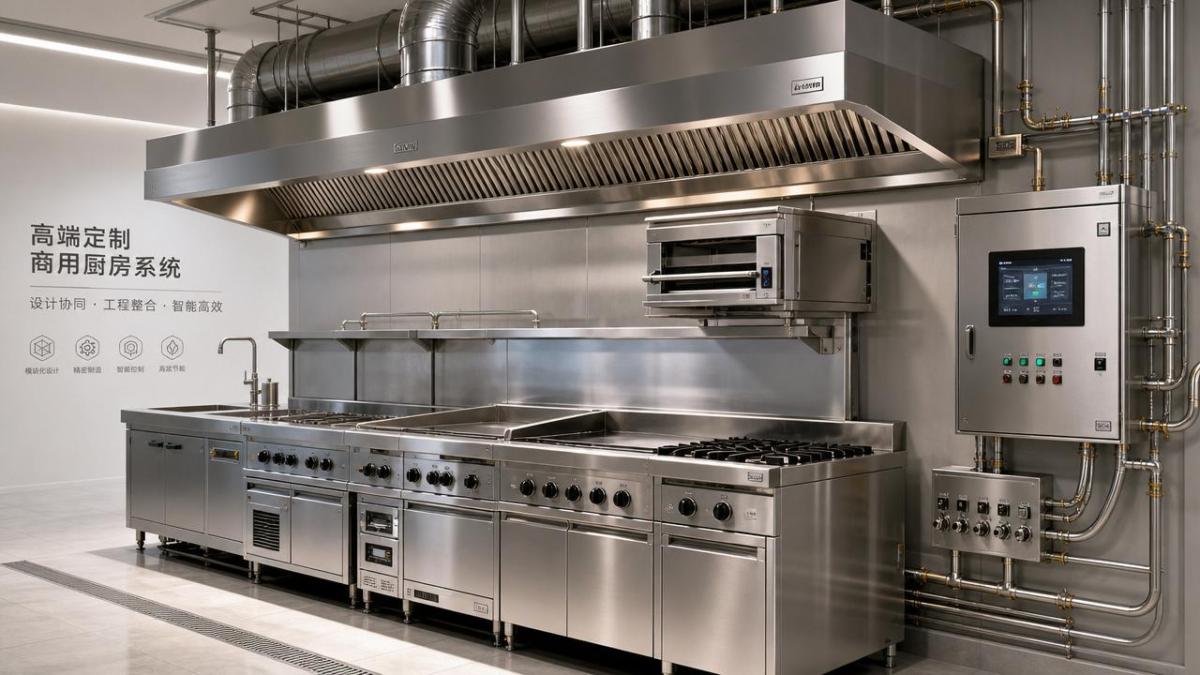
Leading manufacturers are moving away from a simple “catalog plus minor adjustment” model. Instead, they combine design software, engineering review, and modular fabrication methods to deliver faster customization without losing quality control. This is especially important in the kitchen equipment industry, where project requirements increasingly include smart controls, energy-saving systems, hygienic design, and integration across multiple work zones.
In practice, a kitchen design manufacturer may handle custom work through several operational methods. First, many build around standard modules, then customize dimensions, surfaces, supports, and utility positions. This reduces engineering risk while still adapting to site needs. Second, some use digital collaboration with project teams to review 2D layouts, equipment elevations, and clash-sensitive interfaces before fabrication begins. Third, more advanced companies integrate intelligent kitchen equipment, automated prep systems, or digital monitoring functions directly into the design package.
For project managers, this means the right manufacturer is no longer only a fabricator. It is a coordination partner that connects operational planning, manufacturing execution, and installation success.
Key judging standards for design and engineering capability
When reviewing a kitchen design manufacturer, project teams should focus on the following judging standards rather than marketing claims alone.
1. Requirement capture quality
A reliable manufacturer will request detailed inputs such as process flow, user count, service style, cleaning protocol, available utilities, ceiling restrictions, local code needs, and expansion expectations. If the early discussion stays too general, later design revisions are almost guaranteed.
2. Cross-disciplinary coordination
Custom kitchens affect architecture, plumbing, HVAC, gas systems, drainage, power distribution, and fire protection. The best kitchen design manufacturer can identify these interfaces early and issue coordination notes that reduce rework for consultants and contractors.
3. Prototype and validation process
For unusual counters, integrated cooking lines, or hygiene-sensitive fabrication, ask whether the manufacturer offers sample reviews, mockups, or pre-production confirmation. This is a strong sign of process maturity.
4. Material and fabrication control
Custom work often depends on stainless steel grade, weld finish, edge treatment, load-bearing structure, and corrosion resistance. Good manufacturers document these details instead of leaving them implied in drawings.
5. Change response speed
On complex projects, site conditions change. A capable kitchen design manufacturer should quickly evaluate what can be modified without affecting compliance, production slots, or installation logic.
Scenario-based checklist: what changes by project type
Not all custom kitchen projects should be judged the same way. The manufacturer’s approach must match the actual use case.
Restaurants and chain foodservice
Priority checks include speed of service workflow, repeatability across locations, maintenance simplicity, and quick replacement access. If you manage rollout projects, ask the kitchen design manufacturer how they standardize core modules while allowing site-specific adaptation.
Hotels and large hospitality developments
These projects often require multiple kitchen zones, banquet support, pastry, cold prep, dishwashing, room service, and staff dining. Coordination complexity is high, so phased drawing review and utility planning become more important than unit price alone.
Central kitchens and food processing support facilities
Focus on hygienic zoning, throughput, cleanability, automation compatibility, and future capacity growth. The right kitchen design manufacturer should understand production logic, not just commercial kitchen appearance.
High-end residential or mixed-use developments
Space efficiency, finish detail, appliance integration, and aesthetic coordination matter more here. However, custom dimensions and concealed service interfaces still require disciplined technical review.
Common blind spots that create delays or cost growth
- Approving layout drawings before utility loads are confirmed. This leads to field changes and installation conflict.
- Assuming every custom request is low impact. Small changes in height, depth, or service entry can affect fabrication tooling and lead time.
- Ignoring cleaning and maintenance access. Tight spaces may look efficient on paper but fail operationally.
- Not clarifying local standards early. Imported equipment may require adaptation for voltage, gas type, hygiene regulations, or fire code.
- Treating installation as a separate issue from manufacturing. A good kitchen design manufacturer plans packaging, delivery sequence, access path, and assembly method from the start.
- Missing long-term parts and service planning. This is especially risky for projects using smart kitchen technologies or automated components.
Practical execution advice for project managers
If you want better outcomes from a kitchen design manufacturer, prepare structured inputs before requesting a proposal. Share floor plans, utility availability, target production or service volume, workflow expectations, compliance requirements, preferred equipment brands, and delivery milestones. The more complete the brief, the more accurate the design response and budget.
It is also useful to request a review package rather than a simple quotation. Ask for preliminary layout logic, equipment list assumptions, exclusions, lead time conditions, installation responsibilities, and a summary of design dependencies. This makes comparison between manufacturers more meaningful.
During execution, set formal checkpoints at concept approval, utility confirmation, fabrication release, pre-shipment inspection, and site installation readiness. These checkpoints help the kitchen design manufacturer and the project team align decisions before problems become expensive.
A quick comparison table for supplier review
Final decision guide: what to discuss before moving forward
Before appointing a kitchen design manufacturer, project managers should prioritize five final discussions: design scope boundaries, customization limits, production timeline, compliance responsibility, and post-installation service support. These points usually determine whether a custom kitchen project stays controlled or becomes reactive.
If you need to move a project forward, start by confirming the parameters that most affect cost and delivery: operating scenario, required capacity, available utilities, material standards, smart integration needs, installation conditions, and approval timeline. Then ask the manufacturer to explain how those inputs will be converted into drawings, fabrication plans, quality checks, and service commitments.
In today’s kitchen equipment market, the best custom outcomes come from early technical clarity rather than late-stage correction. A strong kitchen design manufacturer should help your team reduce uncertainty, improve coordination, and deliver a kitchen that performs well long after installation is complete.
Popular Tags
Kitchen Industry Research Team
Dedicated to analyzing emerging trends and technological shifts in the global hospitality and foodservice infrastructure sector.
Industry Insights
Join 15,000+ industry professionals. Get the latest market trends and tech news delivered weekly.
No spam. Unsubscribe anytime.
Hot Articles
 ASEAN FTA Upgrade Enters Text Verification Phase; Smart Kitchen Controls Added to Zero-Tariff List
- Electronics Manufacturing Leads with 13.6% Output Growth; Kitchen Appliance Chip Supply Stabilizes
- OpenCLAW-like Agent Deployment Risk Management Guidelines Released
- Green Power Stocks Rally; Overseas Buyers Prioritize Green Electricity Usage

Contact With us
Contact:
Anne Yin (Ceramics Dinnerware/Glassware)
Lucky Zhai(Flatware)