
Durable kitchen tools are not always heavier
Many buyers assume durable kitchen tools must be heavy, but smart design proves otherwise. From stainless steel kitchen tools to ergonomic kitchen tools for home use, catering, and food processing, today’s products balance strength, comfort, and efficiency. Whether you are comparing a kitchen tools price list or sourcing from a kitchen tools supplier, manufacturer, or exporter, choosing the right professional kitchen tools can reduce cost and improve daily performance.
This matters across the kitchen equipment industry, where tools are no longer judged only by thickness or weight. Restaurants, hotels, central kitchens, and food processing facilities now evaluate durability through material grade, structural design, handle stability, corrosion resistance, and life-cycle cost. For operators, lighter tools can reduce wrist fatigue over 6–10 working hours. For procurement teams, better design can lower replacement frequency over 12–24 months.
For information researchers, users, buyers, and decision-makers, the key question is practical: how do you identify kitchen tools that are strong enough for demanding use without paying for unnecessary mass? The answer lies in understanding engineering details, application scenarios, and supplier capabilities rather than relying on the old assumption that heavier always means better.
Why durability in kitchen tools is about design, not just weight
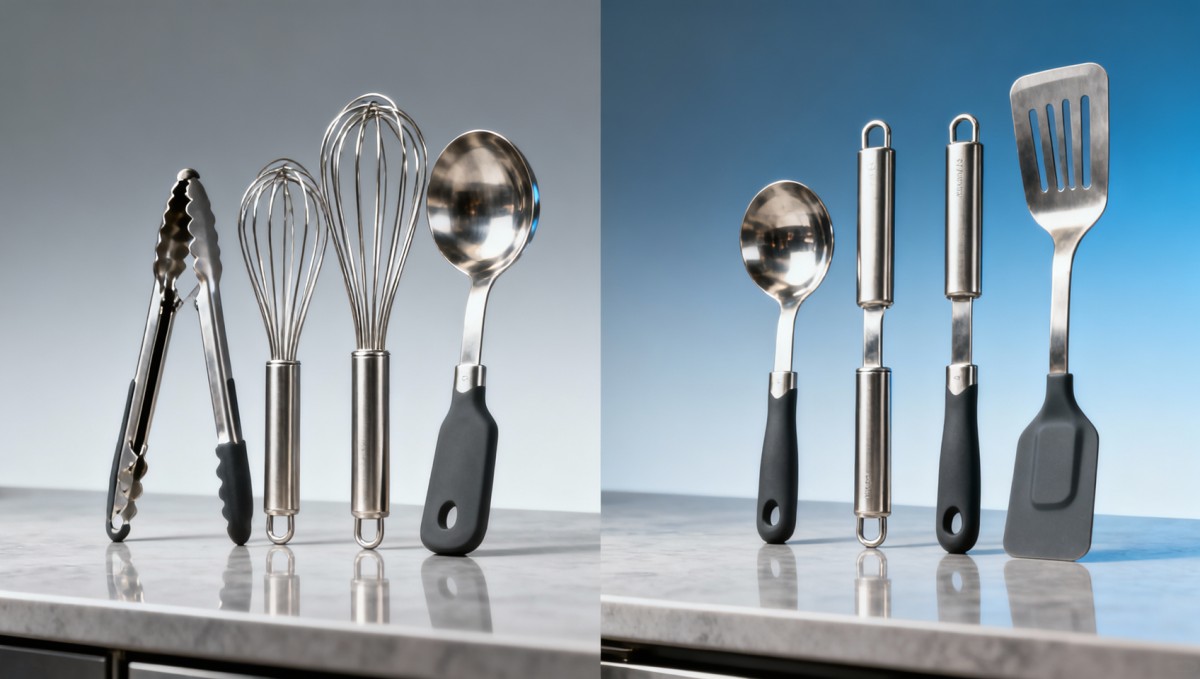
In commercial and residential kitchens alike, durability depends on how a tool performs under repeated stress. A ladle, tong, scraper, or whisk may be used 50 to 300 times per shift in a restaurant. In food processing, repetitive use can be even higher. If the joint, weld, edge finish, or handle connection fails, extra weight will not prevent breakdown. In many cases, poor weight distribution actually accelerates user fatigue and handling errors.
Modern stainless steel kitchen tools often use optimized geometry to maintain strength while reducing bulk. Reinforced ribs, one-piece forming, and balanced handle-to-head proportions can improve rigidity without adding unnecessary material. A well-designed 180 g serving tong may outperform a poorly designed 260 g alternative because the stress points are better supported and the grip remains stable after repeated washing and heat exposure.
This shift is especially relevant in B2B purchasing. Buyers are expected to control cost, improve safety, and maintain output. A tool that lasts 18 months with lower operator strain can be more valuable than a heavier tool that lasts the same period but slows work or increases hand fatigue. In high-volume kitchen operations, even a 5% improvement in handling speed can support smoother service during peak periods.
Another factor is cleaning and compliance. Heavier tools are sometimes harder to maneuver during sanitation, especially in facilities with frequent wash cycles. If a tool is cleaned 2 to 4 times per day, lighter ergonomic construction supports consistency and reduces the chance of dropping or damaging adjacent equipment. This is important for hotels, quick-service kitchens, bakeries, and food preparation lines where hygiene and speed must coexist.
Common reasons lighter tools can still be durable
- Use of corrosion-resistant stainless steel, such as commonly specified food-contact grades, instead of thicker but lower-quality metal.
- One-piece construction that removes weak connection points found in multi-part assemblies.
- Ergonomic handle shaping that distributes pressure evenly across the hand during 4–8 hours of repetitive use.
- Controlled thickness at high-stress zones, so reinforcement is added where needed rather than across the whole tool.
What buyers should stop using as the only benchmark
Weight alone is an incomplete metric. It should be reviewed together with bend resistance, weld quality, edge finishing, handle comfort, heat tolerance, and cleaning compatibility. In procurement reviews, at least 6 checkpoints are more reliable than a simple “heavier equals stronger” assumption.
How to evaluate professional kitchen tools for different application scenarios
The right kitchen tools depend on use environment. A home kitchen may prioritize comfort, storage, and moderate heat resistance. A restaurant line needs speed, anti-slip grip, and durability under continuous use. A food processing plant may focus more on sanitation, material consistency, and compatibility with standard operating procedures. For this reason, the same tool category should not be purchased with a single universal checklist.
A practical evaluation starts with application frequency and task intensity. If a spatula is used fewer than 20 times per day, moderate reinforcement may be enough. If a scraper or tong is used more than 200 times per shift, buyers should focus on fatigue reduction, connection integrity, and wash-cycle stability. The expected operating temperature also matters. Tools used near fryers, ovens, or steam lines need stronger heat resistance than those used in cold preparation zones.
The table below shows how selection priorities change across common kitchen environments. This helps procurement teams match tool specifications to actual workload instead of overbuying heavy products that do not improve output.
The main takeaway is that “best” is scenario-specific. A lighter ergonomic kitchen tool can be the stronger business choice when it supports productivity, sanitation, and lower strain over long shifts. This is why buyers should align product choice with measurable conditions such as use cycles, cleaning frequency, temperature range, and operator profile.
A practical 4-point selection framework
- Define task type: lifting, scraping, stirring, portioning, or serving.
- Estimate workload: low, medium, or high frequency over a 7-day operating cycle.
- Check environment: dry prep, wet zone, hot line, chilled room, or processing area.
- Review maintenance reality: hand wash, dishwasher, chemical cleaning, or sanitation protocol.
Where users often make mistakes
A common mistake is buying oversized or overly heavy tools for light-duty tasks. Another is choosing low-cost products without reviewing edge finishing or joint strength. These issues can lead to early replacement within 3–6 months, even if the initial kitchen tools price list looks attractive.
Key material and structural indicators buyers should compare
When comparing a kitchen tools supplier or manufacturer, the most useful approach is to ask for clear, comparable indicators. Material type is one part of the picture, but thickness distribution, forming method, surface finish, and handle construction also affect performance. A polished finish may look premium, yet a brushed or satin surface can sometimes hide scratches better and support daily commercial use more effectively.
Stainless steel kitchen tools remain widely preferred because they combine corrosion resistance, cleaning convenience, and structural stability. However, not all stainless steel tools are equal. Buyers should ask whether the product is formed in one piece, whether any weld points are reinforced, and whether edges are smoothed to reduce hygiene risk and improve handling safety. For operations with 2–3 sanitation cycles daily, these details matter more than visible thickness alone.
The table below helps purchasing teams compare kitchen tools beyond headline claims. It can also serve as a checklist when reviewing quotations, samples, or factory presentations from exporters and OEM suppliers.
A good comparison process should include both document review and sample testing. Buyers may run a 7-day or 14-day internal trial to observe comfort, cleaning results, and visible deformation. For high-volume users, recording replacement rate and operator feedback across 3 departments can provide more value than focusing on unit price alone.
Questions to ask a kitchen tools manufacturer or exporter
- Can the supplier explain where reinforcement is added and why?
- Are samples available for operational testing before bulk purchase?
- What is the typical lead time for standard orders, such as 15–30 days or 30–45 days?
- Can the supplier support consistent finish and dimensions across repeat orders?
Procurement note
If your operation spans multiple sites, standardization matters. A tool with consistent dimensions and performance helps simplify staff training, storage layout, and replenishment planning across 2, 5, or even 20 locations.
Balancing price, lifecycle cost, and procurement efficiency
A kitchen tools price list only shows part of the cost. The full business impact includes replacement frequency, cleaning time, training simplicity, operator comfort, and procurement consistency. A lower unit price may appear attractive during quotation review, but if tools need replacement every 4 months instead of every 12 months, the annual cost can become significantly higher. This is especially true for hotels, chain restaurants, and foodservice groups managing multiple teams.
For enterprise decision-makers, procurement efficiency also matters. Working with a capable kitchen tools supplier can reduce sourcing complexity by consolidating specifications, packaging, and delivery schedules. Instead of buying from 4 or 5 fragmented vendors, some businesses prefer 1 or 2 coordinated suppliers who can support standard orders, documentation, and after-sales communication. This often saves time during replenishment cycles and quality issue handling.
The table below compares direct unit-price thinking with lifecycle-based purchasing. It is useful for buyers preparing internal proposals or supplier evaluation summaries.
The key conclusion is simple: price should be linked to service life and operational impact. In many cases, a well-designed professional kitchen tool offers stronger value even if its initial price is 10%–20% higher than a basic alternative. If it reduces replacement events, complaints, and operator strain, the payback can be realized within one purchasing cycle.
A 5-step B2B purchasing process
- List tool categories by department and usage level.
- Request a structured quotation with materials, finishes, and pack details.
- Test 2–3 sample options in real kitchen conditions.
- Review lead time, replenishment capability, and communication speed.
- Approve bulk order only after functionality and cleaning checks are passed.
Implementation, maintenance, and common buyer questions
Even the best kitchen tools perform poorly if implementation is inconsistent. Once a business selects a product range, the next step is to standardize usage, storage, and cleaning. This is particularly important in kitchens with 2 or more shifts per day, where tools change hands frequently. Clear placement, simple handling instructions, and scheduled checks can extend usable life and reduce unnecessary losses.
Maintenance does not need to be complicated. Most stainless steel kitchen tools benefit from basic routines: remove food residue quickly, avoid prolonged contact with aggressive chemicals, dry properly after wash cycles, and inspect high-stress points weekly. In commercial settings, a 10-minute end-of-shift inspection can identify early signs of loosening, deformation, or edge damage before they affect service.
Businesses sourcing from a kitchen tools exporter should also confirm packaging logic and delivery planning. Bulk orders often move more smoothly when tools are grouped by function, department, or site. Standard lead times may range from 15–30 days for regular products and 30–45 days for larger or customized runs. Clear documentation reduces receiving errors and speeds internal distribution after arrival.
FAQ: how buyers and users can avoid common errors
How can I tell whether a lighter kitchen tool is durable enough?
Check construction quality first. Review whether the tool has one-piece forming, reinforced stress zones, smooth finishing, and stable grip control. Then run a practical test over 7–14 days under real workload. If the tool remains comfortable, does not deform, and cleans easily, lower weight is not a disadvantage.
Which users benefit most from ergonomic kitchen tools?
Operators in restaurants, catering services, bakeries, and central kitchens benefit the most because they repeat the same movements for 4–10 hours. Ergonomic kitchen tools help reduce grip strain, improve control, and maintain output during busy service periods.
What should procurement teams include in supplier evaluation?
At minimum, compare 6 items: material consistency, structural design, sample performance, cleaning compatibility, lead time, and repeat-order stability. If the supplier can also support packaging coordination and specification consistency across batches, procurement risk becomes easier to manage.
How often should kitchen tools be reviewed after purchase?
For high-use kitchens, a weekly visual inspection and a monthly replacement review are practical. For lower-use environments, a monthly inspection may be enough. The right review cycle depends on usage intensity, wash frequency, and exposure to heat or chemicals.
Durable kitchen tools are not always heavier, and that insight can improve both purchasing quality and daily performance. For modern kitchens, the winning combination is strong material, smart structure, ergonomic handling, and supplier consistency. Whether you are selecting tools for household use, foodservice, catering, or industrial food preparation, the most reliable choice is the one that fits the workload, cleaning routine, and operating environment.
If you are reviewing a kitchen tools price list, testing samples, or comparing a kitchen tools supplier, manufacturer, or exporter, focus on lifecycle value rather than weight alone. To discuss product details, request a tailored sourcing plan, or explore more kitchen equipment solutions for your business, contact us today.
Popular Tags
Kitchen Industry Research Team
Dedicated to analyzing emerging trends and technological shifts in the global hospitality and foodservice infrastructure sector.
Industry Insights
Join 15,000+ industry professionals. Get the latest market trends and tech news delivered weekly.
No spam. Unsubscribe anytime.



Contact With us
Contact:
Anne Yin (Ceramics Dinnerware/Glassware)
Lucky Zhai(Flatware)