
What defines a reliable glass storage container supplier
Choosing a reliable glass storage container supplier can directly impact product quality, food safety, and long-term operational efficiency. For business decision-makers in the kitchen equipment industry, the right supplier is more than a manufacturer—it is a strategic partner that supports consistent supply, customization needs, and compliance with global standards. Understanding what defines a trustworthy supplier is essential for making smarter sourcing decisions in a competitive market.
Why does choosing a reliable glass storage container supplier matter so much?
A glass storage container supplier influences much more than unit price. In the kitchen equipment sector, storage containers are connected to food preservation, kitchen organization, transportation safety, retail presentation, and brand reputation. Restaurants, hotels, food processors, and distributors all depend on containers that can withstand repeated use, temperature changes, cleaning cycles, and food-contact requirements.
If the supplier fails in quality consistency, the consequences can spread quickly: broken containers in transit, lid sealing issues, customer complaints, production delays, or even regulatory risk. That is why procurement teams increasingly evaluate a glass storage container supplier not only on manufacturing capability, but also on traceability, testing standards, packaging reliability, lead time stability, and communication efficiency.
For enterprise buyers, reliability means predictable outcomes. A dependable supplier helps reduce hidden costs, supports repeat orders, adapts to seasonal demand, and contributes to smoother inventory planning. In a market where food safety and operational efficiency are top priorities, reliable sourcing becomes a competitive advantage rather than a routine purchasing task.
What qualities define a truly reliable glass storage container supplier?
A reliable glass storage container supplier usually demonstrates strength across several areas instead of excelling in only one. Decision-makers should assess the supplier as a complete operating partner.
First, product quality must be stable. This includes glass clarity, wall thickness, heat resistance, sealing performance, edge finishing, and resistance to cracking or chipping. Whether the containers are designed for commercial kitchens, meal prep brands, food manufacturing, or home use, consistency from batch to batch is essential.
Second, compliance capability matters. A qualified glass storage container supplier should understand food-contact regulations in target markets and be able to provide supporting documentation such as test reports, material declarations, and relevant certifications. For international buyers, this is often non-negotiable.
Third, production and supply reliability are key. A supplier may offer an attractive sample, but if they cannot maintain delivery schedules at scale, they become a risk. Capacity planning, raw material control, packaging protection, and shipment coordination all affect supply continuity.
Fourth, responsiveness is a strong indicator of professionalism. Reliable suppliers answer technical questions clearly, share timelines transparently, and handle quality issues with structured corrective action. Good communication often reflects good internal management.
Finally, customization support can separate basic manufacturers from strategic partners. Many buyers need logo printing, private-label packaging, lid color options, shape adjustments, or bundled kitchenware solutions. A capable glass storage container supplier should be able to align product development with market positioning and operational needs.
How can buyers evaluate product quality before placing large orders?
The most effective way to assess a glass storage container supplier is to combine document review with physical verification. Samples are important, but samples alone are not enough. Buyers should request a structured evaluation process before approving volume production.
Start with material and product specifications. Clarify whether the containers use borosilicate glass or soda-lime glass, what temperature range they can handle, whether they are microwave-, freezer-, oven-, or dishwasher-compatible, and how the lid system performs under repeated use. Each of these details affects commercial suitability in different kitchen environments.
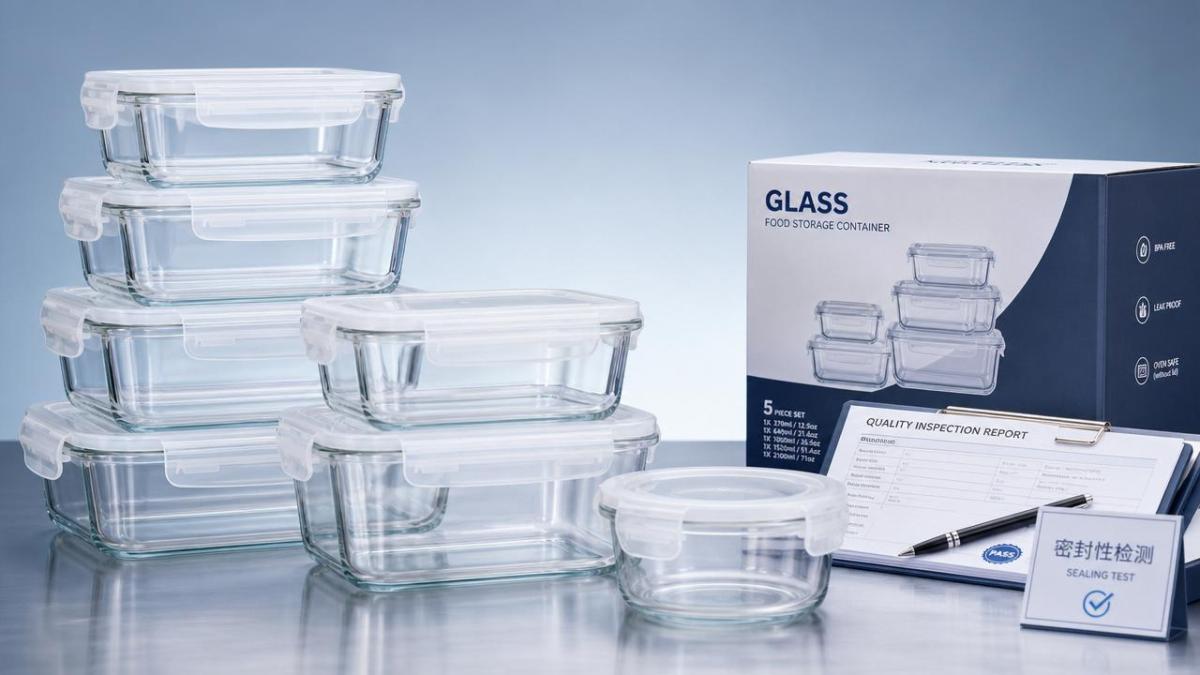
Next, inspect samples under practical conditions. Test stacking stability, seal tightness, resistance to leakage, ease of cleaning, and packaging protection. If the containers will be used in restaurants or food processing settings, sample testing should reflect real workflows rather than only showroom appearance.
It is also wise to review the supplier’s quality control process. Ask how incoming materials are checked, how defects are identified during production, what the acceptable quality level is, and whether final inspections include drop tests, dimension checks, and packaging verification. A reliable glass storage container supplier should explain these procedures confidently and with detail.
For higher-volume or long-term sourcing, factory audits or third-party inspections can provide additional confidence. This is especially useful when supplying demanding customers such as hotel groups, foodservice chains, importers, and branded kitchenware retailers.
Which evaluation factors matter most to business decision-makers?
Enterprise buyers usually need a balanced decision framework. The lowest quote rarely reflects the full cost of ownership. A more practical approach is to score a glass storage container supplier across operational, technical, and commercial dimensions.
This type of comparison helps procurement leaders avoid overemphasizing price. In many cases, a slightly higher-cost glass storage container supplier delivers better commercial results by lowering breakage rates, improving delivery reliability, and reducing complaint handling costs.
What common mistakes do companies make when selecting a glass storage container supplier?
One common mistake is treating all glass containers as interchangeable. In reality, differences in material composition, production technique, lid design, and packaging standards can significantly affect performance. A supplier that fits low-cost retail distribution may not be suitable for professional kitchen equipment channels or foodservice applications.
Another mistake is approving a supplier based only on attractive samples or promotional pricing. Initial samples may not reflect mass production consistency. Buyers should confirm whether the same quality level can be maintained across large batches and repeated orders.
Some companies also overlook packaging and logistics. Because glass products are fragile, transport protection is part of product quality. Even a technically strong glass storage container supplier can create problems if carton strength, internal dividers, palletization, and shipment handling are poorly managed.
A further risk is failing to define application requirements early. For example, storage containers for hotel buffets, frozen meal operations, supermarket shelves, and e-commerce distribution all have different demands. Without clear usage scenarios, buyers may select products that look right but perform poorly in actual operations.
Finally, some teams do not investigate the supplier’s problem-solving culture. Delays, breakage, and specification mismatches can happen in any supply chain. What matters is whether the supplier responds with accountability, data, and corrective measures instead of excuses.
How important are customization, innovation, and long-term cooperation?
They are increasingly important, especially in the modern kitchen equipment market. Buyers are no longer sourcing only functional containers; they are building product systems that support efficiency, storage management, food safety, and brand differentiation. A forward-looking glass storage container supplier should understand these broader business goals.
Customization adds value in several ways. Private labeling supports retailer branding. Tailored sizes can optimize shelf space or kitchen workflow. Improved lid designs can enhance user experience. Coordinated packaging can strengthen e-commerce presentation and reduce damage. For distributors and wholesalers, customization can also improve margin opportunities by creating less price-transparent product lines.
Innovation matters as well. Suppliers that invest in smarter design, more durable sealing systems, stackable formats, sustainable packaging, and energy-efficient production are better aligned with future industry trends. As foodservice and residential kitchen markets continue to evolve, buyers increasingly prefer partners that can adapt products to changing customer expectations.
Long-term cooperation often delivers operational gains that are difficult to achieve through short-term price shopping. A stable glass storage container supplier learns your specifications, quality priorities, demand cycles, and packaging preferences over time. This reduces onboarding friction, speeds up development, and creates a more resilient supply relationship.
What should you confirm before moving forward with a supplier?
Before final selection, business decision-makers should validate both the supplier’s promises and the practical details of cooperation. This step is where sourcing risk is either reduced or carried into the contract stage.
Confirm the exact product specification, including dimensions, glass type, temperature performance, lid material, and packaging method. Misalignment here often causes costly disputes later. Then verify production lead times, minimum order quantities, tooling needs, quality standards, and claim procedures for defective or damaged goods.
It is also important to understand how the glass storage container supplier manages demand changes. Can they support urgent replenishment? What happens during raw material shortages or peak seasons? Do they have backup plans for logistics disruption? Reliable suppliers usually have clearer contingency planning than weaker competitors.
Commercial terms should also be assessed carefully. Payment structure, sample policy, packaging charges, labeling costs, and after-sales support all affect the total business case. A lower factory price can be offset by high breakage rates, delayed shipments, or poor post-sale response.
Most importantly, look for evidence of alignment. The best glass storage container supplier is not simply the one with the broadest catalog, but the one that can support your target market, quality expectations, delivery rhythm, and growth plan with confidence and transparency.
Final question: how should decision-makers approach the next conversation?
A reliable glass storage container supplier is defined by consistent quality, regulatory readiness, dependable delivery, honest communication, and the ability to support long-term business needs. In the kitchen equipment industry, these qualities directly influence food safety, operational efficiency, and customer satisfaction. Choosing well means looking beyond catalog images and quotations to evaluate how the supplier performs under real commercial conditions.
If you need to confirm a specific sourcing plan, it is practical to begin with a focused discussion around product application, target market standards, order volume, customization requirements, test documentation, packaging expectations, lead times, and issue-resolution procedures. These questions will quickly reveal whether a glass storage container supplier can act as a dependable manufacturing partner or only as a short-term vendor.
Popular Tags
Kitchen Industry Research Team
Dedicated to analyzing emerging trends and technological shifts in the global hospitality and foodservice infrastructure sector.
Industry Insights
Join 15,000+ industry professionals. Get the latest market trends and tech news delivered weekly.
No spam. Unsubscribe anytime.
Hot Articles
 ASEAN FTA Upgrade Enters Text Verification Phase; Smart Kitchen Controls Added to Zero-Tariff List
- Electronics Manufacturing Leads with 13.6% Output Growth; Kitchen Appliance Chip Supply Stabilizes
- OpenCLAW-like Agent Deployment Risk Management Guidelines Released
- Green Power Stocks Rally; Overseas Buyers Prioritize Green Electricity Usage

Contact With us
Contact:
Anne Yin (Ceramics Dinnerware/Glassware)
Lucky Zhai(Flatware)