
What sets top restaurant kitchen equipment manufacturers apart
Choosing among restaurant kitchen equipment manufacturers is no longer just about price or product range. For business evaluators, the real differentiators lie in engineering quality, compliance standards, energy efficiency, smart integration, and long-term service capability. As the global foodservice industry moves toward automation and sustainability, understanding what separates top manufacturers can help buyers reduce risk, improve operational performance, and secure stronger long-term value.
For procurement teams, investors, sourcing managers, and technical evaluators, the stakes are high. A weak manufacturing partner can create delays of 4 to 12 weeks, inconsistent product performance, higher utility costs, and expensive downtime after installation. A strong partner, by contrast, improves kitchen workflow, supports compliance, and helps operators scale across single sites, hotel groups, central kitchens, or multi-unit restaurant chains.
The best restaurant kitchen equipment manufacturers stand out through a combination of production discipline, design capability, after-sales structure, and international business readiness. In a market shaped by automation, food safety, and energy efficiency, those differences are now measurable and commercially significant.
What business evaluators should look for first
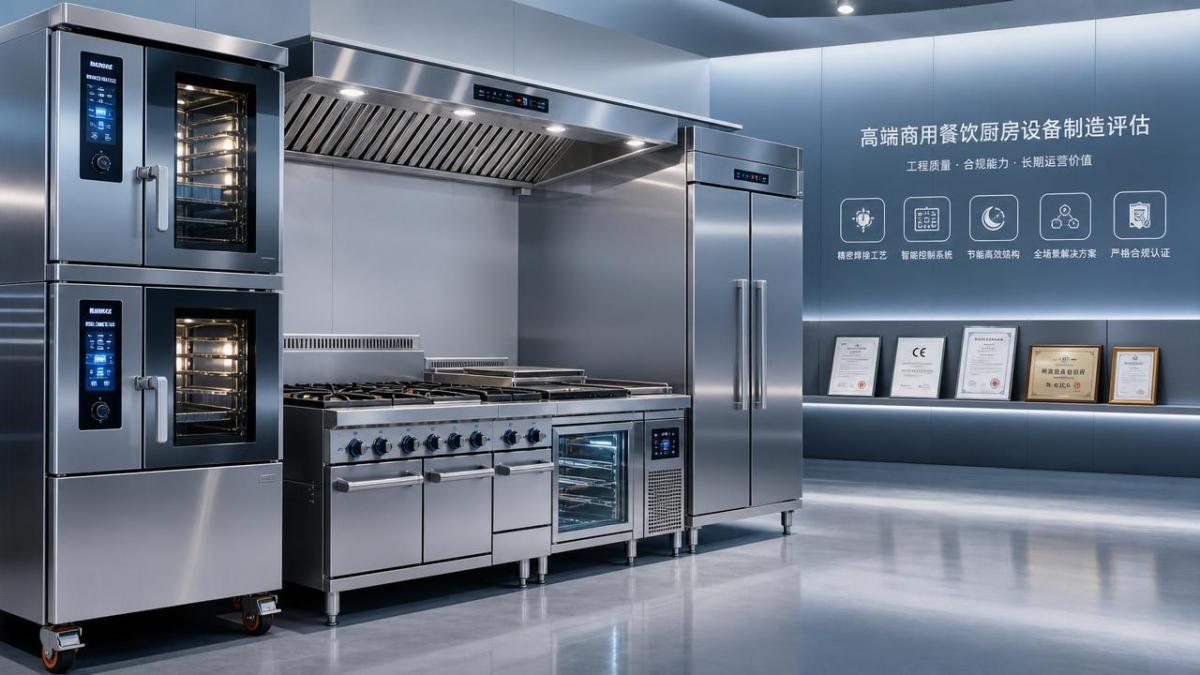
At the early screening stage, business evaluators usually compare 4 core dimensions: technical consistency, compliance fit, manufacturing capacity, and lifecycle support. While catalogs may look similar, performance in these areas often determines whether equipment remains reliable after 2,000 to 5,000 operating hours.
Engineering quality is more than material thickness
Many restaurant kitchen equipment manufacturers promote stainless steel construction, but leading suppliers go deeper. They control weld quality, tolerance consistency, heat distribution, insulation performance, electrical protection, and component matching. For example, an oven body made with food-grade stainless steel may still underperform if door sealing, burner calibration, or airflow design is weak.
Top-tier manufacturers usually maintain tighter process control across cutting, bending, welding, assembly, and testing. In practical terms, this reduces heat loss, noise, vibration, and premature wear. For buyers evaluating commercial ranges, combi ovens, fryers, refrigeration units, or dishwashing systems, build discipline often matters more than a broad SKU count.
Useful technical checks during evaluation
- Check whether temperature variation is controlled within a practical working range, such as ±1°C to ±5°C depending on equipment type.
- Ask for load test or burn-in test duration, often 2 to 8 hours for key powered equipment.
- Review component sourcing for motors, controllers, compressors, valves, and heating elements.
- Confirm whether spare parts remain available for at least 3 to 5 years after delivery.
Compliance capability reduces import and operating risk
For international buyers, compliance is one of the clearest ways to distinguish serious restaurant kitchen equipment manufacturers from low-visibility suppliers. Commercial kitchens operate under strict requirements related to electrical safety, gas systems, hygiene, ventilation compatibility, and food-contact materials.
A strong manufacturer can explain which standards apply by market, prepare accurate documentation, and align labels, voltages, plugs, and manuals before shipment. This becomes especially important when projects involve 220V or 380V systems, gas categories for different regions, or installation in hotels, institutional kitchens, and food processing environments.
The comparison below highlights common evaluation signals that help buyers identify higher-performing manufacturers before moving into pricing negotiations.
The most important takeaway is that better manufacturers make risk visible early. They do not rely on vague claims. Instead, they provide technical evidence, process detail, and service structure that allow business evaluators to compare suppliers on operational value rather than just unit cost.
How top manufacturers create long-term operating value
The best restaurant kitchen equipment manufacturers do not compete only on delivery of hardware. They help buyers improve total cost of ownership over 3 to 7 years. In commercial kitchens, that includes energy use, labor efficiency, maintenance frequency, uptime, and expansion flexibility.
Energy efficiency has become a financial metric
In high-volume kitchens, even a 5% to 15% difference in energy performance can materially affect operating costs. Efficient insulation, burner tuning, inverter-driven refrigeration, heat recovery logic, and standby mode management all contribute to lower utility consumption. This matters especially for equipment running 8 to 16 hours per day.
Leading manufacturers usually design equipment with practical efficiency features rather than just marketing labels. Examples include faster heat-up times, improved door sealing, optimized compressor cycling, and programmable operating modes that reduce unnecessary power draw during non-peak periods.
Smart integration supports consistency across locations
As restaurant groups and hotel operators adopt digital kitchen management, manufacturers with smart capabilities gain an advantage. Programmable recipes, fault alerts, temperature logging, and remote diagnostics help standardize output and reduce operator dependency. For chain operations, these functions can cut training time by 20% to 30% for selected cooking processes.
Not every project requires advanced connectivity, but the ability to integrate with monitoring systems or cloud-based maintenance tools is increasingly relevant. For business evaluators, the key question is not whether a device is “smart,” but whether its digital features reduce errors, service calls, or inconsistency in live operations.
Signs of meaningful smart functionality
- Recipe memory for repeated menu execution across multiple sites.
- Alarm history that records overheating, sensor faults, or door-open events.
- Remote parameter adjustment for approved service teams.
- Usage tracking that helps schedule preventive maintenance every 3, 6, or 12 months.
Service readiness separates exporters from strategic partners
Many suppliers can ship equipment internationally. Far fewer can support installation, commissioning, spare parts, and troubleshooting in a disciplined way. This is where top restaurant kitchen equipment manufacturers build trust with distributors, project contractors, and end users.
A reliable support model should define response windows, parts dispatch procedures, warranty boundaries, and documentation coverage. For powered equipment, buyers often look for initial technical response within 24 to 72 hours, depending on region and service agreement. Delayed support can shut down a production line, buffet operation, or quick-service kitchen during peak periods.
The following table shows how long-term value is usually created across technical, financial, and service dimensions.
When these strengths are present together, the manufacturer becomes more than a vendor. It becomes a lower-risk platform for growth, especially in projects involving multiple kitchens, franchise rollouts, or institutional foodservice expansion.
Practical criteria for supplier comparison and final selection
A good evaluation process should move from broad qualification to site-specific fit. In most cases, a 5-step model helps teams compare restaurant kitchen equipment manufacturers with greater accuracy: define use case, verify technical fit, review production capability, assess service readiness, and confirm commercial terms.
Step 1: Match the equipment to the operating scenario
A hotel banquet kitchen, fast-casual chain, central kitchen, and fine-dining restaurant do not need the same equipment logic. Throughput, menu complexity, cleaning frequency, ventilation limits, and peak-hour pressure all shape the right manufacturing choice. A fryer for 50 baskets per hour requires a different durability profile than one used only during two meal periods.
Step 2: Review lead time and production flexibility
Lead time matters beyond planning convenience. Delays in commercial kitchen projects can affect fit-out schedules, contractor sequencing, and opening dates. Standard equipment may ship in 15 to 35 days, while customized lines often require 30 to 60 days depending on complexity, voltage changes, or layout modifications.
Top manufacturers are usually transparent about bottlenecks, material dependencies, and seasonal capacity. They can also explain what can be customized without disrupting quality control, such as dimensions, power configuration, left-right workflow orientation, or interface language.
Step 3: Test service depth before signing
Business evaluators should request actual service assets, not just promises. This includes installation guides, exploded parts lists, wiring diagrams, cleaning instructions, and recommended preventive maintenance intervals. For cross-border orders, spare parts kits for the first 6 to 12 months can reduce startup risk.
Common supplier comparison questions
- How many inspection stages are used before shipment?
- What is the standard warranty scope for heating, cooling, and control components?
- Can the manufacturer support commissioning documents in the target market language?
- What is the expected spare parts dispatch window for critical components?
- How is operator training handled for programmable or automated equipment?
Step 4: Compare total value, not nominal price
The cheapest quotation often excludes factors that later increase cost: higher energy use, shorter component life, difficult cleaning, or longer service interruption. A stronger evaluation model considers purchase price, installation readiness, maintenance burden, expected operating hours, and service accessibility over a 36- to 84-month horizon.
This approach is especially useful when comparing restaurant kitchen equipment manufacturers from different export regions such as China, Germany, Italy, or Japan. Each market may offer distinct strengths in scale, customization speed, finishing quality, automation, or engineering specialization, and buyers should weigh those advantages against project priorities.
Common mistakes that weaken procurement outcomes
Even experienced sourcing teams sometimes focus too narrowly on catalog breadth or upfront pricing. That can lead to mismatched specifications, rework, or higher failure rates in the first 12 months. Avoiding a few common errors can significantly improve supplier selection results.
Mistake 1: Treating all stainless equipment as equal
Surface appearance is easy to copy. Internal structure, thermal behavior, and component durability are not. Restaurant kitchen equipment manufacturers should be assessed on assembly quality, control stability, and serviceability, not only visual finish or sheet thickness.
Mistake 2: Ignoring local installation conditions
Site realities such as power supply, exhaust layout, floor drainage, water pressure, and operator workflow can determine whether a machine performs as intended. A supplier that asks for layout drawings, utility details, and operating volume before quoting usually has stronger project discipline.
Mistake 3: Underestimating maintenance and training
Equipment with advanced features can still fail commercially if staff training is weak or maintenance access is poor. Cleaning cycles, wear-part replacement, and control logic should be manageable for real kitchen teams, not just ideal technical conditions. In many operations, a simple and robust design delivers higher value than a complex feature set with limited support.
Final perspective for buyers evaluating manufacturing partners
What sets top restaurant kitchen equipment manufacturers apart is their ability to deliver consistent engineering, practical compliance support, measurable operating efficiency, and dependable service over time. These strengths matter whether the buyer is sourcing a single combi oven, a full restaurant line, or equipment for a central food production facility.
For business evaluators, the best decision framework combines technical verification, lifecycle thinking, and realistic service assessment. Manufacturers that can explain their production methods, testing steps, integration options, and support process in detail usually create better long-term outcomes than suppliers competing on price alone.
If you are comparing restaurant kitchen equipment manufacturers for a current project, now is the right time to review specifications, operating requirements, and service expectations in a structured way. Contact us to discuss your application, get a tailored equipment evaluation framework, or explore solutions designed for efficient, compliant, and scalable commercial kitchen operations.
Popular Tags
Kitchen Industry Research Team
Dedicated to analyzing emerging trends and technological shifts in the global hospitality and foodservice infrastructure sector.
Industry Insights
Join 15,000+ industry professionals. Get the latest market trends and tech news delivered weekly.
No spam. Unsubscribe anytime.
Hot Articles

Contact With us
Contact:
Anne Yin (Ceramics Dinnerware/Glassware)
Lucky Zhai(Flatware)