
What separates a reliable kitchen tools factory from a risky one
Choosing the right kitchen tools factory can directly affect product quality, compliance, delivery stability, and long-term procurement risk. For business evaluators, the difference between a reliable manufacturer and a risky one lies not only in price, but also in production standards, quality control, certification, and supply chain transparency. This article outlines the key indicators that help buyers assess factory credibility with greater confidence.
Why scenario-based evaluation matters when selecting a kitchen tools factory
A kitchen tools factory may look strong on paper yet still be the wrong fit for a specific business need. A distributor serving supermarkets requires stable packaging, broad SKU consistency, and barcode-ready labeling. A restaurant supply brand may care more about durability, repeat order speed, and low defect rates across utensils used in high-frequency commercial kitchens. A food processing buyer may prioritize material traceability, hygienic finishing, and compliance with stricter safety expectations.
That is why business evaluators should not ask only whether a supplier is “good” or “bad.” The more practical question is whether the kitchen tools factory is reliable for the intended application scenario. Reliability is contextual. A factory that performs well for low-complexity household products may become risky when asked to support customized commercial-grade tools, private labeling, audit requirements, or multi-country compliance.
In the broader kitchen equipment industry, where automation, food safety, smart production, and energy-efficient manufacturing are reshaping supply expectations, factory assessment must go beyond quotations. It should connect factory capability to actual business use cases, procurement models, and operational consequences.
Typical business scenarios where factory reliability becomes critical
The same kitchen tools factory can present very different levels of risk depending on where its products will be used. For evaluators, the first step is to define the buying scenario clearly before reviewing production claims.
1. Retail and e-commerce private label programs
In this scenario, visual consistency, packaging quality, labeling accuracy, and return-rate control matter as much as the product itself. A risky factory may offer attractive pricing but struggle with color variation, logo inconsistency, packaging damage, or mixed carton labeling. These issues create customer complaints and damage brand reputation quickly.
2. Restaurant, hotel, and foodservice supply chains
Commercial kitchens use tools more aggressively than home users. Here, a reliable kitchen tools factory must demonstrate repeatable strength in materials, welding, edge finishing, ergonomics, and batch durability. Delivery stability is also essential because foodservice buyers often reorder on operational schedules rather than seasonal retail cycles.
3. Food processing and central kitchen applications
For food processing environments, the focus shifts toward hygienic design, corrosion resistance, surface treatment quality, and process discipline. A factory that cannot maintain traceable raw material records or control contamination risks may expose buyers to safety incidents, audit failures, or rejected shipments.
4. Importers managing multiple regional markets
Importers need a kitchen tools factory that understands documentation, testing expectations, product consistency, and shipment coordination across countries. The risk here often comes from incomplete compliance files, poor carton-level control, and weak communication during production changes.
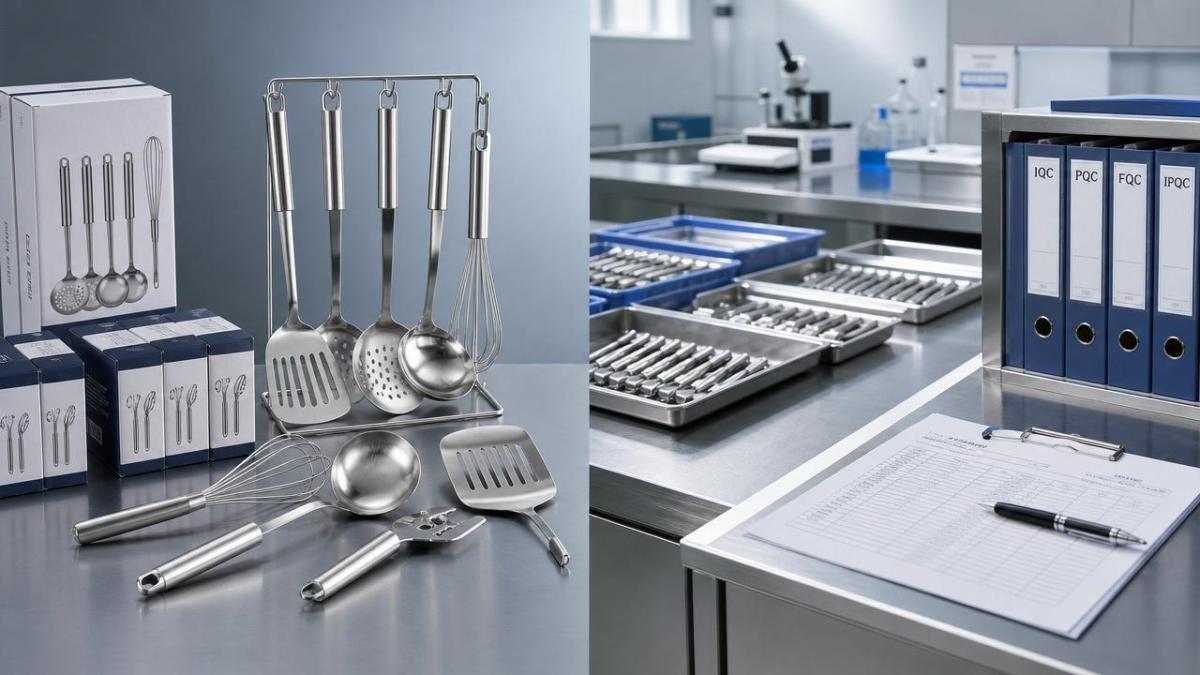
Scenario comparison: what to check first in each buying context
Before auditing any kitchen tools factory, evaluators should map the scenario to the most important decision points. This avoids wasting time on low-priority checks while missing the real sources of supply risk.
Key signs of a reliable kitchen tools factory across different applications
Consistent raw material control
In nearly every scenario, material consistency is one of the strongest predictors of long-term reliability. A credible kitchen tools factory can explain where stainless steel, aluminum, silicone, wood, or plastic inputs come from, how incoming materials are checked, and what standards apply to each category. For buyers serving commercial kitchens or food-contact environments, this matters more than a polished sales presentation.
Production processes suited to the product category
Different kitchen tools demand different process controls. Cutting tools need edge consistency and hardness control. Ladles, tongs, and spatulas require reliable forming, assembly, and handle fixation. Silicone and plastic accessories need stable molding parameters and temperature discipline. A dependable kitchen tools factory does not simply say it can make “all kinds of products.” It can explain which product families it is best at and where its production strengths truly lie.
Visible quality checkpoints
Business evaluators should look for documented inspection points rather than general promises. Reliable factories usually have incoming checks, in-process inspections, final random sampling, and packaging verification. For higher-risk scenarios, they may also maintain functional tests, salt spray testing, dishwasher-related durability checks, or batch-specific appearance records.
Stable workforce and organized production flow
A kitchen tools factory with high labor turnover or chaotic shop-floor flow often struggles to maintain quality over time. This risk becomes severe for custom programs and repeat orders. Evaluators should observe whether workstations are organized, materials are identified clearly, defective items are isolated, and operators understand process requirements. Operational discipline usually predicts fewer surprises after purchase orders are placed.
How risk indicators change by buyer type
Not every buyer should weigh factory warning signs in the same way. A business evaluator should align risk screening with the company’s own exposure.
For brand owners
The biggest risk is reputational damage. If a kitchen tools factory cannot control cosmetic consistency, packaging, labeling, and complaint handling, even minor defects can turn into online review problems or retailer penalties. Brand owners should prioritize pilot orders, golden sample approval, and packaging verification procedures.
For distributors and wholesalers
The main concern is supply continuity. Stockouts, mixed specifications, and unstable lead times create direct sales losses. In this scenario, a reliable kitchen tools factory should prove production planning capability, order tracking discipline, and supplier backup arrangements for key materials.
For foodservice project buyers
Project-based buyers must focus on performance under operational pressure. They should confirm whether the factory has supplied professional kitchens before, whether products withstand repeated washing and heavy usage, and whether spare or replacement supply can be maintained over time.
Common misjudgments when evaluating a kitchen tools factory
One common mistake is assuming export experience alone means low risk. Some factories are experienced exporters but weak in process control. Another mistake is overvaluing certifications without checking whether they match the actual product category, production scope, and current operating conditions. A certificate can support credibility, but it should not replace factory-level verification.
Price is another area where evaluators often misread the situation. A lower quote from a kitchen tools factory may reflect thinner material, reduced inspection, outsourced processes with weaker control, or unrealistic lead times. The true comparison should include defect cost, rework, delay impact, claims handling, and management time.
A final misjudgment is focusing only on samples. Samples are useful, but they are often prepared under ideal conditions. A more accurate test is whether the kitchen tools factory can reproduce the same quality at scale across multiple batches and shipping windows.
Practical evaluation checklist for scenario-fit factory selection
To separate a reliable kitchen tools factory from a risky one, business evaluators should use a structured checklist tied to the actual application scenario:
- Define end-use clearly: household retail, professional kitchen, food processing, or multi-market distribution.
- Confirm material specifications and ask how incoming quality is controlled.
- Review production flow for the relevant product type, not just general factory capability.
- Verify inspection points, defect handling process, and batch traceability.
- Check whether packaging, labeling, and carton control match your sales channel.
- Ask for evidence of repeat order performance, not only first-order references.
- Test communication speed, change management, and issue escalation during sampling.
- Use pilot orders or staged volume increases before full commitment.
FAQ: scenario-based questions buyers often ask
Is a large kitchen tools factory always safer than a smaller one?
Not always. A larger factory may have better capacity and systems, but a smaller specialized supplier can be more reliable for a narrow product category. The key is whether the factory’s processes, quality controls, and communication fit your scenario.
What matters most for commercial kitchen buyers?
Durability, consistency, and replenishment reliability usually matter most. Commercial users place more stress on tools than home users, so batch stability and practical service life should be examined carefully.
How can buyers reduce risk before committing to a long-term supplier?
Start with a targeted audit, approve production samples, define specifications in writing, and place a controlled pilot order. Monitoring first-batch performance is often the best way to validate whether a kitchen tools factory is truly dependable.
Final decision guidance for business evaluators
A reliable kitchen tools factory is not defined by marketing claims or the lowest cost. It is defined by fit: fit between product category and production capability, fit between compliance needs and documentation discipline, fit between delivery expectations and operational control, and fit between your application scenario and the factory’s real strengths.
For business evaluators, the most effective approach is to assess factories through the lens of actual use cases. If your company serves retail brands, test consistency and packaging control. If you support restaurants or hotels, prioritize durability and delivery repeatability. If your products enter food processing environments, raise the bar on traceability and hygienic production. By matching the evaluation method to the scenario, you can identify whether a kitchen tools factory is a stable long-term partner or a hidden procurement risk.
The next step is simple: translate your business scenario into a written factory scorecard, then compare suppliers against the conditions that matter most to your operation. That is where confident sourcing decisions begin.
Popular Tags
Kitchen Industry Research Team
Dedicated to analyzing emerging trends and technological shifts in the global hospitality and foodservice infrastructure sector.
Industry Insights
Join 15,000+ industry professionals. Get the latest market trends and tech news delivered weekly.
No spam. Unsubscribe anytime.

Contact With us
Contact:
Anne Yin (Ceramics Dinnerware/Glassware)
Lucky Zhai(Flatware)