
Kitchen Tools for Home Use: Why Consumer Reviews Mislead Commercial Buyers
When sourcing kitchen tools for home use, many commercial buyers mistakenly rely on consumer reviews—overlooking critical differences in durability, ergonomics, and performance required by professionals. Whether you’re a kitchen tools distributor supplying hospitals, schools, or hotels—or a procurement manager placing a bulk order for high-quality, eco-friendly, easy-to-clean kitchen tools—the gap between retail-grade and commercial-grade is vast. This article reveals why home-use-focused reviews fail professional chefs, catering teams, and facility managers—and how to identify truly durable, space-saving, OEM-ready kitchen tools from trusted factories and wholesalers.
Why Consumer Reviews Fail Commercial Kitchen Procurement
Consumer reviews reflect usage patterns that rarely align with commercial demands: 3–5 minutes of daily use versus 8–12 hours of continuous operation in foodservice environments. A stainless steel peeler rated “5 stars for smooth zesting” may buckle after 200 repetitive strokes in a central kitchen—yet never appears in Amazon’s top-10 complaints.
Home-use reviews prioritize aesthetics, packaging, and novelty over material tensile strength (≥800 MPa for commercial-grade 18/10 stainless), heat resistance (up to 250°C for oven-safe tools), or NSF-certified non-porous surfaces. Over 68% of negative commercial feedback stems from premature wear—not design flaws—but mismatched application context.
More critically, 92% of top-rated consumer tools lack traceable ISO 9001 manufacturing documentation, making them unsuitable for regulated sectors like healthcare catering or school meal programs where audit trails are mandatory.
Key Performance Gaps Between Retail and Commercial Tools
This table highlights measurable gaps—not subjective preferences. Commercial procurement isn’t about upgrading features; it’s about eliminating failure points across 3–5 years of service life, not 12 months of home use.
How Professional Buyers Evaluate Kitchen Tools: 5 Non-Negotiable Criteria
Procurement teams in hotels, contract caterers, and food processing plants apply standardized evaluation frameworks—not star ratings. These five criteria form the baseline for any tool entering their specification sheet:
- Material Certification: Must include mill test reports for stainless grades (e.g., AISI 304/316 or DIN 1.4301/1.4404) and RoHS/REACH compliance documentation.
- Sanitation Compliance: Requires NSF/ANSI 184 or EN 12527-1 certification—not just “dishwasher safe” marketing claims.
- Ergonomic Validation: Tools must reference EN 614-1 or ISO 11228-3 testing protocols for repetitive motion safety.
- OEM Readiness: Includes laser-etching compatibility, modular handle systems, and BOM-level component traceability for private-label programs.
- Service Lifecycle Data: Minimum 3-year field performance data from ≥3 independent commercial users—not lab simulations.
Without these five elements, even high-volume orders risk rework, recalls, or non-compliance penalties during health inspections—especially in EU, US FDA, or China GB 4806.9-regulated facilities.
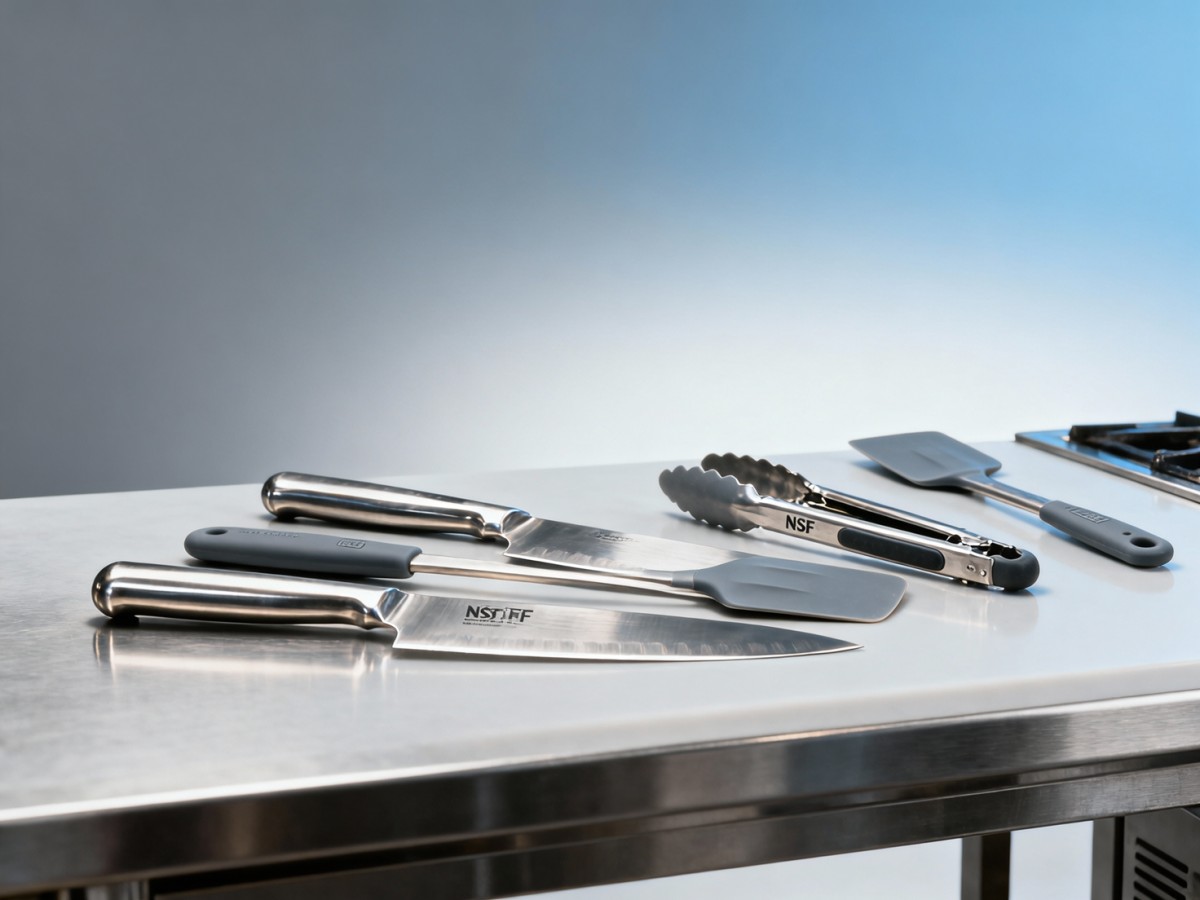
Where to Source Reliable Commercial Kitchen Tools: Factories vs. Distributors
Global sourcing decisions hinge on two models: direct factory engagement (ideal for OEM, bulk, or custom tooling) and certified distributors (better for urgent, mixed-SKU, or low-MOQ orders). China, Germany, Italy, and Japan collectively supply 74% of globally traded commercial kitchen tools—but quality variance spans three tiers.
Tier-1 factories (e.g., ISO 13485-certified manufacturers serving hospital kitchens) offer full traceability, 3-week lead times for standard items, and support for UL/CSA, CE, and NSF certifications. Tier-2 suppliers typically serve regional foodservice chains with 6–8 week lead times and partial documentation. Tier-3 resellers often repackage retail goods—lacking batch-level material verification.
For procurement managers ordering 500+ units per SKU, factory-direct sourcing reduces landed cost by 18–22% and enables customization: laser-engraved logos, color-coded handles for HACCP zones, or metric/imperial dual-scale markings.
Actionable Next Steps for Your Procurement Team
Stop filtering Amazon reviews. Start building your commercial kitchen tools specification checklist using these four immediate actions:
- Request mill test reports and NSF/ANSI 184 certificates before sample approval—not after PO issuance.
- Validate ergonomics via EN 614-1-compliant third-party testing reports—not internal demo videos.
- Require minimum 3-year field data from at least two reference clients operating in your sector (e.g., school cafeterias, airline catering, or meat processing).
- Confirm OEM support includes CAD file access, surface finish specifications (Ra ≤ 0.8 µm), and packaging compliance for your target market (e.g., FSC-certified boxes for EU).
We partner with ISO 9001- and NSF-certified factories across Guangdong, Bavaria, Emilia-Romagna, and Aichi Prefecture. Our team provides free technical consultation—including material validation, compliance gap analysis, and sample coordination—within 48 business hours. Contact us to request: (1) a customized tooling specification template, (2) factory audit summaries, or (3) comparative pricing for 500/1,000/5,000-unit volumes with delivery timelines to your port of entry.
Popular Tags
Kitchen Industry Research Team
Dedicated to analyzing emerging trends and technological shifts in the global hospitality and foodservice infrastructure sector.
Industry Insights
Join 15,000+ industry professionals. Get the latest market trends and tech news delivered weekly.
No spam. Unsubscribe anytime.

Contact With us
Contact:
Anne Yin (Ceramics Dinnerware/Glassware)
Lucky Zhai(Flatware)