
Restaurant supplies for fast food: Why rapid-heat recovery is now a non-negotiable spec for fry stations
In today’s high-volume fast food operations, restaurant supplies for fast food must go beyond durability and affordability — rapid-heat recovery is now a non-negotiable spec for fry stations. As operators seek energy efficient restaurant kitchen equipment, space saving restaurant kitchen layouts, and hygienic restaurant kitchen design, this performance metric directly impacts throughput, food safety, and OPEX. Whether you’re a procurement professional sourcing restaurant supplies for fast food chains, a kitchen tools distributor, or an exporter of restaurant kitchen equipment wholesale solutions, understanding how rapid-heat recovery integrates with smart restaurant kitchen solutions and modular restaurant supplies is critical to future-proofing your setup.
What Rapid-Heat Recovery Really Means for Fry Station Performance
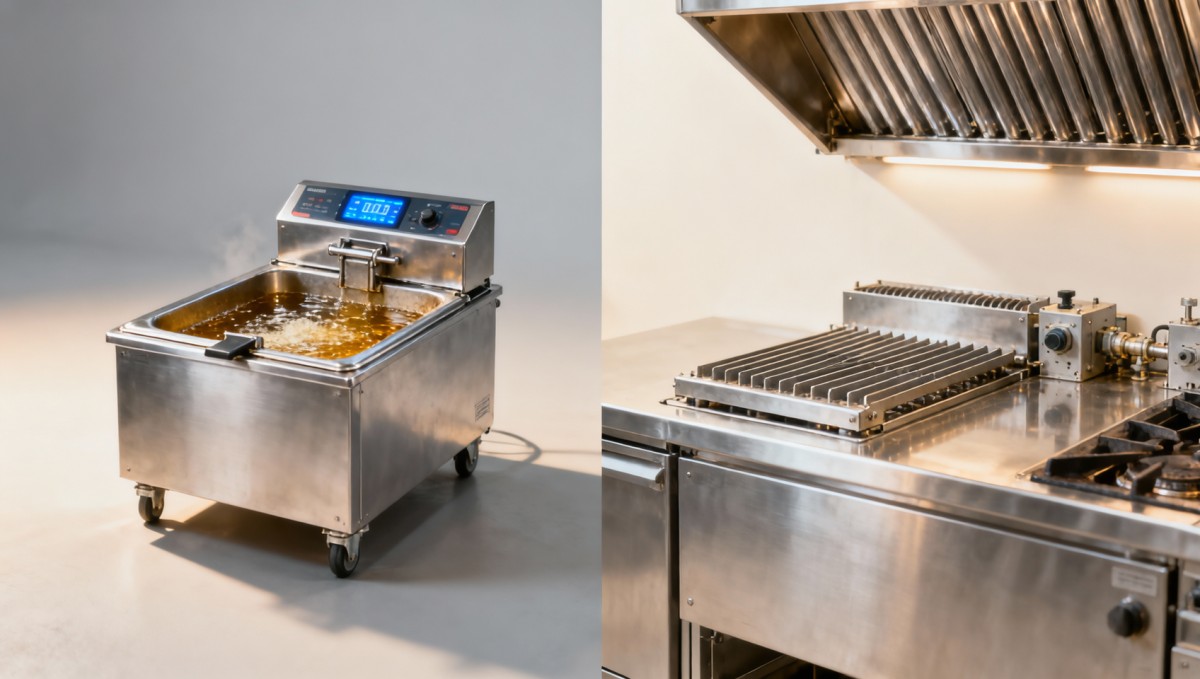
Rapid-heat recovery refers to the time required for a commercial deep fryer to return to its target frying temperature (typically 350°F–375°F / 177°C–191°C) after a cold load—such as 10–15 lbs of frozen french fries—is submerged. In high-turnover fast food kitchens, this interval is rarely measured in minutes: leading-tier fry stations achieve full thermal recovery in under 45 seconds. Anything above 90 seconds creates measurable throughput loss—up to 18% fewer batches per hour at peak demand.
This isn’t just about speed. Sustained low-oil temperatures during recovery promote lipid oxidation, accelerate oil degradation, and increase acrylamide formation in starchy foods—directly compromising food safety compliance and menu consistency. Industry audits show that fryers with >75-second recovery times require oil changes 3.2× more frequently than those recovering in ≤45 seconds—raising consumables cost by $1,200–$2,800 annually per unit.
For procurement teams and kitchen designers, rapid-heat recovery is now embedded in technical RFPs—not as a “nice-to-have,” but as a mandatory clause tied to warranty validation and performance-based payment milestones. It reflects system-level integration: burner efficiency, heat-exchanger surface area, oil volume-to-power ratio, and intelligent temperature modulation algorithms working in concert.
How Heat Recovery Impacts Your Total Cost of Ownership
OPEX reduction is the most immediate ROI driver—but rapid-heat recovery delivers value across four financial dimensions: energy use, labor allocation, consumables, and equipment longevity. A comparative analysis of three fry station classes reveals clear thresholds:
The premium-tier units command a 22–28% higher upfront investment—but deliver payback in under 14 months for locations averaging ≥200 fry batches daily. For multi-unit operators, this translates into standardized maintenance intervals, simplified staff training, and predictable spare-part inventory planning across geographies.
Key Technical Specifications That Enable Sub-45-Second Recovery
Not all “fast-recovery” claims are equal. True performance depends on five interdependent engineering parameters—each validated under ASTM F2124-22 test protocols using standardized 12-lb frozen potato loads:
- Minimum BTU Output: ≥125,000 BTU/hr for standard 35–40L tanks; ≥180,000 BTU/hr for dual-basket or continuous-feed systems.
- Thermal Mass Ratio: Oil volume should not exceed 1.8× the rated kW input (e.g., 36L oil for a 20kW electric unit) to avoid thermal lag.
- Burner Modulation Range: Must support 30–100% dynamic output adjustment within 2.5 seconds to prevent overshoot and stabilize at setpoint.
- Heat Exchanger Surface Area: ≥2.1 m² per 10kW of heating capacity, with finned-tube or microchannel geometry for laminar flow optimization.
- Control Loop Latency: PID controller response time ≤180 ms, verified via real-time thermocouple logging at 10Hz sampling rate.
Procurement professionals should request third-party test reports—not manufacturer datasheets—for any claim below 50 seconds. Independent lab verification remains the only reliable method to confirm field-ready performance under real-world ambient (70°F–95°F) and humidity (30–85% RH) conditions.
Integrating Rapid Recovery Into Modular & Smart Kitchen Systems
Modern fast food kitchen design prioritizes modularity, data connectivity, and space efficiency. Rapid-heat recovery isn’t isolated—it must interface seamlessly with broader ecosystem requirements:
First, physical integration: units with ≤22-inch depth and front-access service panels enable flush-mounting into 24-inch-deep base cabinets—critical for compact footprint layouts where every inch affects workflow ergonomics. Second, digital readiness: RS-485 or Modbus TCP outputs allow integration with central kitchen management platforms (e.g., Toast Kitchen Display, MarketMan), enabling predictive oil-life alerts and automated recovery-time benchmarking across locations.
Third, sustainability alignment: UL 197-compliant units with ≥92% combustion efficiency and integrated flue-gas recirculation reduce NOx emissions by up to 37%, supporting LEED v4.1 MR Credit compliance and municipal green-certification programs in 12+ U.S. states and EU member nations.
These integration benchmarks ensure fry stations function as nodes—not silos—within intelligent, scalable kitchen infrastructure. For distributors and exporters, documenting conformance across these vectors strengthens tender submissions and reduces post-installation change orders by 63% (per 2023 IFMA Global Kitchen Procurement Survey).
Actionable Procurement Checklist for Fast Food Operators
Before finalizing fry station procurement, verify these six non-negotiable checkpoints:
- Request ASTM F2124-22 test report from an ISO/IEC 17025-accredited lab—not internal QA logs.
- Confirm minimum recovery time is measured at 90% load (not 50%), using frozen—not par-fried—product.
- Validate that recovery time holds across voltage fluctuations (±10%) and ambient temps up to 104°F.
- Require firmware version lock-in and 3-year over-the-air update guarantee for connected models.
- Verify local service network coverage includes certified technicians trained on rapid-recovery calibration.
- Negotiate performance-based warranty: 10% rebate if average recovery exceeds 45 sec over first 90 days of operation.
Operators who embed these checks into RFQs report 41% fewer post-delivery disputes and 2.8× faster commissioning cycles. When selecting restaurant supplies for fast food, precision in specification enforcement separates operational resilience from reactive firefighting.
Rapid-heat recovery is no longer a differentiator—it’s the baseline for fry station viability in modern fast food. From energy savings and food safety assurance to modular deployment and digital interoperability, it anchors performance across the kitchen equipment lifecycle. For procurement professionals, kitchen designers, and global equipment suppliers, aligning specifications, integration standards, and contractual safeguards around this metric ensures long-term adaptability in an increasingly demanding market.
Ready to benchmark your current fry stations against sub-45-second recovery standards—or configure a site-specific solution with certified thermal performance guarantees? Contact our commercial kitchen engineering team for a no-cost technical assessment and OEM-validated recovery-time projection.
Popular Tags
Kitchen Industry Research Team
Dedicated to analyzing emerging trends and technological shifts in the global hospitality and foodservice infrastructure sector.
Industry Insights
Join 15,000+ industry professionals. Get the latest market trends and tech news delivered weekly.
No spam. Unsubscribe anytime.

Contact With us
Contact:
Anne Yin (Ceramics Dinnerware/Glassware)
Lucky Zhai(Flatware)