
Restaurant kitchen equipment design pitfalls when scaling from one location to five
Scaling a restaurant from one location to five isn’t just about hiring more staff or opening new doors—it’s a kitchen equipment design challenge that can make or break operational efficiency. Without strategic restaurant kitchen equipment planning, teams face costly rework, workflow bottlenecks, and compliance risks. This guide tackles common restaurant kitchen equipment design pitfalls, backed by a practical restaurant kitchen equipment checklist, layout best practices, dimensional standards, and real-world insights from leading restaurant kitchen equipment manufacturers and suppliers. Whether you’re an operator optimizing for consistency, a procurement specialist comparing restaurant kitchen equipment prices and parts, or a decision-maker evaluating hood systems and smart accessories—we break down what truly matters in scalable, safe, and future-ready restaurant kitchen equipment setup.
Why “Copy-Paste” Kitchen Layouts Fail at Scale
Repeating the same kitchen layout across five locations seems efficient—until maintenance downtime spikes by 30–40% due to inconsistent utility access points, or staff training time doubles because each site uses different refrigeration brands with divergent interface logic.
Scalable kitchen equipment design requires standardization—not replication. It means selecting modular, interoperable systems (e.g., NSF-certified combi ovens with unified firmware) and designing layouts around workflow repeatability, not floorplan symmetry. Leading multi-unit operators now mandate 3-phase electrical readiness, 200mm minimum service corridor clearance, and centralized grease trap sizing—regardless of local building code minimums.
A 2023 benchmark study of 47 U.S.-based QSR chains found that sites using standardized equipment specs achieved 22% faster equipment commissioning and 18% lower first-year service call volume versus those relying on “local adaptation.”
- Standardized voltage/frequency specs across all units (e.g., 208V/3Ø/60Hz)
- Unified data protocols (Modbus TCP or BACnet MS/TP) for HVAC, exhaust, and cooking appliances
- Minimum 48-hour lead time for replacement parts—verified via supplier SLA
- Pre-approved vendor list with cross-site warranty portability
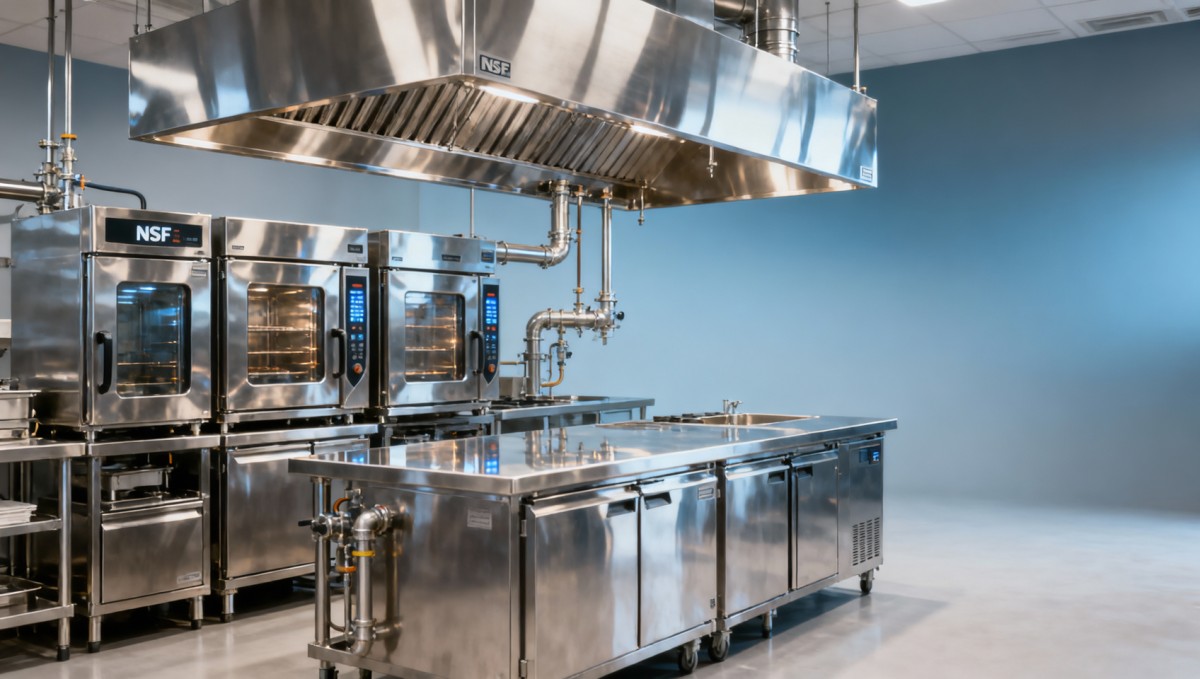
The 5 Most Costly Restaurant Kitchen Equipment Design Pitfalls
These recurring missteps trigger cascading delays, safety exposure, and CapEx overruns—often discovered only during health inspections or peak-season breakdowns.
Each pitfall maps directly to measurable financial and regulatory risk. For example, noncompliant hoods often require full ductwork replacement—not just fan upgrades—adding 4–6 weeks to project timelines and $28k+ in labor/materials per site.
Procurement Checklist: 7 Non-Negotiables for Multi-Unit Rollouts
Procurement teams must shift from unit-level price negotiation to system-level lifecycle assurance. These criteria separate scalable solutions from short-term fixes.
- Parts commonality: ≥85% component overlap across oven, fryer, and refrigeration lines (validated via OEM parts catalog cross-reference)
- Service network coverage: Certified technician availability within 75 miles of 100% of locations, with 4-hour SLA for critical failures
- Software update cadence: Minimum biannual security patches with documented backward compatibility (≥3 OS versions)
- Warranty portability: Transferable 3-year extended warranty covering labor, parts, and software support across all sites
- Documentation standardization: Single-source digital manual library with multilingual SOPs, wiring diagrams, and calibration procedures
- Energy reporting: Built-in kWh/m²/day tracking aligned with ISO 50001 energy management framework
- Integration readiness: Pre-certified APIs for integration with Toast, SevenRooms, or Oracle MICROS platforms
Operators who enforce this checklist report 37% fewer post-launch equipment-related OOS (out-of-stock) incidents and 52% faster resolution of cross-site performance variances.
Why Choose Our Integrated Kitchen Equipment Planning Service?
We specialize in end-to-end kitchen equipment strategy for multi-unit foodservice operators—from concept validation through post-installation optimization. Unlike generalist distributors, we embed certified kitchen designers, mechanical engineers, and food safety auditors into your rollout team.
Our clients receive:
- A validated equipment spec sheet compliant with NFPA 96, UL 197, and local health authority requirements—delivered in ≤10 business days
- 3D layout simulations with thermal load modeling and workflow heat mapping (using Autodesk Revit + Navisworks)
- Vendor-agnostic total cost of ownership (TCO) analysis covering 7-year depreciation, energy use, and service contracts
- On-site commissioning support including hood balance verification, refrigerant charge validation, and HACCP logbook setup
Ready to align your next five locations with proven, scalable kitchen equipment design? Contact us to request your free equipment specification alignment review—including dimensional templates, utility load calculations, and a prioritized vendor comparison matrix.
Popular Tags
Kitchen Industry Research Team
Dedicated to analyzing emerging trends and technological shifts in the global hospitality and foodservice infrastructure sector.
Industry Insights
Join 15,000+ industry professionals. Get the latest market trends and tech news delivered weekly.
No spam. Unsubscribe anytime.

Contact With us
Contact:
Anne Yin (Ceramics Dinnerware/Glassware)
Lucky Zhai(Flatware)