
Do Cookie Jars Keep Cookies Fresh? Why Airtight Seals Matter
Yes, cookie jars can keep cookies fresh, provided the lid forms a reliable airtight seal and the cookies are stored under suitable conditions. A jar with a loose lid offers some protection from dust and handling, but it does little to control the moisture exchange that makes crisp cookies soften and soft cookies turn dry.
The result also depends on what goes into the jar. Crisp shortbread and chewy oatmeal cookies need different storage conditions, and even a well-sealed container cannot preserve both textures when they share the same space. For everyday use, the most useful questions are whether the lid seals properly, which cookies you plan to store together, and how quickly you expect to eat them.
Why the seal changes how long cookies taste fresh
A cookie’s texture depends partly on how much moisture it contains and how that moisture moves during storage. A dry, crisp cookie can absorb moisture from humid air and lose its snap. A soft cookie can release moisture into drier surroundings, becoming harder and less pleasant to eat. An airtight lid slows exchange between the container and the room, helping preserve the texture the cookie had when it went in.
This explains why a decorative jar can disappoint even when its lid feels substantial. A heavy ceramic lid may sit firmly on the rim while leaving small gaps around it. Each gap allows air and water vapor to move between the jar and the kitchen. The effect becomes more noticeable in a humid room or when cookies remain in the jar for several days.
A gasket improves the closure by filling the space between the lid and the rim. Flexible silicone or rubber can compress against the mating surface, creating a more continuous barrier. Some lids use a latch to maintain that pressure; others rely on a fitted push-on design. Either can work well if the parts fit correctly.
Sealing also helps limit the entry of kitchen odors. Cookies contain fats that can pick up unwanted smells, particularly around strongly scented foods. Reduced air exchange can slow some flavor deterioration, although an ordinary cookie jar still contains oxygen and cannot stop fats from becoming rancid indefinitely.
There are limits to what “airtight” can accomplish. Moisture can still move between cookies inside a closed container, and opening the lid repeatedly exchanges the air inside. Heat, direct sunlight, and the cookies’ ingredients also affect quality. A good seal gives you better control over storage; it does not create a fixed shelf life.
How to recognize a cookie jar that seals well
Start by looking at the underside of the lid. A visible, continuous gasket is a useful feature, especially if it can be removed for cleaning and replaced when worn. Check that it sits evenly in its groove and contacts a smooth, undamaged rim. Cracks, distortion, hardened areas, or trapped crumbs can prevent an otherwise sound lid from closing properly.
Then check how the lid closes. It should seat evenly without rocking, and any latch should hold it securely without forcing the lid out of alignment. A push-on lid should engage consistently around the opening. Weight, a satisfying closing sound, or resistance when lifting the lid can offer clues, but none proves airtightness on its own.
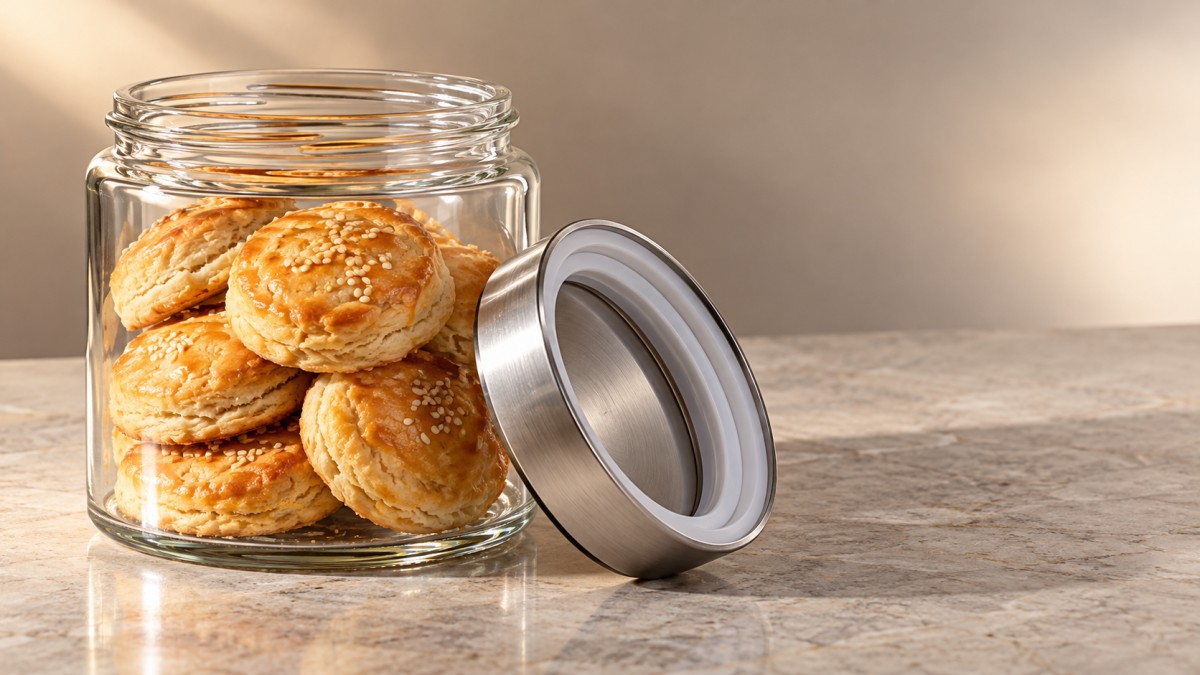
The jar’s material matters for durability, cleaning, and exposure to light, but the closure often makes the bigger difference to freshness:
- Glass: Easy to inspect for crumbs and residue, and it lets you see the contents. Keep clear jars away from direct sunlight and warm appliances.
- Glazed ceramic: Useful for countertop storage when the food-contact surface is intact and the lid includes a well-fitted seal. A ceramic lid resting directly on the rim may allow substantial air exchange.
- Metal: Blocks light and can be durable, but the lid fit still needs attention. Dents around the opening can interfere with closure.
- Food-storage plastic: Lightweight and practical, particularly with a secure gasketed lid. Warping or persistent odors are reasons to reassess the container.
Choose a size that suits the amount you normally keep. A very large jar holding only a few cookies contains more air and may encourage you to mix several batches. A smaller container is often easier to manage. However, reducing empty space cannot compensate for a leaking lid, so closure quality should remain the priority.
Cleaning access deserves equal attention. Deep lid channels and fixed seals can trap grease and crumbs. Follow the manufacturer’s cleaning instructions, clean removable gaskets where permitted, and allow every part to dry before reassembly. Check replacement-seal availability if you want to keep the jar for years.
If you already own a decorative jar with a loose lid, you may not need to replace it. Put the cookies in a sealed food-storage bag or smaller airtight container inside the jar. The outer jar can still provide convenient storage, while the inner container controls air and moisture exchange. Let washed jars dry completely before adding either cookies or an inner bag.
Crisp and chewy cookies should not share the same jar
Separating cookies by texture is one of the most effective ways to preserve them. Soft cookies usually contain more available moisture than crisp varieties. When they share a sealed space, moisture can migrate from the softer cookies toward the drier ones. The crisp cookies soften, and the chewy ones may lose some of their original texture.
Paper dividers and parchment layers help prevent sticking or breakage, but they do not create a moisture barrier. If you want one large jar to hold several cookie types, use separately sealed inner bags or containers. Grouping everything in one open space undermines the benefit of an airtight lid.
For crisp cookies, keep added moisture out
Allow crisp cookies to cool fully on a rack before packing them. A cookie that feels only slightly warm can still release water vapor after the lid closes. That moisture remains inside the container and can soften the batch. Do not refrigerate warm cookies just to speed up packing; give them time to cool in a suitable, clean space.
Store crisp varieties together only when their flavors and coatings are compatible. Strongly spiced cookies can affect more delicate ones, and sticky decorations can transfer between surfaces. Use parchment where needed to protect the finish, while remembering that it will not keep different textures separate.
A bread slice is a poor addition to a jar of crisp cookies because it supplies moisture. The same applies to fresh fruit or other moist ingredients added as storage “hacks.” For a crisp result, start with properly cooled cookies and a clean, dry, tightly sealed container.
For soft cookies, prevent drying without trapping excess moisture
Soft and chewy cookies also benefit from cooling completely before storage. Their existing moisture is generally enough to maintain texture for short-term use when the seal works well. Pack them gently, with parchment between layers if their surfaces tend to stick.
The familiar bread-slice trick can sometimes soften cookies because moisture moves from the bread into the surrounding contents. It is difficult to control, however, and can leave cookies too soft or introduce bread aromas. Bread can also spoil. It should not be treated as a substitute for a good seal or as a way to make old cookies safe to eat.
Some cookies fall outside ordinary countertop storage. Those with perishable cream, custard, fresh dairy toppings, or other fillings that require refrigeration should follow the recipe’s or manufacturer’s storage instructions. An airtight jar does not make a perishable filling suitable for room-temperature storage.
How long can you reasonably expect freshness to last?
There is no single reliable answer for every cookie jar and recipe. Thin, dry cookies, rich shortbread, and moist cookies with fruit inclusions behave differently. Room temperature, humidity, handling, and how often the jar opens all affect the outcome. A commercial package’s date also cannot automatically be applied to cookies after opening or transferring them to another container.
For home use, think of the jar as storage for the portion you expect to eat over the next few days. Check the batch as you go: a crisp cookie losing its snap or a chewy cookie becoming firmer tells you the eating quality is changing. These observations help you adjust future batch sizes, but texture alone does not establish whether food is safe.
Keep the jar in a cool, dry place away from the oven, dishwasher exhaust, and sunny windows. Avoid topping up old cookies with a fresh batch. Emptying the jar first makes it easier to track age, remove crumbs, and clean away grease before refilling it.
Refrigeration is not automatically an improvement for plain cookies. It can change their texture, and a poorly sealed container can expose them to refrigerator odors. Condensation may also form as cold cookies warm up. Use refrigeration when the ingredients require it, with suitable sealed storage, rather than assuming colder storage always produces a better cookie.
For surplus plain cookies that freeze well, freezing is often more useful than trying to stretch countertop storage. Let them cool, divide them into practical portions, and pack them in freezer-suitable airtight containers or bags. Protect delicate cookies from crushing, and separate sticky layers. Keeping plain cookies covered while they thaw helps limit exposure to humid room air; cookies with perishable fillings need handling appropriate to those ingredients.
If a batch has already lost its ideal texture, decide whether it has merely become stale or shows signs of spoilage. Some plain crisp cookies can regain texture with gentle reheating, although results depend on the recipe and coatings. Reheating does not reset storage life or make spoiled food safe. Discard cookies with mold or unusual odors, and do not taste suspicious food to check it.
A useful everyday arrangement is a small, well-sealed jar for the cookies you will eat soon, with the rest stored separately or frozen as appropriate. If your current jar leaves crisp cookies soft and chewy cookies dry, check the lid and separate the textures before buying a different material or a larger container. Those two changes address the most common reasons a cookie jar fails to keep its contents enjoyable.
Popular Tags
Kitchen Industry Research Team
Dedicated to analyzing emerging trends and technological shifts in the global hospitality and foodservice infrastructure sector.
Industry Insights
Join 15,000+ industry professionals. Get the latest market trends and tech news delivered weekly.
No spam. Unsubscribe anytime.

Contact With us
Contact:
Anne Yin (Ceramics Dinnerware/Glassware)
Lucky Zhai(Flatware)