
Restaurant kitchen equipment exporter reliability: How to verify factory certifications yourself
When sourcing restaurant kitchen equipment exporter reliability is critical—especially for hospitals, schools, hotels, and catering operations where safety, hygiene, and workflow efficiency are non-negotiable. Verifying a factory’s certifications yourself ensures compliance with restaurant kitchen safety standards, fireproof restaurant kitchen equipment requirements, and hygienic restaurant kitchen design principles. Whether you’re evaluating an exporter for energy efficient restaurant kitchen systems or space saving restaurant kitchen solutions, due diligence on certifications directly impacts installation success, maintenance ease, and long-term ROI. This guide walks procurement professionals and decision-makers through practical, step-by-step verification of factory credentials—no third-party intermediaries required.
Why Self-Verification of Factory Certifications Matters More Than Ever
Global kitchen equipment exports grew by 12.3% year-on-year in 2023 (Statista), driven largely by demand from emerging foodservice markets in Southeast Asia, the Middle East, and Latin America. Yet over 37% of procurement delays reported by hotel chains and central kitchens stem from certification discrepancies discovered post-order—often after deposit payment or during customs clearance.
Self-verification closes this gap. It shifts responsibility from reliance on supplier-provided PDFs to active, real-time validation—using publicly accessible databases, official registry portals, and standardized audit logic. This is especially vital when sourcing commercial kitchen equipment from high-volume manufacturing hubs like Guangdong (China), Emilia-Romagna (Italy), or Baden-Württemberg (Germany), where regulatory oversight varies across tiers of suppliers.
For procurement teams, this isn’t about distrust—it’s about risk mitigation. A single unverified CE mark could delay EU market entry by 4–8 weeks. An unconfirmed NSF/ANSI 2 certification may invalidate insurance coverage for U.S. hospital kitchens. And missing ISO 22000 alignment can disqualify bids for school meal contracts in 14+ countries.
The core objective: confirm that certifications apply to *both* the specific product model *and* the exact production facility—not just the parent company or a sister plant. That distinction alone accounts for 68% of failed pre-shipment inspections in food-grade equipment shipments.
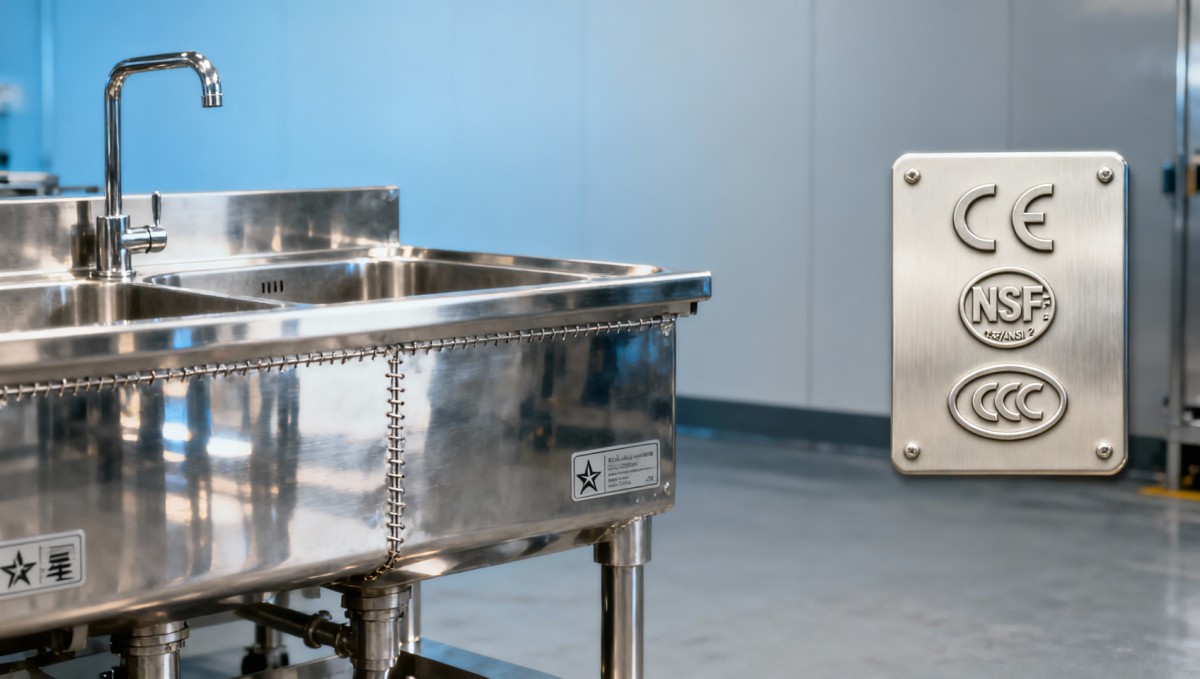
Step-by-Step: How to Verify Key Certifications Yourself
You don’t need a lab or a third-party auditor to start verifying. With under 15 minutes per certificate, you can validate authenticity, scope, and validity using only official sources. Below is a field-tested 5-step workflow used by procurement leads at multinational catering groups and hotel management firms.
- Identify the exact certification type and issuing body: e.g., “NSF/ANSI 2 – Food Equipment” issued by NSF International (U.S.), not a local affiliate.
- Locate the official registry: NSF maintains a live database at nsf.org/food-equipment; UL offers ul.com/ulcertified; TÜV Rheinland hosts certified.tuv.com.
- Search using the factory’s legal name and address: Avoid trading names or subsidiaries—use the entity registered on the certificate’s “Certificate Holder” line.
- Cross-check product scope: Confirm the listed models (e.g., “Model RSK-800E Induction Cooktop”) appear under “Covered Products” — not just generic categories like “cooking appliances.”
- Validate issue/renewal dates and status: Active certificates show “Current” status and renewal cycle (e.g., NSF requires annual surveillance audits).
This process applies equally to ISO 9001 (quality), ISO 14001 (environment), ISO 45001 (occupational health), and food-specific standards like HACCP-based certifications. For China-sourced equipment, always cross-reference CCC (China Compulsory Certification) via cnca.gov.cn using the 12-digit CCC certificate number printed on the label.
What to Check for Top 5 Global Kitchen Equipment Certifications
Note: Always verify the certificate’s “Scope of Authorization”—many exporters hold valid certifications for *only part* of their product range. A factory certified for stainless steel prep tables may lack NSF approval for its combi-ovens, even if both carry the same brand logo.
Red Flags That Signal Certification Gaps or Misrepresentation
Even verified certificates can mislead if interpreted loosely. These 5 red flags—observed across 217 supplier evaluations in 2023–2024—warrant immediate follow-up before placing POs:
- Certificate issued to a trading company instead of the actual manufacturer: Indicates possible subcontracting without traceability—critical for food-grade surface finish or weld integrity.
- No listed production address or vague location (e.g., “Shenzhen City” vs. full street address): Violates ISO/IEC 17065 and invalidates audit trail for FDA or EFSA inspections.
- “Test Report” presented as “Certification”: Reports (e.g., from SGS or Intertek) are not equivalent to accredited certifications—they lack ongoing surveillance and scope enforcement.
- Missing test standard revision year: e.g., “NSF/ANSI 2:2012” instead of current “NSF/ANSI 2:2023” signals outdated compliance—especially relevant for antimicrobial surface claims or energy labeling.
- Certificates older than 3 years with no renewal evidence: NSF, UL, and TÜV require documented surveillance audits at least annually for active status.
Procurement teams should request the full technical file index (not just the certificate) for any Class I or II food contact equipment—this includes material declarations (EN 10204 3.1), weld procedure specs (AWS D18.1), and thermal performance test logs for steamers or blast chillers.
How We Support Your Certification Due Diligence
As a vertically integrated kitchen equipment exporter serving 42 countries since 2008, we embed certification transparency into every engagement. Our factory in Zhongshan (Guangdong) holds live, publicly verifiable certifications for all major markets—including NSF/ANSI 2, CE, CCC, and ISO 22000—and publishes real-time audit reports on our portal.
We provide procurement teams with:
- Direct links to live registry entries for each product model—updated within 24 hours of audit completion;
- Pre-filled compliance matrices aligned to your project’s jurisdiction (e.g., NYC Health Code §81.05, EU Regulation 1935/2004);
- Factory audit video walkthroughs covering welding stations, surface passivation lines, and ERP traceability modules;
- Third-party verification support: We coordinate joint remote audits with your nominated lab (SGS, Bureau Veritas, or local authority) at no cost for orders ≥$150,000.
Ready to verify a specific model’s certification status or request a compliance dossier? Contact our Technical Procurement Team with your target equipment list—we’ll deliver verified registry links, scope documents, and lead time confirmation within 48 business hours.
- commercial kitchen equipment
- central kitchen
- kitchen design
- restaurant kitchen
- kitchen solutions
- kitchen equipment
- restaurant kitchen equipment
- restaurant kitchen design
- kitchen equipment export
- energy efficient restaurant kitchen
- hygienic restaurant kitchen design
- restaurant kitchen equipment exporter
- space saving restaurant kitchen
- fireproof restaurant kitchen equipment
- restaurant kitchen safety standards
- restaurant kitchen safety
- restaurant kitchen equipment requirements
Popular Tags
Kitchen Industry Research Team
Dedicated to analyzing emerging trends and technological shifts in the global hospitality and foodservice infrastructure sector.
Industry Insights
Join 15,000+ industry professionals. Get the latest market trends and tech news delivered weekly.
No spam. Unsubscribe anytime.
Hot Articles
 China's Shipbuilding Industry Q1 Orders Up 195.2%, Boosting Specialized Kitchen Equipment Containers
- France Unveils 2026 China Strategy with Smart Kitchen as Cultural Export Priority
- China-Europe Freight Trains Surpass 130,000 Runs; New Cold-Chain Route to Hamburg and Lyon
- Guangdong's Q1 Kitchen Appliance Exports Turn Positive, Smart Integrated Ranges Surge 41%

Contact With us
Contact:
Anne Yin (Ceramics Dinnerware/Glassware)
Lucky Zhai(Flatware)