
What a restaurant supplies quotation should include first
Before comparing a restaurant supplies quotation, buyers should first check whether it clearly covers core items, specifications, quantities, and pricing. For businesses sourcing commercial kitchen tools, kitchen tools for restaurants, or restaurant supplies for catering companies, a complete quotation helps control restaurant supplies cost, avoid hidden fees, and ensure the right quality, delivery terms, and supplier reliability from the start.
In commercial kitchen procurement, the quotation is not just a price sheet. It is a practical document that connects technical requirements, purchasing budgets, installation planning, and long-term operating costs. If the first version of a quote is vague, missing key details, or based on generic descriptions, the risk of ordering unsuitable equipment rises quickly.
This matters to several groups at once. Operators need equipment that fits workflow and output targets. Purchasing teams need comparable pricing and clear scope. Business decision-makers need cost visibility, lead time control, and lower after-sales risk. A strong restaurant supplies quotation creates alignment before money is committed.
For buyers of commercial kitchen equipment, restaurant appliances, food preparation tools, and catering supplies, the first review should focus on completeness. The right starting point is not the lowest number. It is whether the quotation includes the information required to make a safe, efficient, and financially sound decision.
The first elements every restaurant supplies quotation should show
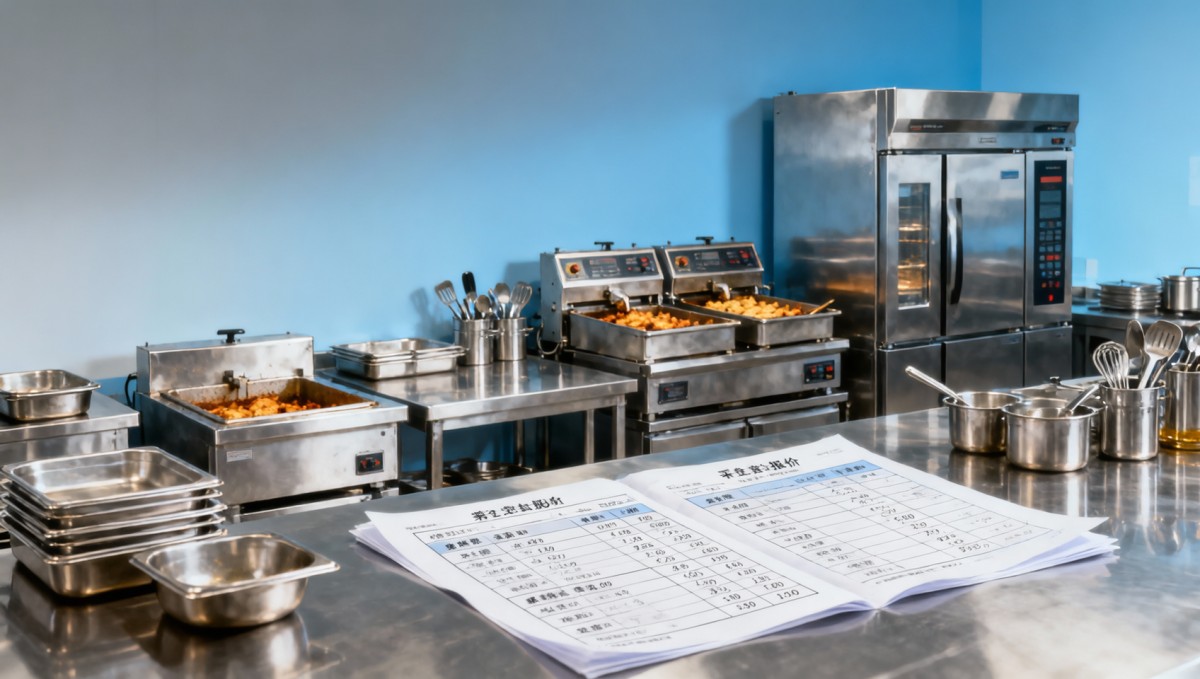
The first check is simple: can a buyer understand exactly what is being offered within 3 to 5 minutes? A usable restaurant supplies quotation should identify each item by product category, application, material or construction, dimensions, power requirements if relevant, quantity, unit price, and total price. If any of these fields are missing, comparison becomes unreliable.
In the kitchen equipment industry, small omissions can create large downstream costs. A stainless steel worktable without thickness information, a fryer without voltage details, or a refrigeration unit without temperature range can lead to incompatibility during installation. For restaurants and catering companies, a wrong specification may delay opening by 7 to 14 days or force rework after delivery.
A quotation should also distinguish between standard products and custom-made items. Standard stock products usually have shorter lead times, often 3 to 10 business days depending on quantity. Custom fabrication, such as counters, sinks, shelving systems, or integrated prep stations, may require 2 to 6 weeks. This distinction affects budget planning and launch schedules.
Another basic requirement is pricing transparency. Buyers should be able to see unit price, subtotal, taxes if applicable, shipping charges, installation cost, and optional accessories. If the quote only presents a lump sum, it becomes difficult to understand where restaurant supplies cost is concentrated and where negotiation is possible.
Core fields that should appear first
The table below shows the minimum information a quotation should contain before any deeper technical or commercial discussion begins. These fields help information researchers, users, buyers, and managers evaluate completeness from the start.
If these four fields are incomplete, buyers should not move straight to price comparison. The first priority is to request clarification. A detailed quotation reduces misinterpretation, improves supplier accountability, and makes later negotiation far more efficient.
Quick first-screen checklist
- Check whether all quoted items have clear names rather than generic wording such as “kitchen set” or “restaurant tools.”
- Confirm whether dimensions, material grade, voltage, gas type, capacity, or output are listed where relevant.
- Review whether the quotation validity period is shown, commonly 7, 15, or 30 days.
- Verify that commercial terms, taxes, packaging, and freight are separated instead of hidden in one total.
Specifications, quantities, and technical details that prevent costly mistakes
In restaurant equipment sourcing, unclear specifications are one of the most common causes of procurement error. A quotation may look competitive, but if it fails to define dimensions, material thickness, heating type, refrigeration capacity, or electrical load, the buyer cannot judge whether the product fits the intended kitchen layout or operational demand.
For example, a catering company may compare two stainless steel prep tables at similar prices. However, one may use thinner material, lighter load-bearing structure, or different backsplash configuration. Without these technical details, the quote hides a quality gap that affects durability over 12 to 36 months of daily use.
Quantities also need precision beyond total numbers. A quotation for restaurant supplies for catering companies should separate front-of-house items, back-of-house tools, cooking equipment, storage products, and hygiene accessories. This makes receiving, installation, and inventory control easier, especially when projects include 20, 50, or more individual line items.
Technical details become even more important for automated and energy-efficient kitchen equipment. Smart ovens, induction units, digital temperature monitoring systems, and automated food processing machines often require compatible voltage, connectivity settings, ventilation planning, or drain access. A proper quote should not force the buyer to guess these conditions later.
Key technical points by product category
The following comparison helps buyers identify which details should appear in a quotation for common commercial kitchen categories. These are typical procurement checkpoints rather than brand-specific requirements.
This kind of detail helps both users and buyers. Operators know whether the equipment supports actual service volume. Purchasing teams know whether quotations from different suppliers are genuinely comparable. Decision-makers gain a clearer picture of cost versus performance rather than cost alone.
Practical quantity controls
- Break the quotation into zones such as cooking, prep, washing, storage, and serving.
- Use item codes or internal references for projects with more than 15 line items.
- Flag critical spare parts or accessories separately, especially for imported equipment.
- Match quantities to service capacity, for example 80-seat, 120-seat, or multi-shift operations.
A quotation that includes these details is more than complete; it becomes a workable implementation tool. That is particularly valuable in modern kitchens where workflow, hygiene, and energy management must be planned together.
Commercial terms, hidden costs, and supplier responsibilities to review early
After confirming product details, buyers should review the commercial structure of the restaurant supplies quotation. Many procurement problems come from costs that are not technically hidden but are simply not highlighted. Freight, insurance, import duty, installation, commissioning, training, packaging upgrades, and after-sales visits may all sit outside the product subtotal.
For a small order of kitchen tools for restaurants, these extra charges may be limited. For a full commercial kitchen project, they can materially affect budget planning. It is not unusual for logistics, installation, and site adaptation to add 8% to 20% to the initial equipment value, depending on product mix, location, and building readiness.
Payment terms also deserve early review. A quote should state whether payment is split into deposit and balance, for example 30/70 or 50/50, and whether the balance is due before shipment, upon delivery, or after installation. Procurement teams should also check whether quotation validity is limited to 15 or 30 days, especially when steel prices, freight costs, or exchange rates are unstable.
Supplier responsibility must be visible as well. Does the supplier provide only products, or also drawings, layout advice, utility guidance, installation, commissioning, and maintenance support? In integrated kitchen projects, unclear division of scope can cause disputes between the equipment supplier, contractor, and site operator.
Cost items buyers should isolate before approval
A line-by-line cost view helps prevent underestimation. The table below outlines common quotation components and the questions buyers should ask before issuing a purchase order.
When these cost components are separated, buyers can compare quotations more accurately. A higher product price may still deliver lower total ownership cost if warranty support, installation, and faster delivery are included. This is especially relevant for decision-makers balancing capital expense with operational continuity.
Red flags in commercial terms
- No quotation validity date, making later price changes difficult to challenge.
- No delivery condition stated, such as warehouse pickup versus site delivery.
- Warranty language that covers parts but excludes labor or travel without saying so clearly.
- Custom items quoted without approval drawings, dimensions, or finish confirmation.
How different buyers should evaluate the same quotation
A restaurant supplies quotation is read differently by different stakeholders. Information researchers often focus on product scope, terminology, and comparability. Kitchen users care about ease of operation, durability, cleaning access, and output. Procurement teams prioritize price clarity, lead time, and supplier responsiveness. Business leaders look at budget control, project risk, and long-term return.
Because of this, one quotation should answer at least four decision layers. First, what is included? Second, does it fit the real use case? Third, what is the total commercial commitment? Fourth, what operational and maintenance burden will follow after installation? If a quotation fails on any one of these layers, internal approval becomes slower and less confident.
This is particularly important in a kitchen equipment market that is moving toward intelligent, automated, and energy-efficient solutions. Newer systems may reduce labor steps, improve temperature consistency, or lower energy consumption over time, but they also require better documentation at the quotation stage. Decision-makers should not approve digital or automated equipment based only on headline features.
A practical way to evaluate a quote is to score it using a cross-functional checklist. This approach works well for projects above 10 line items, multi-branch restaurant groups, hotels, central kitchens, and foodservice operators with staged purchasing plans.
Four-angle quotation review method
- Operational fit: confirm capacity, workflow compatibility, cleaning requirements, and user safety details.
- Procurement clarity: verify item coding, quantity accuracy, pricing breakdown, lead time, and payment terms.
- Management control: assess total cost exposure, project timeline, supplier reliability, and service commitments.
- Lifecycle value: consider maintenance frequency, energy use, spare parts access, and expected replacement cycle.
Questions each role should ask first
Operators should ask whether the quoted equipment supports actual meal volume and shift intensity. A kitchen serving 150 to 300 meals per service period needs different throughput than a small café. Buyers should ask whether all accessory items are included and whether line items can be matched to internal purchase references.
Decision-makers should ask whether the quotation supports a 12-month to 36-month operating horizon, not just initial purchase price. If a lower-cost item requires more frequent service calls or replacement parts, the apparent savings may disappear quickly. This is why a good quotation must support operational and financial review at the same time.
When suppliers understand these different review angles, they usually provide stronger quotations with clearer documentation, better option comparison, and fewer change orders later in the project.
A practical process for requesting and comparing quotations
The best results come when buyers standardize the request process before asking suppliers to quote. If each supplier receives a different description, the returned quotations will vary in scope and cannot be compared fairly. For commercial kitchen equipment and restaurant supplies, the request package should include application, layout, utility conditions, expected output, preferred material, and delivery location.
A practical sourcing cycle often has 5 steps: requirement definition, supplier inquiry, quotation review, clarification and revision, then commercial approval. Depending on project size, this process may take 5 to 10 business days for standard product packages or 2 to 4 weeks for customized kitchen systems with drawings and installation scope.
When comparing quotations, buyers should normalize the data. Use the same currency, tax treatment, delivery basis, and technical assumptions. If one supplier includes freight and another does not, the comparison is incomplete. If one quote includes installation and operator training while another excludes both, the lower price may be misleading.
It is also useful to request one revision round. Many suppliers can improve technical alignment or clarify options after receiving buyer comments. This is especially helpful for restaurant supplies for catering companies, where quantities, pack sizes, and usage patterns may change after menu or workflow review.
Recommended quotation comparison workflow
This workflow improves procurement quality without making the process slow. It also gives suppliers a fair basis to present value, not just a number. For many restaurant projects, the quotation that wins is the one that best balances completeness, fit, and predictable execution.
Common quotation comparison mistakes
- Choosing the lowest total without checking whether accessories, freight, or installation are excluded.
- Comparing custom-fabricated products without reviewing drawings or dimensional tolerances.
- Ignoring after-sales response time, especially for refrigeration, cooking, and automated systems.
- Approving a quote before verifying utility needs such as voltage, drainage, exhaust, or gas connection.
Frequently asked questions before approving a restaurant supplies quotation
How detailed should a quotation be for a small restaurant project?
Even a small project should include item description, quantity, material or technical specification, unit price, total price, lead time, and warranty terms. If the order includes refrigeration, cooking, or electrical equipment, voltage, capacity, and installation conditions should also be listed. A basic quote with only names and totals is usually not enough.
What lead time is reasonable for restaurant supplies?
For standard smallwares and stocked restaurant tools, 3 to 10 business days is common in many markets. For custom stainless steel fabrication, 2 to 4 weeks is a common planning range. For integrated kitchen systems or imported commercial equipment, buyers should allow 4 to 8 weeks or more depending on shipping method and site readiness.
Should buyers always choose the lowest quotation?
Not necessarily. The better decision is to compare total delivered value. A quotation that includes clearer specifications, shorter lead time, safer packaging, installation support, and defined warranty service may reduce total risk and ownership cost. Lower initial price is useful only when scope and quality are truly equal.
Which quotation items matter most for automated or smart kitchen equipment?
Buyers should focus on power requirements, control interface, connectivity needs, operating capacity, maintenance schedule, training support, and spare parts availability. Because intelligent kitchen systems often affect workflow and energy performance, quotation details should be specific enough to support both technical review and operator training planning.
A restaurant supplies quotation should first prove that it is complete, precise, and commercially transparent. Clear item details, technical specifications, quantities, pricing structure, lead time, and supplier responsibilities help buyers control restaurant supplies cost and reduce project risk before purchase. This approach supports better decisions for researchers, operators, purchasing teams, and business leaders alike.
If you are evaluating commercial kitchen tools, restaurant appliances, or restaurant supplies for catering companies, a detailed quotation is the fastest way to improve comparability and avoid expensive revisions later. Contact us now to discuss your sourcing list, get a tailored quotation structure, or learn more about practical kitchen equipment solutions for your business.
- commercial kitchen equipment
- restaurant equipment
- smart kitchen
- cooking equipment
- refrigeration equipment
- central kitchen
- kitchen tools
- restaurant supplies
- Stainless Steel Worktable
- kitchen equipment
- smart kitchen equipment
- restaurant supplies for catering
- restaurant supplies quotation
- restaurant supplies cost
- restaurant supplies for catering companies
- kitchen tools for restaurants
- commercial kitchen tools
Popular Tags
Kitchen Industry Research Team
Dedicated to analyzing emerging trends and technological shifts in the global hospitality and foodservice infrastructure sector.
Industry Insights
Join 15,000+ industry professionals. Get the latest market trends and tech news delivered weekly.
No spam. Unsubscribe anytime.



Contact With us
Contact:
Anne Yin (Ceramics Dinnerware/Glassware)
Lucky Zhai(Flatware)