
When a Commercial Induction Cooker lowers energy bills fastest
For finance decision-makers, a Commercial Induction Cooker becomes most compelling when rising utility costs, long daily operating hours, and maintenance-heavy legacy equipment start eroding margins. Beyond faster cooking, it can reduce energy waste, improve kitchen productivity, and support more predictable operating expenses—making the payback period easier to justify in restaurants, hotels, and high-volume foodservice operations.
Why scenario differences matter before approving a kitchen equipment upgrade
A Commercial Induction Cooker does not deliver the same financial impact in every kitchen. The speed of savings depends on operating hours, menu type, labor structure, ventilation load, downtime risk, and local electricity pricing. For a finance approver, this means the decision should not be based only on equipment price or generic energy-efficiency claims. It should be based on where the cooker will be used, how intensely it will be used, and what costs it can realistically replace.
In the broader kitchen equipment industry, energy-efficient and intelligent systems are becoming central to capital planning because foodservice businesses now face pressure from higher labor costs, tighter food safety expectations, and sustainability targets. A Commercial Induction Cooker fits this transition well, but the fastest return usually appears in specific operational settings rather than across all kitchens equally.
That is why scenario-based evaluation matters. A quick-service chain with standardized output will evaluate throughput and utility savings differently than a hotel banquet kitchen, while a central kitchen may care more about consistency, cleaning efficiency, and equipment uptime than front-of-house experience. The right question is not simply whether induction is efficient. The right question is: in which business scenario does it reduce total operating cost fastest?
Where a Commercial Induction Cooker usually lowers energy bills the fastest
The most favorable scenarios share several traits: long daily run time, repeated high-heat cooking, pressure to control ambient kitchen temperature, and frequent maintenance issues from gas or traditional electric equipment. In these cases, the Commercial Induction Cooker can influence not only direct cooking energy, but also cooling demand, line efficiency, and downtime exposure.
1. High-volume restaurants with extended service hours
Restaurants that run lunch and dinner continuously often see the shortest payback period. Their burners stay active for many hours, making wasted heat more expensive. Because induction transfers energy more directly to the cookware, less heat escapes into the surrounding space. Over time, this can lower both cooking energy use and the burden on kitchen ventilation and air conditioning systems. For finance teams, this creates a more measurable savings profile than in low-usage kitchens.
2. Hotels with mixed service formats
Hotels combine à la carte service, banquets, room service, and breakfast operations. That complexity makes flexibility valuable. A Commercial Induction Cooker can support fast response during peak periods while improving comfort in enclosed production spaces. In hotels, the financial case often strengthens when management values quieter operation, safer working conditions, lower heat output, and reduced cleaning burden alongside utility savings.
3. Central kitchens and commissaries
Central kitchens prioritize consistency, scheduled production, and equipment reliability. If a facility runs large batches daily, even small efficiency gains multiply quickly. A Commercial Induction Cooker is especially attractive when management wants tighter process control, repeatable heating performance, and easier sanitation. Savings may come from energy use, but also from reduced rework, smoother workflow, and fewer interruptions caused by burner maintenance.
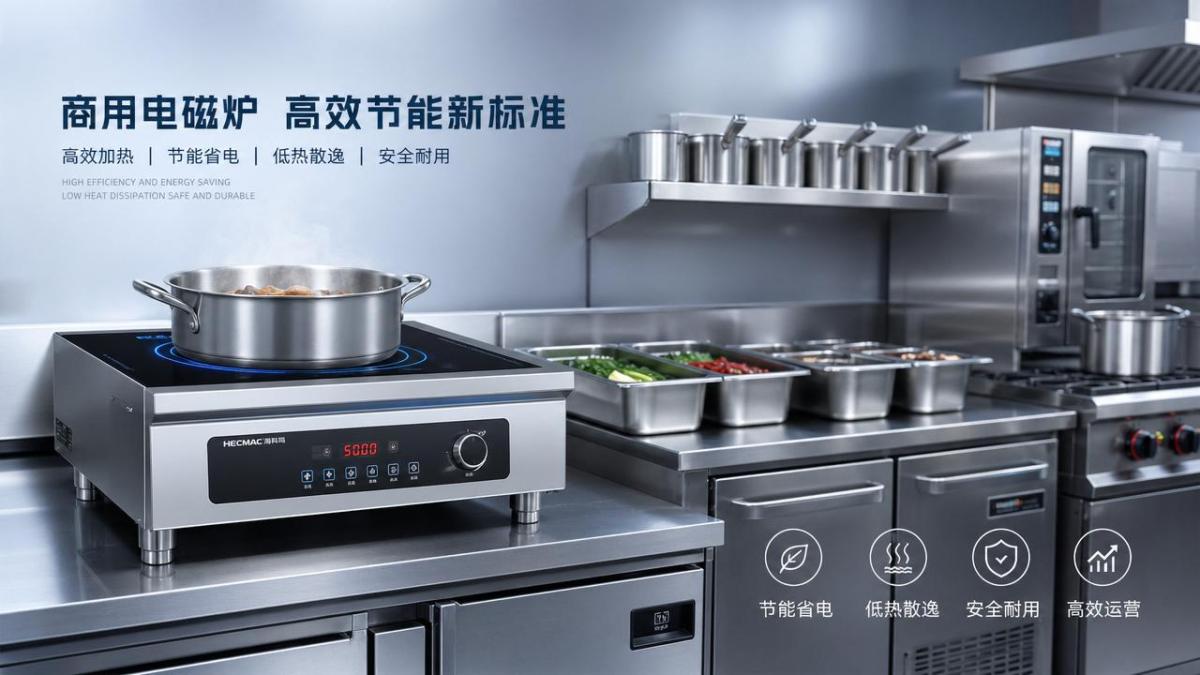
4. Foodservice sites with high ventilation or cooling costs
In hot climates or tightly enclosed kitchens, excess heat has a hidden cost. Traditional cooking equipment can force HVAC systems to work harder, especially during long production windows. In these settings, the Commercial Induction Cooker may deliver savings beyond the meter attached to the cooking line. Finance decision-makers should include indirect energy effects when comparing alternatives, because the total utility reduction can be materially better than a simple appliance-to-appliance benchmark suggests.
Scenario comparison: where the payback case is strongest
The table below helps compare common foodservice scenarios from a financial approval perspective.
Different scenarios, different approval metrics
A finance approver should resist using one universal ROI formula for every site. The same Commercial Induction Cooker can solve different problems depending on the operation.
Restaurants: focus on energy intensity and line speed
If the kitchen runs all day, the key variables are energy rate, burner utilization, ticket volume, and queue pressure during peaks. In this scenario, a Commercial Induction Cooker is most attractive when it can shorten cook times, reduce idle heat, and improve staff movement around the line. The financial value comes from turning a busy kitchen into a more efficient production unit.
Hotels: focus on versatility and risk reduction
Hotels often make purchasing decisions across several departments, not just one kitchen manager. Here, the Commercial Induction Cooker should be assessed for banquet responsiveness, breakfast recovery speed, and staff comfort during long operating windows. Lower surface heat and easier cleaning may reduce safety incidents and housekeeping burden, which matters when labor costs are under pressure.
Central production: focus on repeatability and maintenance control
For a commissary or food processing support kitchen, consistency is financially important because variation creates waste. A Commercial Induction Cooker is often justified when management wants stable output quality, programmable control, and less dependence on technician intervention. In these environments, lower maintenance disruption can be nearly as valuable as lower energy use.
Conditions that usually accelerate payback
The fastest savings rarely come from the equipment alone. They come from the combination of equipment performance and the site conditions around it. A Commercial Induction Cooker tends to pay back faster when the following conditions are present:
- The kitchen operates for long hours, especially across multiple meal periods.
- Existing gas or electric ranges waste heat and increase cooling demand.
- Maintenance calls on legacy cooking equipment are frequent or costly.
- Menu items require quick heating response and consistent repeat cycles.
- The site values safer, cleaner, and more comfortable working conditions.
- Management is already tracking utility consumption and operational KPIs.
When several of these factors appear together, the Commercial Induction Cooker shifts from being a premium equipment choice to a margin-protection decision.
Common scenario misjudgments that slow ROI
Some projects underperform not because induction is ineffective, but because the site was misread. One common mistake is focusing only on the purchase price while ignoring utilization. A lightly used station may not produce rapid energy savings, even if the technology is more efficient. Another mistake is evaluating a Commercial Induction Cooker as a direct one-to-one replacement without considering cookware compatibility, electrical readiness, staff habits, and process redesign.
Finance teams should also avoid assuming all utility environments are equal. If electricity pricing is unfavorable and gas remains relatively cheap, the business case needs more support from labor, ventilation, maintenance, or safety benefits. On the other hand, in kitchens where heat management is a major issue, the indirect savings can be meaningful enough to outweigh pure energy-rate comparisons.
Another overlooked point is scale. In multi-site operations, a Commercial Induction Cooker can justify faster approval because standardized deployment improves training, procurement consistency, spare parts planning, and data visibility. At chain level, savings often accumulate faster than a single-site model would suggest.
How to judge fit before approving budget
A practical approval process should connect site reality to measurable outcomes. Before signing off on a Commercial Induction Cooker, ask for data in five areas:
- Daily operating hours by station, not just by store.
- Current utility cost split between cooking and kitchen climate control.
- Maintenance history and downtime frequency of existing equipment.
- Menu and workflow suitability, including cookware requirements.
- Site electrical capacity and any installation adjustments needed.
This approach keeps the evaluation grounded in operating reality rather than marketing averages. In many cases, the strongest approval case is a pilot deployment in the most energy-intensive location, followed by measured comparison against baseline costs and throughput.
FAQ for finance decision-makers
Is a Commercial Induction Cooker only worth it for large kitchens?
No, but larger or busier kitchens usually recover the investment faster because they use the equipment more intensively. Smaller operations may still benefit through safety, cleaning efficiency, and modernization, though the payback period can be longer.
Should approval be based only on direct energy savings?
No. A Commercial Induction Cooker may also reduce ambient heat, ventilation load, maintenance exposure, and service delays. These indirect factors often determine whether the business case is average or exceptional.
Which sites should be prioritized first?
Prioritize kitchens with long daily operating hours, high energy use, frequent line congestion, and aging equipment. Those environments usually reveal the value of a Commercial Induction Cooker most clearly and most quickly.
Final decision guidance by scenario
A Commercial Induction Cooker lowers energy bills fastest when it is deployed in the right operational context: busy restaurants, multi-format hotel kitchens, central production facilities, and heat-intensive sites where utility waste is already visible. For finance approvers, the most reliable path is to review each scenario through three lenses: hours of use, hidden operating costs, and process impact. If the equipment can reduce direct energy use, ease thermal load, improve uptime, and support smoother output, the payback case becomes much stronger.
The best next step is to match your own kitchen profile against these scenarios, shortlist the highest-usage locations, and request a site-specific savings model. That way, the decision to invest in a Commercial Induction Cooker is tied to measurable business conditions rather than broad assumptions—exactly the level of discipline finance teams need when evaluating modern kitchen equipment.
Popular Tags
Kitchen Industry Research Team
Dedicated to analyzing emerging trends and technological shifts in the global hospitality and foodservice infrastructure sector.
Industry Insights
Join 15,000+ industry professionals. Get the latest market trends and tech news delivered weekly.
No spam. Unsubscribe anytime.
Contact With us
Contact:
Anne Yin (Ceramics Dinnerware/Glassware)
Lucky Zhai(Flatware)