
Restaurant kitchen equipment checklist for ghost kitchens: Less gear, more precision
Launching a ghost kitchen? Streamline operations with a smart restaurant kitchen equipment checklist—designed for minimal footprint and maximum precision. This guide covers essential restaurant kitchen equipment ideas, layout considerations, dimensions, standards, and cost-effective setup strategies. Whether you’re planning your first virtual brand or scaling across multiple locations, discover how to select the right equipment—from hoods and prep tables to energy-efficient appliances—while balancing restaurant kitchen equipment requirements, repair needs, and supplier options. Ideal for procurement teams, operators, and decision-makers seeking clarity in restaurant kitchen equipment design and implementation.
What Makes Ghost Kitchen Equipment Different?
Ghost kitchens operate without dine-in space, front-of-house staff, or traditional branding infrastructure. This shifts equipment priorities from versatility and aesthetics to repeatability, space efficiency, and regulatory compliance. Unlike full-service restaurants requiring fry stations, salad bars, and dishwashing bays, ghost kitchens optimize for high-output, low-footprint workflows—often serving 3–5 virtual brands from one compact line.
Core differentiators include: (1) 70%+ reduction in non-cooking floor area; (2) reliance on modular, stackable, and NSF-certified units; (3) integration-ready controls for digital kitchen management systems (DKMS); and (4) preference for dual-function appliances—e.g., combi ovens that replace steamers, convection ovens, and proofers.
Equipment must support consistent output across peak windows (typically 11:30–14:00 and 17:00–20:00), tolerate 8–12 hours of continuous operation, and meet local ventilation and grease-trap mandates—even in non-traditional spaces like retail basements or industrial parks.
Essential Restaurant Kitchen Equipment Checklist (Minimalist Edition)
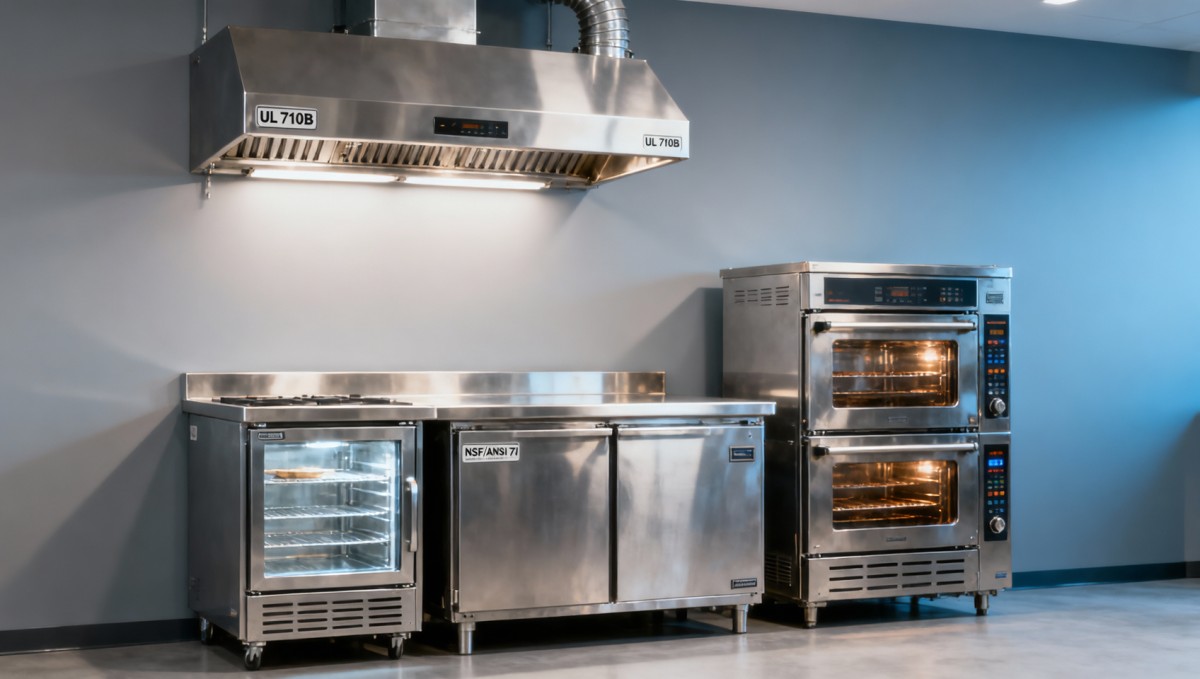
Core Cooking & Holding Units
- Single-phase or three-phase induction cooktops (3.5–7 kW per zone, ±1℃ temperature control)
- Convection/combi oven (10–20 tray capacity, programmable multi-stage cycles)
- Compact blast chiller (≤90 minutes to cool from 70℃ to 3℃, NSF/ANSI 7 compliant)
- Undercounter refrigerated prep table (1.2–1.8m length, 2°C–8°C range, ≥12-hour hold time)
Ventilation & Compliance Essentials
Unlike conventional kitchens, ghost facilities often face stricter local fire codes due to shared building infrastructure. A Type I hood system is mandatory for any open-flame or high-heat cooking—but compact ductless hoods with catalytic filtration (UL 710B certified) are gaining adoption in Class A office conversions where full ductwork isn’t feasible.
This table reflects baseline compliance thresholds—not just performance benchmarks. For example, ENERGY STAR® v3.0+ dishwashers reduce water use by 25% vs. standard units, directly lowering utility costs in high-volume ghost operations (150–300 orders/day).
Procurement Priorities: What Decision-Makers Actually Evaluate
Procurement teams weigh five non-negotiable dimensions: (1) Total cost of ownership (TCO) over 5 years—not just sticker price; (2) Lead time (standard delivery: 4–6 weeks; expedited: +18–22% premium); (3) Service network coverage (minimum 3 certified technicians within 50 miles); (4) Integration capability with POS/delivery platforms (e.g., Toast, Uber Eats API compatibility); and (5) Modularity for future brand expansion (e.g., plug-and-play hood sections or scalable refrigeration racks).
Suppliers from Germany and Japan lead in precision engineering (±0.3°C thermal stability, 10,000-cycle durability), while Chinese OEMs offer competitive value on entry-tier combi ovens and induction units—with 90-day warranty extensions available upon bulk order (≥5 units).
Energy efficiency is no longer optional: EU Ecodesign Directive (EU) 2015/1188 mandates minimum 45% efficiency for commercial ovens. In the U.S., ASHRAE 90.1-2022 requires 20% lower energy use vs. 2013 baseline—making variable-frequency drives (VFDs) and intelligent defrost cycles critical selection criteria.
Why Partner With a Global Kitchen Equipment Specialist?
We support ghost kitchen operators across 32 countries with standardized, pre-vetted equipment packages—including full documentation for local health authority submissions. Our process includes: (1) free site assessment (remote or on-site); (2) 3D layout simulation with equipment clearances and workflow heatmaps; (3) coordinated logistics (crating, customs clearance, white-glove installation); and (4) post-installation DKMS integration support.
Whether you need UL/CSA-certified hoods for U.S. municipalities, CE-marked chillers for EU rollout, or GB-standard prep tables for China-based cloud kitchens—we align specifications to your exact jurisdiction and volume tier (small batch: ≤100 orders/day; mid-scale: 100–400; enterprise: 400+).
Ready to finalize your ghost kitchen equipment list? Contact us to request: (a) a customized spec sheet with model numbers and compliance tags; (b) lead time confirmation for your region; (c) TCO comparison across 3 configuration tiers; or (d) sample validation reports for blast chillers and combi ovens.
Popular Tags
Kitchen Industry Research Team
Dedicated to analyzing emerging trends and technological shifts in the global hospitality and foodservice infrastructure sector.
Industry Insights
Join 15,000+ industry professionals. Get the latest market trends and tech news delivered weekly.
No spam. Unsubscribe anytime.
Hot Articles
 China's Shipbuilding Industry Q1 Orders Up 195.2%, Boosting Specialized Kitchen Equipment Containers
- France Unveils 2026 China Strategy with Smart Kitchen as Cultural Export Priority
- China-Europe Freight Trains Surpass 130,000 Runs; New Cold-Chain Route to Hamburg and Lyon
- Guangdong's Q1 Kitchen Appliance Exports Turn Positive, Smart Integrated Ranges Surge 41%

Contact With us
Contact:
Anne Yin (Ceramics Dinnerware/Glassware)
Lucky Zhai(Flatware)