
Eco-friendly restaurant supplies vs standard lines on lifespan
Choosing between eco-friendly restaurant supplies and standard lines is no longer just a sustainability question—it directly affects lifespan, operating costs, and daily performance. For buyers comparing restaurant supplies B2B options, from restaurant supplies for schools and cafeterias to bars, bakeries, and fast food operations, understanding durability matters. This guide explores how energy efficient restaurant supplies, modular restaurant supplies, and heavy duty restaurant supplies perform over time to support smarter sourcing decisions.
In commercial kitchens, lifespan is not measured only by how many years a product stays in service. Buyers also need to evaluate how long a unit maintains safe performance, stable output, and acceptable maintenance costs under real workloads. A stainless prep table that lasts 8 years but requires frequent repairs after year 3 may deliver less value than an eco-friendly alternative that holds up for 6 to 7 years with lower downtime and lower utility consumption.
This matters across the kitchen equipment industry, where food safety, energy efficiency, automation, and smart management are shaping procurement decisions. For operators, the priority is dependable daily use. For procurement teams, it is total cost over a 3 to 10 year horizon. For business decision-makers, the goal is balancing capital expenditure, brand standards, compliance, and sustainability targets without sacrificing durability.
Why lifespan comparisons matter in commercial restaurant supply sourcing
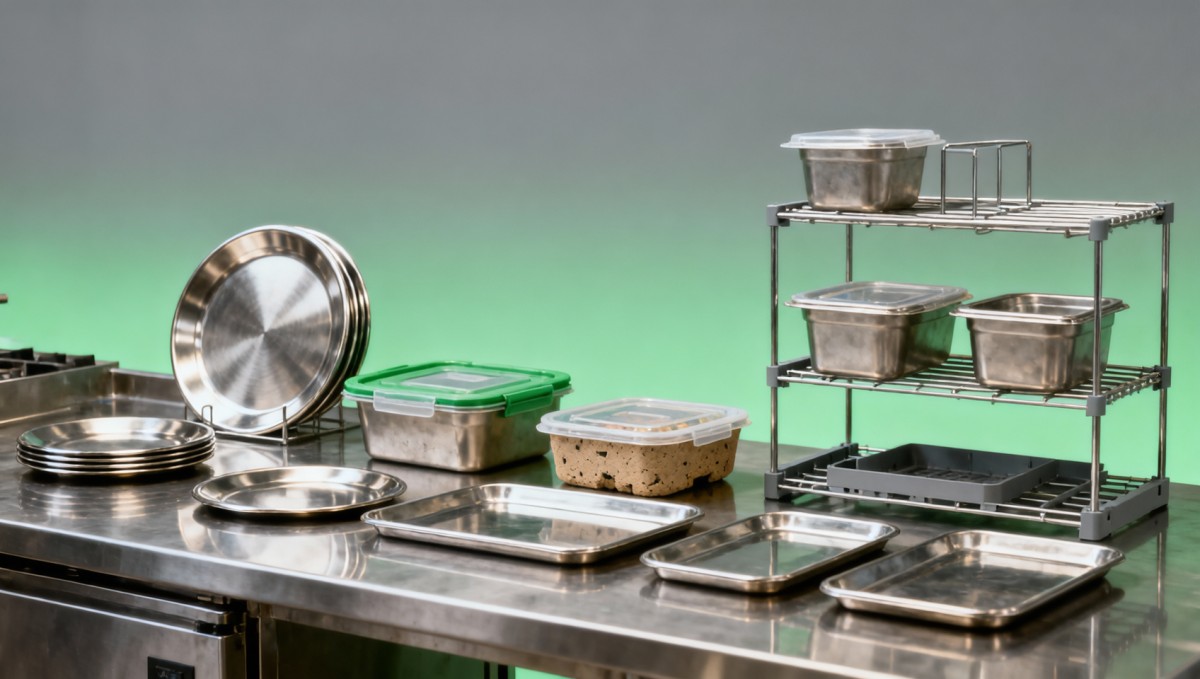
In a restaurant, hotel, bakery, central kitchen, or cafeteria, supplies are exposed to high-frequency use, repeated cleaning cycles, temperature variation, moisture, grease, and chemical contact. These conditions accelerate wear on trays, food containers, utensils, prep tools, shelving, and service equipment. A lifespan comparison between eco-friendly restaurant supplies and standard lines must therefore reflect actual use intensity, not just supplier claims.
Standard lines often win on lower purchase price, especially in large-volume orders. However, lower initial cost can be offset by a 15% to 30% higher replacement frequency in heavy-use environments if materials are thinner, coatings degrade faster, or impact resistance is lower. Eco-friendly restaurant supplies, especially those built from recycled stainless steel, durable bamboo composites, or food-safe reusable polymers, can perform competitively when engineered for commercial duty rather than retail-grade use.
For B2B buyers, the real question is not whether eco-friendly products are “greener,” but whether they maintain structural stability, hygiene, and workflow efficiency over 12 months, 36 months, and beyond. In schools and cafeterias, where use can peak 2 to 3 times daily across large meal volumes, product fatigue becomes highly visible. In bars or fast food operations, impact resistance and ease of cleaning may matter more than raw tensile strength alone.
Lifespan also links directly to hidden cost factors. If one line requires replacement every 18 to 24 months while another lasts 36 to 60 months, the difference affects labor, downtime, inventory planning, and waste disposal. This is particularly relevant in multi-site operations where a procurement team may be managing 50, 200, or even 1,000 units across different locations.
Key lifespan drivers buyers should review
- Material thickness and composition, such as 18/8 or 18/10 stainless steel, reinforced polymers, or fiber-based molded products with protective coatings.
- Use intensity, including daily handling frequency, washing cycles, stacking pressure, and exposure to hot holding or refrigerated environments.
- Cleaning compatibility, especially whether the product tolerates commercial dishwashing, sanitizing chemicals, and temperatures between 60°C and 85°C.
- Repairability and modular replacement, which influence whether damaged parts can be swapped in 1 step or require full-unit replacement.
The table below compares common lifespan considerations across standard and eco-friendly restaurant supplies in typical commercial settings.
The main takeaway is that lifespan is context-specific. Eco-friendly restaurant supplies do not automatically outlast standard lines, and standard lines are not automatically more durable. The more accurate comparison is between commercial-grade eco-friendly products and commercial-grade standard products under the same workload.
Material quality, construction, and usage conditions that affect service life
Service life in the kitchen equipment sector depends first on material engineering. In prep, storage, and service categories, stainless steel remains the benchmark for long-term structural stability. Reusable eco-friendly lines built with corrosion-resistant steel or high-performance composites can match or exceed many standard products. In contrast, eco-focused items made primarily for appearance or branding may underperform if they lack reinforcement at stress points such as corners, handles, hinges, or stack edges.
For example, a heavy duty restaurant supplies line intended for back-of-house use should tolerate repeated impact, wet cleaning, and load pressure. Shelving units may need to support 80 kg to 250 kg per tier depending on format. Storage bins may require resistance to cracking at low temperatures around -18°C if used in freezer areas. A compostable or lightweight product may still be useful, but not necessarily in the same duty cycle as a reusable commercial item.
Usage conditions also change the equation. Restaurant supplies for schools and cafeterias often experience predictable but intense traffic within short serving windows. Bakery environments create flour dust, heat, and repeated tray handling. Bars introduce moisture, acidic liquids, and glass-contact risk. Fast food kitchens combine grease, speed, and frequent washing. A supply line that lasts 5 years in a hotel pantry may last only 2 years on a fast-paced cook line.
This is why procurement teams should request not only material descriptions but also usage guidance, maintenance limits, and test conditions. Terms like “eco-friendly,” “energy efficient,” or “modular” should be tied to practical performance details such as wash-cycle tolerance, recommended load range, heat resistance, and component replacement options.
What to check in a technical review
Structural durability indicators
- Thickness consistency across panels, rims, and joints rather than only on main surfaces.
- Weld quality or fastener design in mobile units, racks, and modular assemblies.
- Resistance to warping after repeated heat and wash exposure over 500 to 1,000 cycles.
Operational suitability indicators
- Compatibility with dishwashers, sanitizers, freezer zones, and stack storage systems.
- Safe surface finish for food contact and ease of cleaning within daily sanitation routines.
- Availability of replaceable parts in 7 to 30 days for high-turnover items.
The table below shows how material and operating conditions influence expected lifespan in common commercial applications.
These ranges are not guarantees, but they help buyers compare realistic service windows. The strongest procurement decisions come from matching product construction to actual kitchen conditions rather than choosing by sustainability label or price tag alone.
Total cost of ownership: purchase price versus replacement, energy, and downtime
For enterprise buyers and purchasing managers, lifespan decisions should be tied to total cost of ownership. This includes initial purchase price, maintenance labor, cleaning time, utility use where relevant, replacement frequency, and interruption to operations. An energy efficient restaurant supplies line may cost more at the start, but if it reduces water use, resists deformation, or lowers breakage rates, the long-term value may be stronger over a 24 to 60 month period.
This is especially relevant for items connected to broader kitchen systems. In the kitchen equipment industry, energy-efficient equipment and durable accessories increasingly work together. Better-insulated food holding units, efficient warewashing support items, and modular storage systems can improve handling and reduce damage. Even simple supplies, such as pans, lids, or trays, affect workflow speed, heat retention, and cleaning labor.
Downtime is often underestimated. If low-cost standard supplies fail during service, the direct cost is not only replacement. Teams may spend 10 to 30 extra minutes per shift adjusting workflow, borrowing inventory, or increasing manual handling. Across 6 days a week and multiple sites, that creates measurable labor loss. In contrast, durable modular restaurant supplies allow selective replacement of handles, inserts, seals, or shelves rather than full-unit disposal.
Procurement teams should also factor ordering efficiency. If a supplier can maintain stable quality, predictable 2 to 6 week lead times, and consistent specifications across regions, replacement planning becomes easier. That is critical for chain restaurants, hospitality groups, and institutional foodservice operators that standardize operations across several kitchens.
A simple 4-point ownership model
- Calculate expected service life in the intended application, not in a general catalog category.
- Estimate annual replacement volume, such as 20 units, 100 units, or site-wide replenishment by quarter.
- Add labor and downtime costs linked to breakage, difficult cleaning, or poor compatibility.
- Review whether modular parts, recyclability, or lower utility demand reduce operating cost over time.
Below is a practical cost comparison framework for sourcing teams reviewing eco-friendly restaurant supplies against standard lines.
The strongest B2B buying decision is rarely the cheapest line item. It is the option that keeps kitchens running with fewer failures, more predictable maintenance, and lower replacement pressure across the full operating cycle.
Best-fit choices by application: schools, bars, bakeries, fast food, and central kitchens
Different operations put different stress on restaurant supplies. That means buyers should avoid one-size-fits-all assumptions when comparing eco-friendly restaurant supplies and standard lines on lifespan. The right answer depends on volume, cleaning intensity, staff handling, menu profile, and storage patterns. A school cafeteria serving 500 to 2,000 meals daily has very different needs from a bakery that rotates trays through proofing, baking, cooling, and display stages.
Restaurant supplies for schools and cafeterias usually benefit from durable reusable systems with reinforced edges, stackable geometry, and commercial dishwashing tolerance. Here, eco-friendly lines can work well if they are designed for repeated cycles rather than single-event sustainability messaging. The practical target is not just recyclability, but 2 to 5 years of reliable use under routine institutional handling.
Bars often need moisture resistance, compact storage, and products that maintain appearance after repeated cleaning. Bakeries prioritize heat resistance, dimensional stability, and easy release surfaces. Fast food operations need heavy duty restaurant supplies that survive rapid turns, dense prep, and aggressive wash schedules. Central kitchens and food processing sites typically favor modular restaurant supplies because parts standardization reduces downtime and simplifies replacement planning.
For decision-makers, the practical approach is to define the top 3 failure modes in each site type, then select materials and designs that minimize those failures. Common issues include cracking, corrosion, warping, chipped coatings, loose joints, and unstable stacking. This helps align sustainability goals with productivity rather than treating them as separate procurement tracks.
Application-based selection priorities
- Schools and cafeterias: prioritize dishwasher-safe reusable lines, ergonomic handling, and stack durability for 2 to 3 daily meal peaks.
- Bars: focus on moisture tolerance, compact footprint, stain resistance, and easy wipe-down surfaces.
- Bakeries: choose heat-tolerant tools and trays that resist bending under repeated thermal cycles.
- Fast food: use heavy duty restaurant supplies with impact resistance and quick-clean features to support high-speed production.
- Central kitchens: favor modular systems with replaceable parts and standardized dimensions for scalable maintenance.
Common buyer mistake
A frequent sourcing mistake is selecting eco-friendly products based only on material origin while overlooking duty rating. Another is assuming all standard lines are equally robust. In practice, a commercial-grade eco-conscious line can outperform a low-tier standard option, while a premium standard stainless line may still be the better choice in extremely abrasive or high-heat zones. Matching the supply line to the operational load remains the most reliable rule.
How to evaluate suppliers, implement replacements, and extend product life
The final determinant of lifespan is not only the product itself, but also supplier consistency and on-site management. In the kitchen equipment industry, buyers increasingly need suppliers that can support smart, efficient, and scalable operations. That means stable specifications, documented materials, replacement part availability, and practical guidance on cleaning and handling. A product that performs well in testing can still fail early if staff are not given usage limits or if replacement parts take 8 weeks to arrive.
Implementation should begin with a pilot. For a chain operator or institutional buyer, testing 10 to 30 units in one or two sites over 60 to 90 days can reveal whether eco-friendly restaurant supplies truly outperform or match standard lines in that setting. Track cleaning outcomes, breakage incidents, fit with storage systems, and operator feedback. This creates evidence for broader rollout and reduces procurement risk.
Maintenance also matters more than many teams expect. Basic controls such as load limits, correct stacking, temperature compliance, and routine inspection can extend usable life by months or years. For example, replacing worn seals early, avoiding overstacking beyond rated levels, and separating chemical-sensitive items during warewashing can reduce avoidable damage. These are low-cost actions with measurable effect on replacement frequency.
Supplier review should include commercial criteria as well. Buyers should check MOQ, lead times, spare parts policy, batch consistency, and response time for complaints or technical questions. In B2B restaurant supplies, a dependable after-sales process is often more valuable than a small price difference, especially when the product is used across multiple shifts or multiple branches.
A practical 5-step sourcing and rollout process
- Define the use case by site type, daily volume, wash process, and failure history.
- Compare 2 to 3 shortlisted lines using material, duty rating, lifespan estimate, and replacement logic.
- Run a 60–90 day pilot with documented operator feedback and damage tracking.
- Confirm lead time, parts availability, and reorder consistency before wider purchase.
- Train staff on cleaning, stacking, and inspection standards to protect service life.
FAQ: common procurement questions
How long should commercial reusable supplies last?
Depending on category and workload, many reusable commercial supplies last from 1.5 years to 10 years. Small utensils and containers may sit at the lower end, while shelving, racks, and stainless structures often sit at the higher end when maintained correctly.
Are eco-friendly restaurant supplies always more durable?
No. Durability depends on engineering, material quality, and duty rating. Commercial-grade eco-friendly lines can be highly durable, but light-duty eco products may wear out quickly in demanding kitchen environments.
What should procurement teams ask suppliers first?
Ask about material composition, wash-cycle tolerance, load limits, spare part availability, typical lead time, and recommended applications. These six checks reveal far more than price alone.
When does modular design improve lifespan?
Modular design improves lifespan when common wear parts can be replaced separately in 1 to 3 service steps. This is especially useful in central kitchens, chain stores, and institutional sites that need fast maintenance and standardized inventory.
Choosing between eco-friendly restaurant supplies and standard lines should be treated as a long-term operational decision, not only a sustainability preference. The best option depends on material quality, application fit, replacement strategy, and supplier reliability across the full lifecycle. Buyers who compare lifespan, total cost, and real working conditions will make stronger sourcing decisions for schools, bakeries, bars, fast food sites, central kitchens, and other commercial foodservice operations.
If you are reviewing restaurant supplies B2B options and need help matching durable, energy efficient, modular, or heavy duty restaurant supplies to your operation, now is the right time to evaluate specifications in detail. Contact us to discuss your application, request a tailored product recommendation, or explore more kitchen equipment solutions for efficient and sustainable commercial performance.
Popular Tags
Kitchen Industry Research Team
Dedicated to analyzing emerging trends and technological shifts in the global hospitality and foodservice infrastructure sector.
Industry Insights
Join 15,000+ industry professionals. Get the latest market trends and tech news delivered weekly.
No spam. Unsubscribe anytime.
Contact With us
Contact:
Anne Yin (Ceramics Dinnerware/Glassware)
Lucky Zhai(Flatware)