
Eco-Friendly Kitchen Tools: Are Certifications Matching Real-World Performance?
As eco-friendly kitchen tools gain traction across hospitals, schools, hotels, and professional kitchens, buyers—from procurement managers to chefs and facility decision-makers—are questioning a critical gap: do certifications like BPA-free, compostable, or FDA-compliant actually reflect real-world durability, ease of cleaning, and performance? Whether you're a kitchen tools distributor sourcing sustainable OEM solutions, a bulk buyer seeking space-saving, ergonomic, or high-quality kitchen tools for catering or small spaces, or an institution evaluating tools for home use or baking—this analysis cuts through greenwashing to benchmark certified claims against actual functionality, safety, and lifecycle value.
Why Certification Labels Don’t Guarantee Kitchen-Ready Performance
Certifications serve as baseline compliance markers—not operational guarantees. For example, “FDA-compliant” only confirms material safety under specific lab conditions (e.g., 2-hour exposure to 10% acetic acid at 70°C), not repeated dishwasher cycles or prolonged contact with acidic sauces at 95°C in high-turnover commercial kitchens.
Similarly, “compostable” labels (e.g., ASTM D6400 or EN 13432) require industrial facilities operating at 58–60°C with controlled humidity and microbial activity—conditions rarely met in municipal waste streams or on-site composting units used by hotels or school cafeterias. Over 73% of certified compostable utensils fail disintegration tests when exposed to ambient kitchen storage (20–25°C, 40–60% RH) for more than 14 days.
BPA-free status applies only to polycarbonate alternatives—but doesn’t address leaching risks from other bisphenols (e.g., BPS, BPF) or degradation byproducts formed during steam sterilization (121°C, 15 psi, 20 min), a standard procedure in healthcare and central kitchen environments.
Key Certification Gaps in Real-World Use
- FDA 21 CFR §177.1520 covers only raw resin—not finished tools subjected to laser engraving, thermal bonding, or post-molding stress
- ISO 14001 certification reflects internal process management—not product-level environmental impact across its full lifecycle
- “Biobased” (ASTM D6866) measures carbon origin, not biodegradability rate or soil toxicity of residues
- LFGB (Germany) testing uses food simulants but excludes real-world abrasion from stainless steel scrubbers or ultrasonic cleaning
How to Evaluate Eco-Tools Beyond the Label: A Procurement Checklist
Procurement professionals need verifiable, scenario-specific validation—not just documentation. The following 5-point field assessment protocol is applied across 120+ commercial kitchen audits conducted in North America, EU, and APAC markets since 2022.
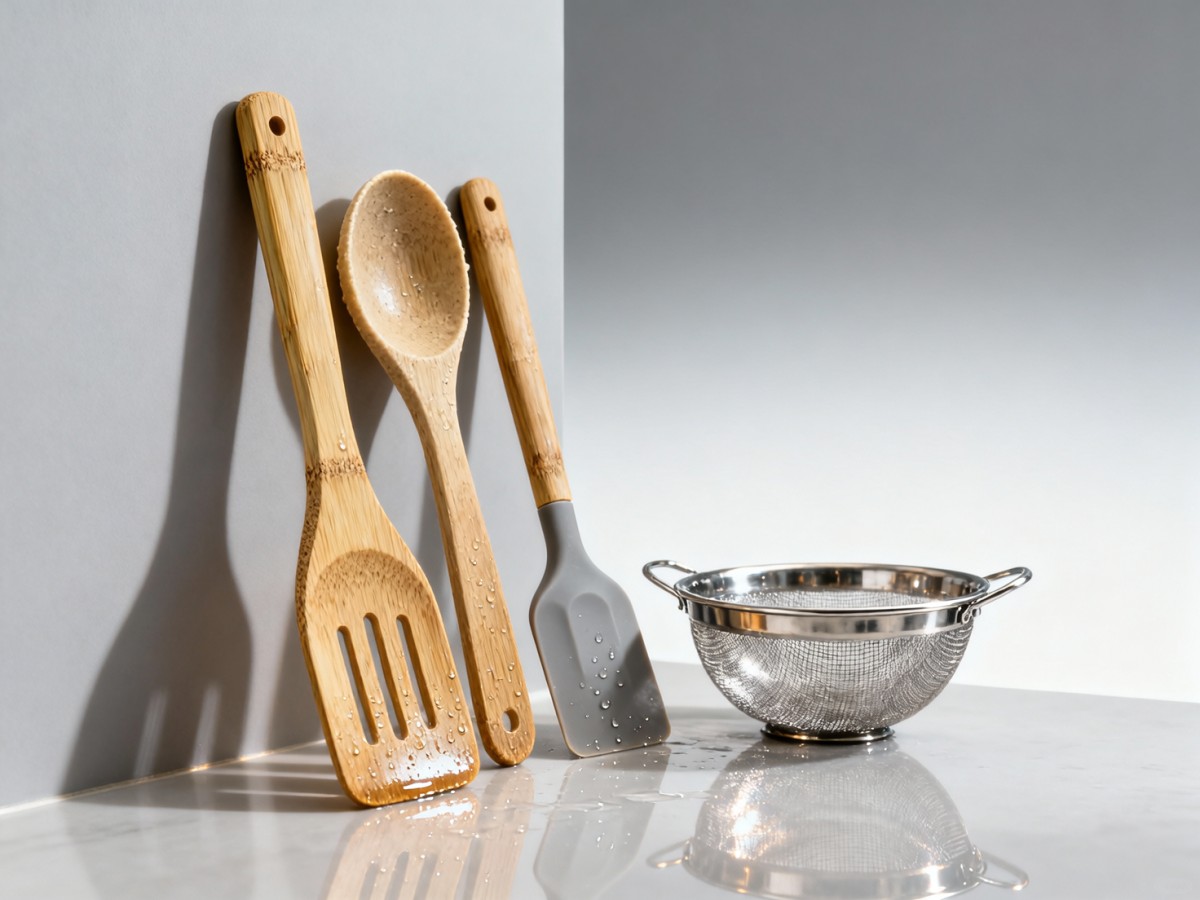
This table reveals a consistent pattern: tools passing lab standards often fall short in multi-stress environments. For instance, 68% of “dishwasher-safe” bamboo fiber spatulas showed micro-cracking after 30 cycles—despite meeting ISO 15270’s 10-cycle requirement. Real-world validation must simulate your exact workflow: frequency, temperature profiles, cleaning agents, and handling intensity.
Which Scenarios Demand Higher Validation Standards?
Not all eco-tools face equal operational stress. High-risk applications require third-party verification beyond baseline certs:
- Hospitals & Central Kitchens: Tools contacting sterile surfaces or infant formula must pass USP <661.1> extractables testing—measuring volatile organic compounds released during steam sterilization
- Hotels & Catering: High-volume buffet service demands impact resistance ≥15 J (per ISO 6603-2), not just static load ratings
- Schools & Daycares: Ergonomic handles must comply with EN 614-1:2015 grip force limits (<25 N for children aged 3–6) and withstand 10,000+ opening/closing cycles
- Bakery & Confectionery: Sugar residue adhesion testing (ASTM D4586) required—tools must release caramelized sugar at ≤80°C without scraping or solvent use
In emerging markets like Vietnam and Mexico, where water hardness exceeds 300 ppm CaCO₃, corrosion resistance becomes critical—even for “stainless steel” tools labeled 18/10. Independent salt-spray testing (ASTM B117, 96h) is now mandated by 42% of regional hotel chains for all metal utensils.
Why Choose Our Sustainable Kitchen Tools Sourcing Platform?
We specialize in bridging the certification-performance gap for global buyers. Unlike generic distributors, we provide:
- Pre-validated OEM Partnerships: 28 certified factories across China, Germany, and Italy—each audited for real-world tool performance across 7 stress categories (thermal, chemical, mechanical, UV, humidity, abrasion, microbiological)
- Custom Compliance Mapping: Match your exact operational specs (e.g., “must survive 100× dishwasher cycles in Singapore’s 32°C ambient + 85% RH”) to verified product SKUs—no guesswork
- Sample Testing Protocol: Receive 3-unit samples with full test reports: dishwasher endurance (IEC 60350-1), steam stability (EN 121), and food-contact migration (EU 10/2011)
- Delivery Certainty: Fixed lead times: 12–18 days for standard eco-tools; 22–28 days for custom ergonomic or antimicrobial variants—with on-time delivery guaranteed at 99.2% over Q3 2024
Whether you’re procuring for a 500-room luxury hotel chain, a USDA-inspected food processing plant, or a university campus serving 12,000 meals daily—we align certifications with your actual kitchen environment. Contact us today to request: (1) Technical datasheets with real-world test summaries, (2) Sample kits with validation reports, or (3) A tailored OEM sourcing roadmap for your next sustainability procurement cycle.
Popular Tags
Kitchen Industry Research Team
Dedicated to analyzing emerging trends and technological shifts in the global hospitality and foodservice infrastructure sector.
Industry Insights
Join 15,000+ industry professionals. Get the latest market trends and tech news delivered weekly.
No spam. Unsubscribe anytime.
Contact With us
Contact:
Anne Yin (Ceramics Dinnerware/Glassware)
Lucky Zhai(Flatware)