
Restaurant supplies for bakeries that handle flour and heat better
Choosing the right restaurant supplies for bakeries is essential when daily operations involve heavy flour use, high temperatures, and constant production pressure. From heat-resistant equipment to easy-clean prep tools, durable solutions help operators improve safety, efficiency, and product consistency. This article explores practical supply options that perform better in demanding bakery environments and support smoother, more reliable kitchen workflows.
Why bakery supply decisions are changing faster than before
Bakery operations have always been demanding, but the decision process around restaurant supplies for bakeries has become more complex in recent years. Operators are no longer choosing tools only by price or basic function. They now have to consider heat exposure, flour dust control, labor efficiency, food safety expectations, energy use, cleaning time, and equipment durability under near-continuous production. This shift matters because bakeries combine two difficult working conditions at once: airborne dry ingredients and sustained high-temperature workflows.
In the broader kitchen equipment industry, automation, intelligent monitoring, and energy-efficient systems are influencing purchase behavior across restaurants, hotels, and food processing facilities. Bakeries are part of that change, but their priorities are more specific. Flour can accumulate on surfaces, enter moving parts, and slow cleaning routines. Heat from ovens, proofers, and hot pans puts pressure on worktables, racks, gloves, trays, and transport equipment. As a result, restaurant supplies for bakeries are increasingly judged by how well they perform under repetitive flour handling and high heat rather than by appearance or short-term savings.
Another important signal is the rising demand for consistency. Whether a bakery serves a local café, a hotel breakfast line, or a central kitchen, product uniformity has become a business requirement. That means operators need supplies that reduce handling errors, prevent contamination, and support stable throughput during peak hours. The market is moving toward solutions that are easier to sanitize, more resistant to thermal stress, and better integrated into efficient kitchen workflows.
The main forces pushing bakery supply upgrades
Several industry forces are driving this change. First, labor pressure is making easy-operation tools more valuable. When experienced staff are limited, operators need restaurant supplies for bakeries that reduce manual adjustment, simplify cleaning, and shorten setup time between batches. A heat-resistant tray that warps less or a prep table with smoother surfaces can save minutes every shift, which becomes significant over time.
Second, food safety expectations are becoming stricter in everyday practice. Flour dust may look harmless, but in busy kitchens it can settle into corners, wheels, seams, and hardware. Supplies with fewer hard-to-clean joints, durable stainless steel construction, and sealed or protected components are becoming more attractive because they support routine sanitation more effectively.
Third, energy efficiency is reshaping the equipment ecosystem around bakery production. As ovens and heated holding systems become more efficient, supporting supplies also need to tolerate more continuous use cycles. Operators increasingly notice whether racks, pans, oven tools, and insulated transport items hold up under repeated heating and cooling without deforming, corroding, or creating downtime.
Fourth, production flexibility is now more important than before. Many bakeries no longer produce only bread. They may switch between pastries, pizza dough, laminated products, cookies, and par-baked items. That variety increases the value of modular restaurant supplies for bakeries, including stackable bins, mobile shelving, temperature-tolerant utensils, and workstations that adapt to multiple tasks.
Which restaurant supplies for bakeries are gaining importance
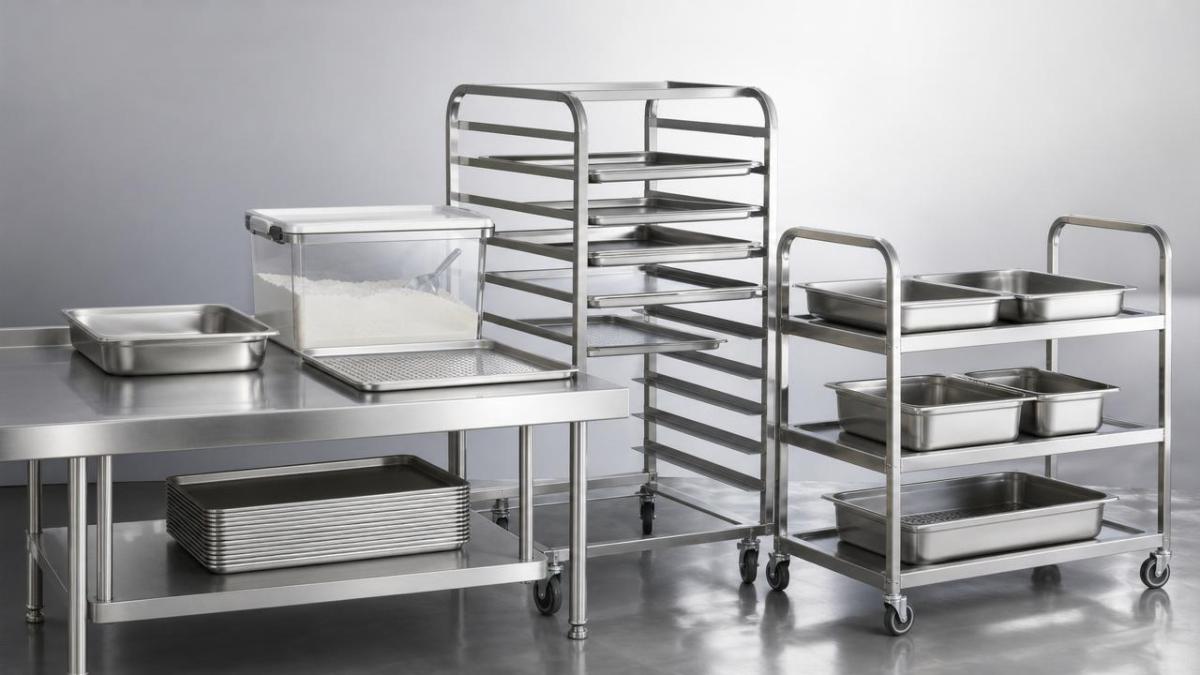
The biggest shift is not toward one single product, but toward a better-matched supply system. In high-flour and high-heat environments, operators are paying more attention to material performance and workflow fit. Stainless steel worktables remain a strong choice because they handle cleaning chemicals well, resist moisture issues, and support dough prep in demanding settings. Heavy-duty ingredient bins with tight covers are also becoming more important because they help reduce flour contamination and keep storage more manageable.
Heat-resistant sheet pans, baking trays, oven racks, and transport racks are another priority area. In many bakeries, lower-grade metal items warp under repeated thermal stress, which affects product consistency and handling safety. Operators increasingly prefer commercial-grade restaurant supplies for bakeries that maintain shape and structural stability over long production cycles.
Hand tools are changing as well. Scrapers, spatulas, brushes, measuring tools, and oven gloves are no longer treated as minor purchases. When these items fail, staff lose time and may compromise quality. Easy-grip, heat-tolerant, and easy-clean designs are becoming more valuable, especially in kitchens where operators move quickly between scaling, mixing, shaping, baking, and unloading.
Mobile support equipment is also gaining attention. Flour-heavy bakeries often need frequent movement of ingredients, trays, and finished goods. Carts, dollies, and mobile racks that roll smoothly and clean easily can improve internal logistics. This is especially relevant in central kitchens and multi-station production lines where cross-traffic can create delays.
How these changes affect operators on the floor
For users and operators, the impact is practical rather than abstract. Better restaurant supplies for bakeries can lower daily friction. A stable rack reduces the risk of spills when moving hot trays. A smooth prep surface prevents flour build-up in creases. A better bin system reduces ingredient waste and shortens retrieval time. These improvements may seem small in isolation, but together they create a safer and more controlled bakery environment.
There is also a strong ergonomic impact. Supplies that are easier to lift, grip, store, or clean help reduce fatigue across long shifts. In bakery work, repetitive handling is constant, so even small design improvements can support operator performance. This is one reason why supply selection is increasingly linked to labor retention and training efficiency, not just procurement cost.
Another effect is improved consistency. When trays, molds, utensils, and transport tools behave predictably under heat and repeated use, the production team can maintain more stable process control. That helps with baking times, batch organization, and quality checks. In a competitive foodservice market, consistency is often what protects customer trust.
Impact by operating area
What signals buyers and operators should monitor next
One clear signal is the growing overlap between basic supplies and smarter kitchen systems. Even when a bakery is not fully automated, its restaurant supplies for bakeries need to fit a more structured production environment. Supplies that stack efficiently, label clearly, and move safely between stations work better in kitchens adopting digital scheduling, production tracking, or tighter quality controls.
Another signal is the rising value of total operating cost. Buyers are increasingly asking not only how much an item costs to purchase, but how often it must be replaced, how hard it is to clean, and whether it creates hidden labor costs. In bakery environments, cheaper items can become expensive if they trap flour, deform under heat, or interrupt production.
Sustainability is also influencing decisions, though usually in a practical way. Operators are more interested in long-life products, reduced breakage, better energy compatibility, and fewer disposable replacements. This aligns with the wider kitchen equipment industry trend toward greener and more efficient operations.
Finally, supply standardization is becoming more important for businesses with multiple outlets or central production. Standard restaurant supplies for bakeries make training easier, simplify replacement planning, and help maintain consistent product handling across sites. This is especially useful for businesses expanding into wholesale, hotel supply, or chain bakery models.
Practical judgment points before upgrading supplies
Operators and managers should avoid upgrading based only on catalogs or appearance. A stronger approach is to review where friction happens most often during daily production. If flour clean-up takes too long, storage and prep surfaces may need attention first. If tray handling creates delays, then rack design, pan quality, or transport tools may be the better starting point. If equipment life is short near ovens, thermal resistance should become a purchasing priority.
It is also useful to test whether supplies support actual movement patterns in the kitchen. Restaurant supplies for bakeries should not be evaluated as isolated items. They should be judged by how they connect receiving, storage, mixing, shaping, baking, cooling, and dispatch. Supplies that work well in one area but create bottlenecks in another may not deliver real operational value.
Material quality deserves close attention. In bakery settings, surfaces should resist corrosion, tolerate frequent cleaning, and hold up under both dry ingredients and temperature changes. Handles, joints, wheels, corners, and edges are often where failure begins, so these details matter more than many buyers expect.
A practical direction for the next stage of bakery supply planning
The next stage is not simply buying more products. It is building a more resilient bakery workflow. That means selecting restaurant supplies for bakeries that perform reliably under flour-heavy prep, repeated heating cycles, and high-volume movement. In many cases, the best result comes from upgrading a group of connected items rather than replacing one isolated tool.
For example, a bakery may gain more value by improving ingredient bins, prep tables, racks, and oven-handling tools together than by changing only one visible piece of equipment. This system view reflects the broader direction of the kitchen equipment industry, where integration, efficiency, and durability are becoming central to competitive performance.
If a business wants to judge the future impact of these trends on its own operation, it should confirm a few key questions: Which supplies fail most often under heat or flour exposure? Where does cleaning time slow production? Which handling steps create the most risk or inconsistency? And which upgrades would reduce downtime while supporting safer, more repeatable work? Clear answers to those questions can guide smarter supply decisions and help bakery teams operate with greater confidence in a changing market.
Popular Tags
Kitchen Industry Research Team
Dedicated to analyzing emerging trends and technological shifts in the global hospitality and foodservice infrastructure sector.
Industry Insights
Join 15,000+ industry professionals. Get the latest market trends and tech news delivered weekly.
No spam. Unsubscribe anytime.
Hot Articles
 ASEAN FTA Upgrade Enters Text Verification Phase; Smart Kitchen Controls Added to Zero-Tariff List
- Electronics Manufacturing Leads with 13.6% Output Growth; Kitchen Appliance Chip Supply Stabilizes
- OpenCLAW-like Agent Deployment Risk Management Guidelines Released
- Green Power Stocks Rally; Overseas Buyers Prioritize Green Electricity Usage

Contact With us
Contact:
Anne Yin (Ceramics Dinnerware/Glassware)
Lucky Zhai(Flatware)