
Non-stick kitchen tools: coating safety vs service life
Choosing non-stick kitchen tools means balancing coating safety, heat resistance, and long-term value. Whether you source kitchen tools wholesale, compare a kitchen tools price list, or select durable kitchen tools for restaurants, catering, baking, or home use, understanding materials and lifespan is essential. This guide helps buyers, operators, and decision-makers evaluate non-stick kitchen tools alongside stainless steel kitchen tools for safer, more cost-effective purchasing.
In commercial kitchens, central food preparation sites, bakeries, and household environments, non-stick kitchen tools are selected for speed, convenience, and easier cleaning. Yet the same purchasing decision often raises practical questions: Which coating is safer at repeated cooking temperatures? How long will a spatula, ladle, tong, or turner last under daily use? When does stainless steel become the lower-risk alternative? These questions matter not only for operators but also for procurement teams that need predictable replacement cycles and stable supply.
For B2B buyers, the real issue is not simply whether a tool is non-stick. The issue is whether the material system, coating process, substrate, and maintenance conditions match the intended task. A tool used 20 to 50 times per day in a restaurant line has very different service demands from one used 3 to 5 times per week at home. Good sourcing decisions reduce breakage, prevent coating damage, support food safety procedures, and improve total cost over 6 to 24 months.
Understanding coating safety in non-stick kitchen tools
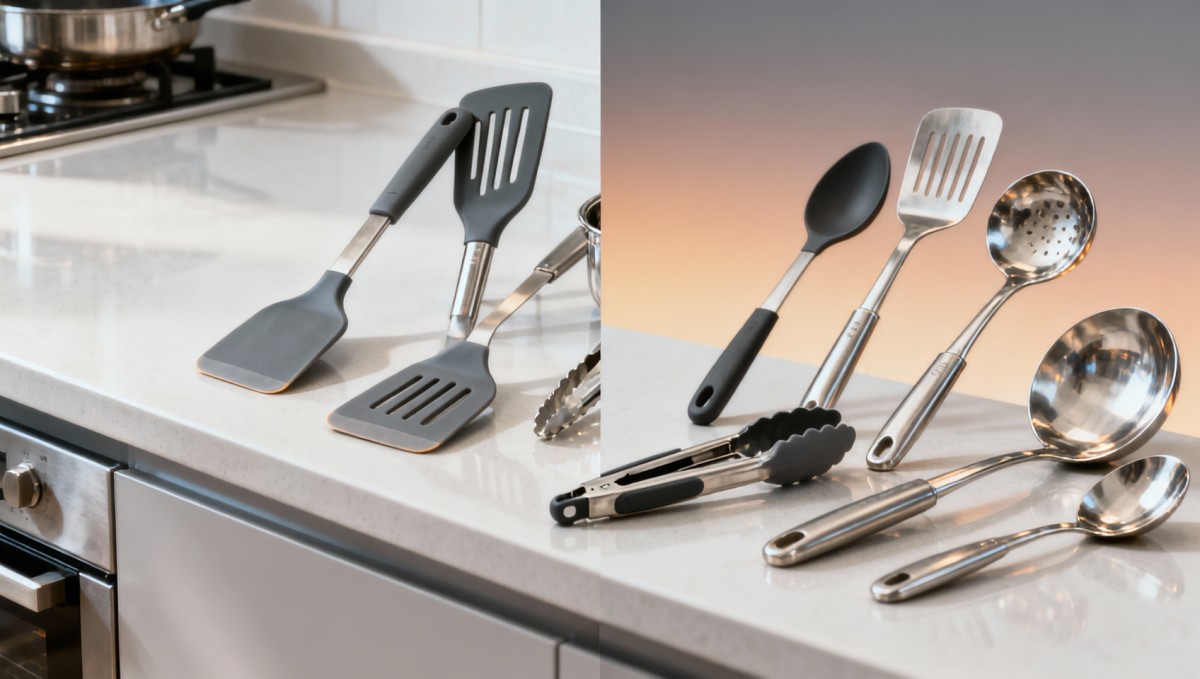
Non-stick kitchen tools usually combine a base material with a functional surface designed to reduce food adhesion. Common substrates include nylon, silicone, aluminum, and stainless steel with coated contact areas. In practical sourcing, buyers should separate 3 questions: what touches food, what temperature the tool must tolerate, and how the surface behaves after repeated scraping, washing, and storage. Coating safety is not only a material question but also a use-condition question.
Many operators assume all non-stick surfaces behave the same, but that is rarely true. A silicone spatula rated for 220°C to 250°C works differently from a low-cost coated nylon turner that may deform near 180°C to 210°C. In restaurant kitchens where hot holding pans, sauté stations, and baking trays create rapid temperature swings, a small difference of 20°C to 40°C can influence safety, odor release, shape retention, and coating integrity over time.
From a risk-control perspective, the most common failure points are overheating, abrasive cleaning, and contact with sharp metal edges. If a tool is exposed to direct flame, heated oil, or continuous pan contact above its rated threshold for even 5 to 10 minutes, the coating or outer layer may degrade faster than expected. Procurement teams should therefore request temperature guidance, dishwasher suitability, and cleaning limitations as part of product comparison.
What buyers should verify before purchase
A practical safety review should cover food-contact material declaration, operating temperature range, odor performance at high heat, and edge wear after repeated friction. For wholesale kitchen tools, it is also useful to ask whether the coating is applied as a thin surface layer or whether the non-stick property comes mainly from the body material itself, such as food-grade silicone. Tools with fewer layered interfaces often show more stable performance in demanding kitchens.
Basic safety checklist
- Confirm the recommended working temperature range, ideally with a clear upper limit such as 210°C, 230°C, or 250°C.
- Check whether the tool is intended for direct pan contact, baking use, serving use, or light mixing only.
- Review dishwasher guidance, because repeated wash cycles of 1 to 2 times per day can accelerate surface aging.
- Inspect handle bonding, seams, and any visible cracking points that may trap residue after 3 to 6 months of use.
The table below compares common non-stick kitchen tool materials from a sourcing perspective. It is intended as a practical reference for restaurants, catering operations, distributors, and import buyers evaluating service life against coating safety.
The key takeaway is that safer selection comes from matching temperature, contact type, and cleaning method. For many kitchens, silicone-based non-stick tools offer a useful middle ground between gentle cookware protection and reliable heat tolerance. However, where scraping force, impact, or edge precision matter more than non-stick behavior, stainless steel kitchen tools may still be the safer long-term option.
Service life: what really determines durability
Service life is often misunderstood as a fixed number of months, but in practice it depends on workload intensity, cleaning chemistry, storage habits, and task fit. A non-stick spatula used in a bakery for folding batter 10 times per shift can remain functional for 12 to 24 months. The same tool used to turn burgers on a hot flat top 40 times per shift may show edge wear, discoloration, or surface damage within 3 to 6 months.
For procurement planning, it helps to think in usage cycles rather than in calendar time alone. High-frequency restaurant kitchens, hotel breakfast stations, and catering operations usually need a replacement review every 90 to 180 days. Home-use channels may review every 12 months or longer. This distinction is important when comparing a low upfront kitchen tools price list with true operating cost across a year.
Durability also relates to structure. One-piece molded silicone tools generally reduce weak points because there are fewer seams where handles can loosen or moisture can collect. Multi-part tools may offer lower purchase cost, but if joints fail after repeated dishwasher cycles or heat exposure, the service life shortens. In B2B sourcing, failure at the handle-neck junction is one of the most common reasons for early replacement.
Main drivers of early wear
- Repeated contact with cookware edges or grill plates at temperatures near or above the rated limit.
- Cleaning with abrasive pads, alkaline chemicals, or long dishwasher exposure cycles of 60 to 90 minutes.
- Stacking and storage pressure that bends thin heads or chips coated surfaces during transport and back-of-house handling.
- Using soft non-stick tools for heavy scraping, portioning frozen foods, or lifting loads beyond intended design.
The table below offers a practical service-life framework by usage intensity. Actual results vary by design and care, but these ranges are useful for inventory planning and replacement budgeting.
The most cost-effective decision is often not the cheapest unit price but the most appropriate durability level for the task. If one tool lasts twice as long while reducing cookware damage and cleaning time, the annual cost can be lower even when the purchase price is 20% to 40% higher. That is why service life should be discussed together with safety, rather than as a separate issue.
Non-stick vs stainless steel kitchen tools by application
A common sourcing mistake is framing the choice as non-stick versus stainless steel, as if one must replace the other in every kitchen. In reality, the better question is which tool family fits each application. Non-stick kitchen tools are ideal where surface protection, low adhesion, and easy cleaning matter most. Stainless steel kitchen tools perform better where edge strength, rigidity, impact resistance, and long-term structural stability are priorities.
For example, silicone turners and spatulas work well with coated pans, baking trays, and delicate mixtures. Stainless steel tongs, ladles, skimmers, and serving spoons are often preferred in buffet, frying, boiling, and heavy prep environments. In mixed operations such as hotels, central kitchens, and catering services, a combined inventory strategy is usually more practical than choosing one material system for 100% of tasks.
From a decision-maker’s perspective, dividing tools into 4 operational groups can simplify procurement: cookware-safe tools, high-heat line tools, precision serving tools, and heavy-duty prep tools. This reduces misuse, improves service life, and supports staff training. It also allows buyers to build a more accurate kitchen tools wholesale plan by function rather than by broad category.
Recommended matching by task
The following comparison can help operators and buyers decide where each type creates more value in day-to-day use.
The practical conclusion is that non-stick kitchen tools should not be judged only by softness or convenience. They are specialized tools for specific food-contact conditions. Stainless steel remains essential in many commercial settings, especially when the job demands force, speed, or frequent sanitation cycles. The strongest procurement approach is to assign each type to the right environment and replacement schedule.
A balanced procurement mix often includes
- Soft-contact tools for coated cookware and baking lines.
- Stainless steel tools for high-load cooking and serving.
- Dedicated utensils for allergen control or color-coded process zones.
- Backup stock equal to 5% to 10% of active kitchen tool count for fast replacement.
How buyers should evaluate suppliers, price lists, and product specifications
When comparing suppliers, a kitchen tools price list is only the starting point. For importers, distributors, restaurant groups, and hospitality buyers, the more useful metric is total procurement value over a 6- to 12-month operating window. This includes product consistency, packaging quality, lead time, defect handling, and the ability to provide a repeatable specification across batches. Low initial pricing can lose its advantage quickly if replacement frequency rises or if dimensions vary between orders.
A reliable specification review should include at least 6 points: material type, temperature rating, product dimensions, handle construction, cleaning recommendation, and carton packing details. Buyers should also clarify whether the tools are intended for retail packaging, foodservice bulk packing, or mixed-channel distribution. In wholesale transactions, packaging efficiency can directly affect freight utilization and warehouse handling cost.
Lead times matter as well. Standard kitchen tools wholesale orders may move in 15 to 35 days depending on quantity, packaging complexity, and shipping mode. If a supplier cannot keep stable dimensions, color consistency, or handle strength across production lots, the operational cost of complaints and replacements can outweigh any short-term unit savings. Procurement teams should therefore combine sample testing with a clear acceptance checklist.
Core evaluation criteria for B2B sourcing
- Request sample validation under real kitchen conditions for 7 to 14 days before larger purchasing decisions.
- Compare temperature tolerance and intended application, not only overall appearance or handle design.
- Review carton quantity, inner packing, and labeling if products will be resold across retail and hospitality channels.
- Confirm complaint handling process, reorder lead time, and availability of matching product families.
The table below provides a practical procurement scoring framework that can be adapted by sourcing teams and category managers.
In many cases, the best supplier is not the one with the lowest piece price but the one that gives clearer use limits, better consistency, and lower replacement risk. That approach supports restaurant groups, distributors, and enterprise buyers who need predictable performance across multiple kitchens or markets.
Maintenance, common mistakes, and long-term value optimization
Even good non-stick kitchen tools lose value quickly when care practices do not match the material. In many operations, tool failure is caused less by manufacturing defects than by misuse in the first 30 to 90 days. Common examples include leaving tools on hot pan edges, using them for scraping baked-on residue, or cleaning them with steel wool. These habits shorten service life and create avoidable replacement costs.
A simple maintenance protocol can noticeably improve life span. Tools should be rinsed soon after use, washed with non-abrasive materials, dried before stacking, and stored so heads are not bent under load. In kitchens with high turnover or multiple shifts, periodic visual checks every 2 to 4 weeks can identify cracks, loose handles, or worn edges before they affect food safety or work efficiency.
For managers and supervisors, staff guidance matters as much as product quality. If teams understand which tool belongs to which process, misuse drops. A short training note posted in the wash area or prep zone can reduce the wrong-tool rate significantly. This is especially useful in restaurant groups and catering sites where temporary staff may not know the heat limits or handling differences between stainless steel kitchen tools and non-stick alternatives.
Frequent mistakes to avoid
- Using soft-contact tools above rated heat for direct stir-frying or prolonged hot-surface contact.
- Mixing damaged and undamaged utensils in active inventory instead of removing worn items immediately.
- Purchasing one low-cost universal tool for all stations rather than assigning tools by application.
- Ignoring replacement records, which makes annual cost review less accurate.
FAQ for buyers and operators
How do I know when a non-stick kitchen tool should be replaced? Replace it when you see cracks, peeling, permanent deformation, loosened joints, or persistent odor after heating. In commercial kitchens, inspection every 30 days is a practical baseline.
Are non-stick kitchen tools suitable for restaurants? Yes, but mainly for cookware-safe handling, baking, mixing, and plated-food contact. For high-force cooking or heavy boiling tasks, stainless steel kitchen tools are often more durable.
What should I prioritize when comparing a kitchen tools price list? Look beyond unit cost. Compare heat rating, structure, expected replacement cycle, packing method, and reorder lead time. A 15% higher purchase price may still lower annual spend if service life improves by 30% to 50%.
Is dishwasher safety enough to guarantee long life? No. Dishwasher compatibility does not mean unlimited wash cycles. Frequent exposure to 1 or 2 hot wash cycles per day can still accelerate aging, especially for bonded or coated parts.
Choosing between coating safety and service life is not a matter of selecting the softest or the cheapest tool. It is a matter of matching material behavior, heat resistance, cleaning method, and application intensity. For buyers evaluating kitchen tools wholesale, for operators managing daily use, and for decision-makers planning multi-site procurement, the strongest results come from role-based selection: non-stick tools where surface protection and easy release matter, and stainless steel kitchen tools where strength and endurance are essential.
If you are comparing product options, reviewing a kitchen tools price list, or building a more durable kitchen tool program for restaurants, catering, baking, or home-use channels, now is the right time to define specifications more clearly. Contact us to discuss product details, request a tailored sourcing plan, or explore more kitchen equipment solutions that balance safety, service life, and long-term purchasing value.
Popular Tags
Kitchen Industry Research Team
Dedicated to analyzing emerging trends and technological shifts in the global hospitality and foodservice infrastructure sector.
Industry Insights
Join 15,000+ industry professionals. Get the latest market trends and tech news delivered weekly.
No spam. Unsubscribe anytime.



Contact With us
Contact:
Anne Yin (Ceramics Dinnerware/Glassware)
Lucky Zhai(Flatware)