
School kitchen design mistakes that slow daily meal service
Even well-funded school projects can struggle with slow meal service when layout decisions overlook workflow, safety, and equipment coordination. In kitchen design for schools, small planning mistakes often lead to bottlenecks, staff inefficiency, and higher operating costs. This article highlights the most common design errors project managers should avoid to build faster, safer, and more reliable school meal operations.
For project managers and engineering leads, the real issue is rarely a lack of equipment. It is usually the mismatch between menu volume, staff movement, receiving flow, storage logic, preparation zones, and serving capacity. When these factors are not designed as one connected system, meal service slows down every day, even if the kitchen looks modern on paper.
The core search intent behind this topic is practical risk prevention. Readers looking for guidance on kitchen design for schools want to identify layout mistakes before construction, understand what causes service bottlenecks, and make better decisions about workflow, equipment placement, compliance, and long-term operating efficiency. They are not looking for generic design theory. They want usable planning insight that supports faster service, safer operations, and better return on project investment.
That means the most valuable content is specific: where schools lose time, which design choices create daily friction, how project teams can evaluate plans early, and what layout principles improve throughput without compromising food safety. The sections below focus on those decision points.
Why school meal service slows down even in newly built kitchens
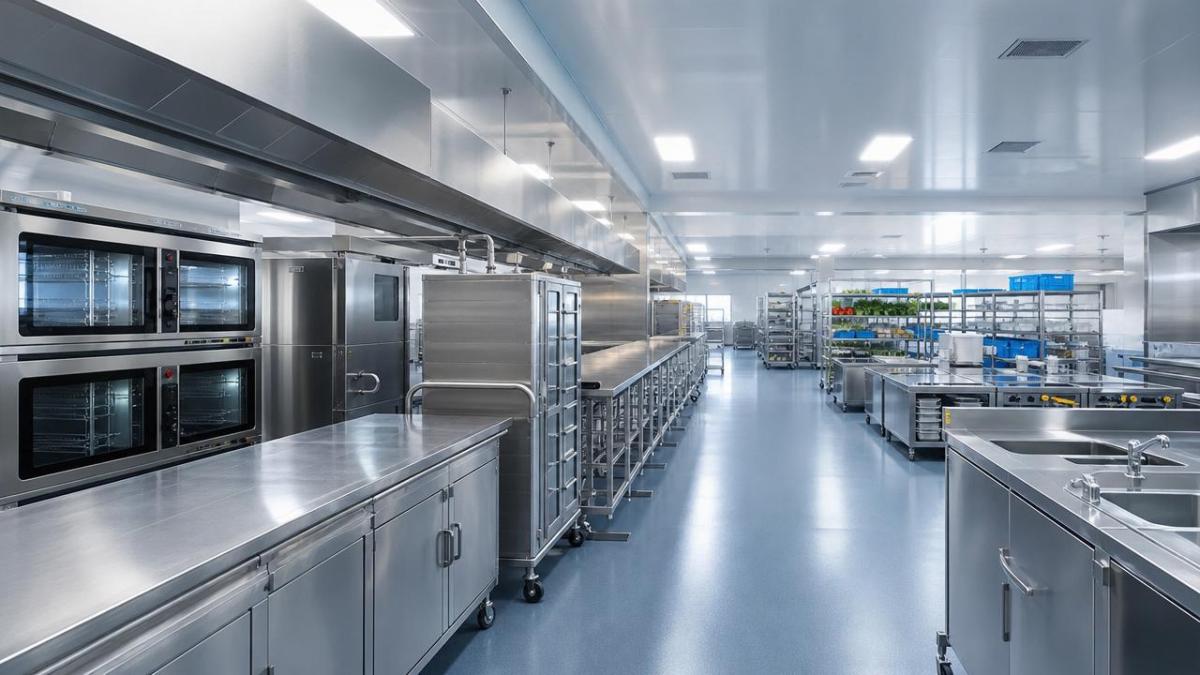
In many school projects, slow service is the result of design assumptions made too early and tested too little. A drawing may satisfy room size requirements and equipment lists, yet still fail under real operating conditions. The kitchen may look efficient in plan view, but staff must cross paths, wait for shared workstations, or move ingredients through awkward routes.
School kitchens are especially sensitive to these mistakes because they work under compressed service windows. Unlike a hotel or full-service restaurant, a school often needs to produce and serve a high volume of meals in a short period, sometimes with staggered lunch periods and limited labor flexibility. A design that adds even a few seconds to each task can create long lines and missed schedules.
For project managers, this is why kitchen design for schools must be evaluated around daily throughput, not just room allocation. The right question is not “Does the kitchen fit the equipment?” but “Can the kitchen support predictable, fast, safe service at peak demand?”
Mistake 1: Designing around floor space instead of workflow
One of the most common errors is treating the kitchen as a space-planning problem rather than an operational flow system. Teams may focus on fitting receiving, storage, prep, cooking, holding, dishwashing, and waste areas into the available footprint, but not on the sequence connecting them. As a result, the layout works geometrically but not operationally.
In school settings, workflow should follow the real path of food, staff, clean utensils, dirty returns, and waste. If dry storage is far from prep, if cold storage doors open into traffic lanes, or if hot holding is too far from service points, the kitchen loses time at every stage. These are not minor inconveniences. They become permanent operating costs.
Project leaders should ask for flow mapping during design review. A simple line drawing that traces ingredient intake, prep movement, cooked food transfer, tray service, and dish return will reveal hidden friction much faster than equipment schedules alone. If multiple routes cross each other repeatedly, the kitchen likely needs redesign before procurement begins.
Mistake 2: Underestimating peak meal volume and service timing
Many delays start with an inaccurate planning basis. Designers may size the kitchen for total student population but not for the actual peak load per service period. In practice, meal output depends on how many students are served within each lunch wave, how many menu items are produced simultaneously, and whether meals are plated, line-served, or distributed to multiple points.
When the service model is misunderstood, critical areas become undersized. Holding cabinets may be insufficient, final assembly space too tight, and service counters too short. Staff then improvise by staging food in circulation zones, delaying replenishment, or interrupting production to keep lines moving.
For engineering and project teams, the solution is to define throughput targets early. Estimate meals per hour, tray count, menu complexity, batch size, and service duration. Then stress-test whether the planned prep and service zones can handle those numbers without staff collision or equipment overload. This is far more useful than relying on broad assumptions about school size alone.
Mistake 3: Poor separation between receiving, storage, prep, and service
Another frequent design issue is weak zoning. In a high-functioning kitchen, each zone supports the next while maintaining clear separation between raw inputs, ready-to-serve food, clean items, dirty returns, and waste. In weak layouts, these boundaries are blurred, creating delays and sanitation risks at the same time.
For example, if receiving is too close to the main staff movement corridor, deliveries can block internal circulation. If raw prep sits beside final assembly without proper spatial control, staff may need extra cleaning steps or awkward routing to maintain safety standards. If dish return passes near service dispatch, dirty and clean flows may interfere during the busiest part of the day.
In kitchen design for schools, zoning is not just a compliance matter. It directly affects speed. Better zone separation reduces unnecessary walking, prevents task interference, and makes staffing easier to manage. Project managers should review whether each area has a clear purpose, a logical handoff, and enough room for simultaneous activity during peak periods.
Mistake 4: Creating too many cross-traffic points for staff and carts
Cross-traffic is one of the least noticed but most expensive design problems. A plan may appear compact and efficient, yet force cooks, prep workers, servers, and dish staff to share the same narrow routes. Add ingredient carts, tray racks, waste bins, and hot food transport, and small traffic conflicts become daily service delays.
In schools, these conflicts are amplified because operations are highly time-dependent. Staff cannot simply absorb delays by extending service over a longer shift. If one cart blocks access to a combi oven or service line, the effect can ripple across the entire meal period.
During design reviews, look beyond code minimums and ask how people and mobile equipment actually move at the same time. A corridor that seems acceptable in a static drawing may fail once doors open, racks turn, and two-way movement begins. Simulation walks, mock layouts, or digital flow analysis can help reveal these issues before construction.
Mistake 5: Overspecifying equipment without coordinating placement and use
Some school kitchens are slowed not because they lack equipment, but because too much equipment is specified without enough attention to use frequency, operator access, ventilation impact, cleaning clearance, and sequence of operation. This often happens when teams focus on equipment features instead of integrated workflow.
A premium oven, large kettle, or advanced refrigeration unit can still hurt efficiency if placed in the wrong position. Staff may need to backtrack for ingredients, wait for door clearance, or compete for landing space. Equipment that requires regular loading and unloading must be positioned with enough adjacent work surface and transport access. Otherwise, its capacity is never fully used.
Project managers should evaluate equipment decisions with three practical questions: How often will this be used during peak production? What supporting space does it require before and after operation? Does its placement reduce or increase movement across the room? These questions often matter more than equipment size alone.
Mistake 6: Not leaving enough landing space, staging space, and temporary holding capacity
Fast school meal service depends on transition space. Food does not move from prep to cooking to service in a perfectly continuous line. There are always moments when trays, pans, ingredients, or finished items need short-term staging. If the design ignores this, staff start using any available surface, including circulation paths or sanitation-sensitive areas.
Missing landing space around ovens, blast chillers, mixers, slicers, and service counters slows every task. Missing staging space near assembly and dispatch creates confusion during rush periods. Insufficient hot or cold holding forces production to pause while service catches up.
This is a common blind spot in kitchen design for schools because staging areas do not look as impressive as major equipment on a plan. Yet they are essential to throughput. A project team should treat staging and holding capacity as core production infrastructure, not leftover space.
Mistake 7: Ignoring dish return and warewashing as a service-speed issue
Many teams treat dishwashing as a back-end function with limited influence on front-end service. In school kitchens, that is a mistake. Dish return traffic, tray scraping, sorting, washing, drying, and clean-item redistribution all affect congestion, staffing efficiency, and the readiness of the next meal period.
If the dish return point is poorly located, students and staff may interfere with food service queues. If soiled items travel through key production routes, sanitation and movement problems grow quickly. If clean racks do not return efficiently to service and prep zones, staff lose time retrieving them.
Warewashing should be planned as part of the total meal cycle. The design should support one-way dirty flow, clear separation from clean storage, and enough accumulation space to handle surges without blocking adjacent functions. For projects with multiple lunch waves, this is especially important.
Mistake 8: Failing to align the kitchen with the actual menu and production model
A school kitchen designed for scratch cooking will not function well if the operation mostly reheats, assembles, and holds food. The reverse is also true. When the production model is unclear, layouts often become compromised hybrids that do nothing particularly well. This can slow service and lead to future retrofits.
Menu drives space and equipment logic. The ratio of cold prep to hot production, the need for vegetable washing, bakery support, allergen control, bulk cooking, packaging, or satellite distribution all change the ideal layout. A design based on assumptions instead of documented menu patterns is risky.
Project managers should require a menu-based planning brief before finalizing the design. That brief should define cooking methods, prep intensity, volume by meal component, special dietary needs, and expected changes over time. Without that operational baseline, even well-intentioned design choices may miss the school’s real service demands.
Mistake 9: Treating compliance and safety as separate from efficiency
Some teams assume there is a tradeoff between a safe kitchen and a fast kitchen. In reality, the best-performing school kitchens usually support both. Clear handwashing access, proper temperature control, safe raw-to-ready separation, adequate ventilation, slip-resistant circulation, and ergonomic workstation heights all contribute to smoother service.
When safety is poorly integrated, staff add workarounds. They walk farther to wash hands, spend more time sanitizing compromised surfaces, avoid using awkward stations, or slow down around congested hot zones. These adjustments reduce throughput and raise fatigue.
For project leaders, safety planning should be reviewed as an operational enabler. If staff can move confidently, access tools quickly, and maintain hygiene without extra detours, service speed improves naturally. Compliance should not be layered on after layout decisions; it should be built into the flow from the start.
How project managers can catch these mistakes before they become expensive
The most effective prevention method is structured design review focused on operations. Instead of reviewing plans only for dimensions, finishes, and equipment counts, organize reviews around real meal scenarios. Walk through receiving day, morning prep, peak lunch service, dish return, cleanup, and maintenance access.
Invite stakeholders beyond the design team. Foodservice operators, maintenance staff, school administrators, and kitchen supervisors often spot practical issues that consultants and contractors may miss. Their feedback is especially useful on line replenishment, storage access, staffing patterns, and cleaning routines.
It also helps to use measurable criteria. Review travel distances between key zones, count traffic intersections, confirm holding capacity against peak demand, and test whether two or three staff can work safely at adjacent stations. If a layout cannot perform well in these basic checks, it is unlikely to perform well after handover.
What better kitchen design for schools looks like in practice
A strong school kitchen layout is not necessarily the largest or most equipment-heavy. It is the one that supports a logical sequence, minimizes interference, protects food safety, and matches the school’s meal model. Good designs reduce unnecessary motion, keep peak-period tasks close to their support tools, and provide enough staging and holding space to absorb rushes.
They also leave room for operational resilience. Schools may face menu changes, staffing constraints, enrollment growth, or new nutrition requirements over time. Flexible worktables, modular service points, scalable refrigeration, and adaptable utility planning can protect the project from expensive redesign later.
From a capital planning perspective, this is where value is created. A kitchen that serves faster, operates more safely, and uses labor more effectively will usually outperform a cheaper layout that creates daily inefficiency. For project managers, the best result is not just a completed facility, but a kitchen that works under real school conditions from day one.
Conclusion: Faster meal service starts with fewer design compromises
Slow meal service in schools is often a design problem long before it becomes an operational complaint. The biggest mistakes usually involve workflow, zoning, peak-capacity planning, cross-traffic, staging space, and poor alignment between equipment and the actual production model. These issues can remain hidden during design, then show up every day once the kitchen opens.
For anyone leading a school facility project, the key takeaway is clear: kitchen design for schools should be judged by how well it supports real service performance, not just by whether all required rooms and equipment fit into the plan. When the layout is built around throughput, safety, and coordinated operations, schools gain faster lines, better labor use, lower disruption, and more reliable meal delivery.
The earlier these questions are addressed, the less costly they are to solve. A school kitchen that flows well is not an accident. It is the result of disciplined planning, operational testing, and design decisions made with daily service in mind.
Popular Tags
Kitchen Industry Research Team
Dedicated to analyzing emerging trends and technological shifts in the global hospitality and foodservice infrastructure sector.
Industry Insights
Join 15,000+ industry professionals. Get the latest market trends and tech news delivered weekly.
No spam. Unsubscribe anytime.
Hot Articles
 ASEAN FTA Upgrade Enters Text Verification Phase; Smart Kitchen Controls Added to Zero-Tariff List
- Electronics Manufacturing Leads with 13.6% Output Growth; Kitchen Appliance Chip Supply Stabilizes
- OpenCLAW-like Agent Deployment Risk Management Guidelines Released
- Green Power Stocks Rally; Overseas Buyers Prioritize Green Electricity Usage

Contact With us
Contact:
Anne Yin (Ceramics Dinnerware/Glassware)
Lucky Zhai(Flatware)